组成图示
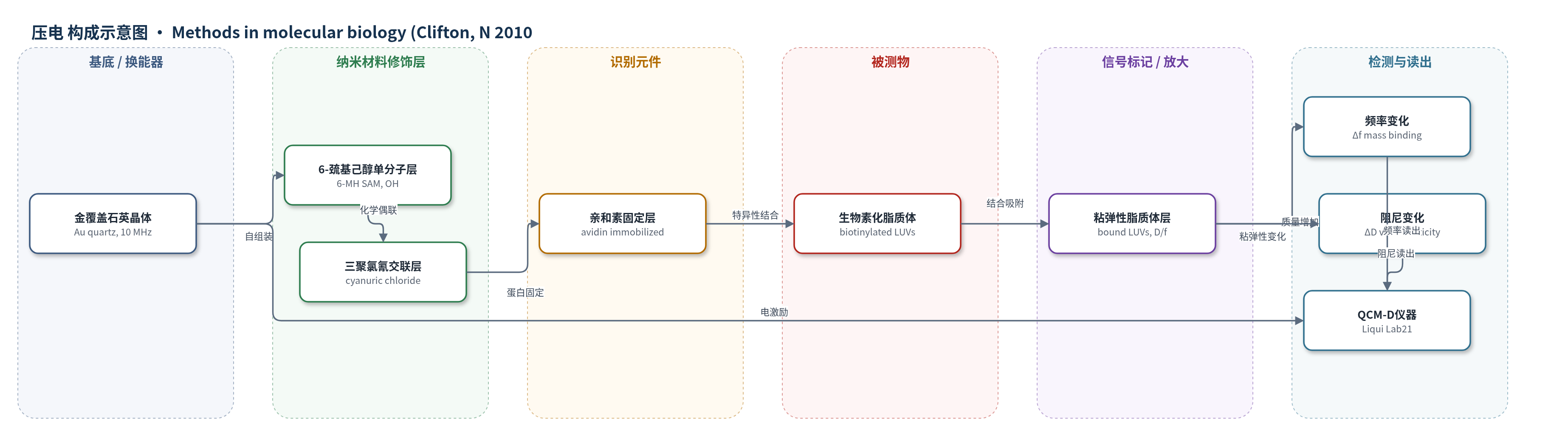
点击图片查看大图 · 依据论文自动绘制
传感器类型
压电(QCM)生物传感器
检测对象
生物素化脂质体(biotinylated liposomes, LUVs;含 SPC、PEG-PE 2000、biotin-PE/biotin-PEG-PE),样品基质:PBS 流动相(pH 7.4)
检测原理
该传感器以金覆盖石英晶体为压电换能器,在交流激励下产生厚度剪切振荡。表面依次形成6-巯基己醇自组装单分子层、三聚氯氰交联层和亲和素固定层。生物素化脂质体经生物素-亲和素高亲和识别事件结合到表面,使界面质量增加;根据 Sauerbrey 方程,结合质量越大,共振频率下降(Δf)越大。同时,脂质体作为粘弹性颗粒会改变振荡阻尼(ΔD):完整脂质体阻尼较高,压平或融合后阻尼降低,D/f 比值可区分未变形、变形和融合/双分子层状态。脂质体表面多价生物素可增强界面结合质量,生物素浓度和脂质组成决定结合强度与形貌变化。
检测灵敏度
原文未报告 LOD、线性范围、灵敏度斜率或相关系数。
效应效果
该 QCM-D 方法可实时监测脂质体结合,结合在 4 min 内达到饱和。通过 BSA 偶联对照评估非特异性结合,体现生物素-亲和素体系的选择性。Δf 用于量化结合质量,ΔD 与 D/f 用于判断脂质体形貌:D/f 为 4–3 表示未变形或低变形(如 PEG 化脂质体),更低表示更强变形,≤1 表示融合并形成双分子层。生物素-PE 浓度 ≤5 mol% 时变形较低,≤20 mol% 时明显压平,30 mol% 时发生破裂和双分子层形成;PEG 化脂质体显示高阻尼和构象稳定性。作者认为该方法可预测并调控脂质体在靶点结合位点的行为,对治疗靶向有价值。原文未报告 RSD、回收率或与 ELISA/HPLC/qPCR 的对比。
传感器的构成
- 基底/换能器:金覆盖石英晶体(Au-coated quartz crystal,10 MHz)作为压电换能器与电极。
- 自组装修饰层:6-巯基己醇(6-mercaptohexan-1-ol, 6-MH)通过硫醇-金作用形成终端羟基单分子层,用于后续偶联。
- 交联层:三聚氯氰(cyanuric chloride)作为反应性连接子,与亲核基团反应以固定蛋白。
- 识别元件:亲和素(avidin)固定层,特异性结合生物素化脂质体。
- 特异性对照:牛血清白蛋白(BSA)以相同浓度偶联,用于非特异性结合对照。
中文摘要
生物传感器可将生理底物出现或配体-受体识别等生物学事实转化为可检测信号,而无需额外标记。本章介绍声学波传感器作为质量敏感工具,用于研究脂质体在模拟生物表面的结合行为。该类传感器不仅能定量脂质体结合强度,还可提供结合位点处脂质体形貌信息,例如变形或融合。由于脂质体在靶标结合位点的行为可能显著影响治疗效果,借助生物传感器有望预测并调控脂质体形貌。文中报道了石英晶体微天平(QCM)的工作原理以及石英传感器的生物功能化方法,用于一系列脂质体结合实验。选用含生物素的脂质体作为模型配体,评估其与亲和素修饰传感器的结合。结合强度和脂质体变形数据被用于解释结合强度与脂质组成对脂质体行为的作用。
英文摘要
Biosensors can be regarded as analytical devices that transform biologically given facts, such as the appearance of physiological substrates, or biological recognition processes of ligands and receptors into detectable signals without the need of further labeling. This chapter introduces acoustic wave sensors as mass-sensitive tools to investigate the liposomal binding behavior onto simulated biological surfaces. These sensors do not only allow for quantification of the liposomal binding intensity, but further analytical readings give insight into the liposomal appearance at the binding site, e.g., deformation or fusion. Since the liposomal behavior at the target binding site might have strong impact on therapeutic effects, a prediction of liposomal appearance and a controlled modulation thereof appear possible with the help of biosensors.Here, the function of a quartz crystal microbalance (QCM) and the bio-functionalization of quartz sensors are reported for a series of liposomal binding experiments. Liposomes containing biotin as model ligands were selected to evaluate their binding to avidin-modified sensors. The data, representing binding intensity and liposome deformation, are explained with respect to the role of binding strength and lipid composition for liposomal behavior.