组成图示
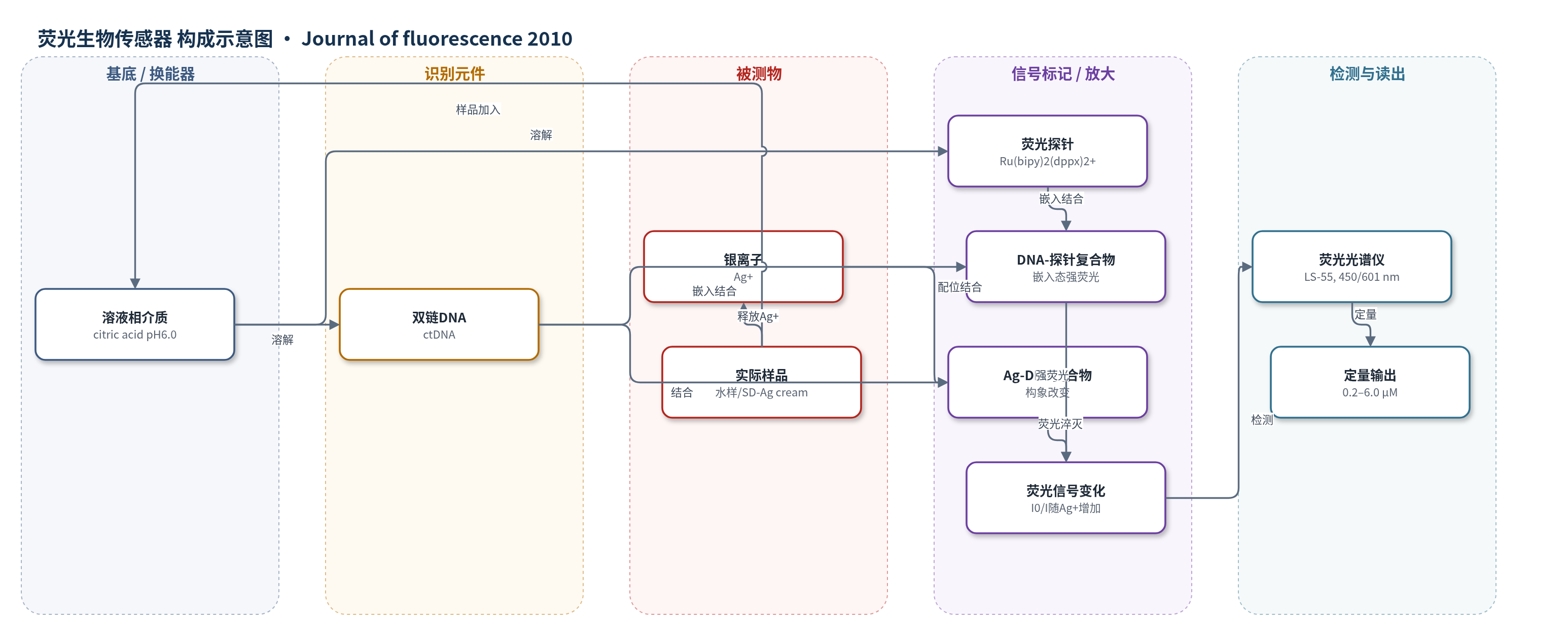
点击图片查看大图 · 依据论文自动绘制
传感器类型
荧光生物传感器
检测对象
银离子(Ag+);样品基质:水样(长江水、东湖、汉江水)和磺胺嘧啶银乳膏(SD-Ag cream)
检测原理
Ru(bipy)2(dppx)2+在水溶液中因水分子与配体氮原子氢键作用而荧光被淬灭;当嵌入双链ctDNA后,配体被保护,金属-配体电荷转移(MLCT)发射增强,在450 nm激发下于601 nm产生强荧光。Ag+与DNA碱基(如胞嘧啶N3、腺嘌呤N7)配位并结合,改变ctDNA构象,干扰或阻碍Ru探针嵌入,使荧光强度下降。体系遵循Stern–Volmer关系I0/I=1+KSV·CAg,KSV为4.5×10^5 L mol−1,因此I0/I随Ag+浓度升高而增大。该方法无需酶或纳米材料放大,依赖核酸分子光开关的强荧光增强和Ag+诱导的构象扰动实现检测。
检测灵敏度
LOD(3σ): 3.2×10⁻⁸ M;线性范围: 0.2–6.0 μM;R^2 = 0.997;KSV: 4.5×10^5 L mol−1
效应效果
选择性良好:5 μM下Na+、K+、NH4+、Ca2+、Fe3+、Mg2+、Zn2+、Co2+、Cu2+、Pb2+、Ba2+、Al3+、Hg2+、Mn2+、Ni2+几乎无干扰;乳膏中硬脂酸、醋酸纤维素、甘油、PEG 2000、明胶、羊毛脂、液状石蜡、三乙醇胺、凡士林基本无影响。反应快速,Ag+与ctDNA 3 min内完成,加Ru探针5 min内完成,荧光稳定>1 h。水样回收率91.4%–99.2%,RSD 2.3%–4.3%;SD-Ag乳膏测得1.004%(标示1.0%),RSD 4.4%,Er 0.4%。相比AAS/ICP-MS等昂贵耗时方法,作者认为其简单、快速、低成本,适合实际样品Ag+测定。
传感器的构成
- 溶液相基底:超纯水与0.1 mol/L citric acid buffer(pH 6.0),提供反应介质并维持最佳pH
- 识别元件:ctDNA(牛胸腺DNA),双链DNA作为Ag+识别模板,结合Ag+后构象改变
- 信号标记物:Ru(bipy)2(dppx)2+,嵌入ctDNA后产生强荧光,Ag+导致荧光淬灭
- 被测物:Ag+(银离子),目标分析物,与ctDNA相互作用
- 信号读出:Perkin-Elmer LS-55 fluorescence spectrometer,450 nm激发、601 nm发射检测荧光强度
中文摘要
作为核酸分子“光开关”,Ru(bipy)2(dppx)2+在双螺旋DNA存在时显示强荧光,是检测双链DNA的良好探针。然而,当向Ru(bipy)2(dppx)2+-DNA体系中加入Ag+时,其荧光被淬灭。基于这一现象,作者提出了一种简单、快速且特异的Ag+测定方法。在最佳条件下,Ag+浓度与Ru(bipy)2(dppx)2+荧光强度在0.2–6.0 μM范围内呈线性关系,检出限(3σ)为3.2×10⁻⁸ M。该方法已成功应用于水样和磺胺嘧啶银乳膏中Ag+的测定。由于DNA存在时Ru(bipy)2(dppx)2+具有强荧光,Ag+与DNA的相互作用通过荧光显微镜得到证实,荧光图像与光谱结果一致。作者还利用圆二色光谱和等温滴定量热法讨论了可能的反应机制。
英文摘要
As one of nucleic acid molecular "light switch", Ru(bipy)(2)(dppx)(2+) is a good probe for the determination of double-helical DNA, which displays intense fluorescence when double-helical DNA is present. However, the fluorescence of Ru(bipy)(2)(dppx)(2+) is quenched when Ag(+) is added to the Ru(bipy)(2)(dppx)(2+)-DNA system. Based on the quenching of the fluorescence of Ru(bipy)(2)(dppx)(2+)-DNA system by Ag(+), a simple, rapid and specific method for Ag(+) determination was proposed. In the optimum conditions, Ag(+) concentration versus Ru(bipy)(2)(dppx)(2+) fluorescence intensity gave a linear response in the range from 0.2 to 6.0 microM with a detection limit (3sigma) of 3.2 x 10(-8) M. The proposed method has been applied to determine the Ag(+) in water samples and sulfadiazine silver cream successfully. Because of the intense fluorescence of Ru(bipy)(2)dppx(2+) when DNA is present, the interaction between Ag(+) and DNA was confirmed by fluorescence microscopy and the phenomenon of the fluorescence images agreed well with the results. The possible mechanism of the reaction was also discussed by circular dichroism spectra and isothermal titration calorimetry.