组成图示
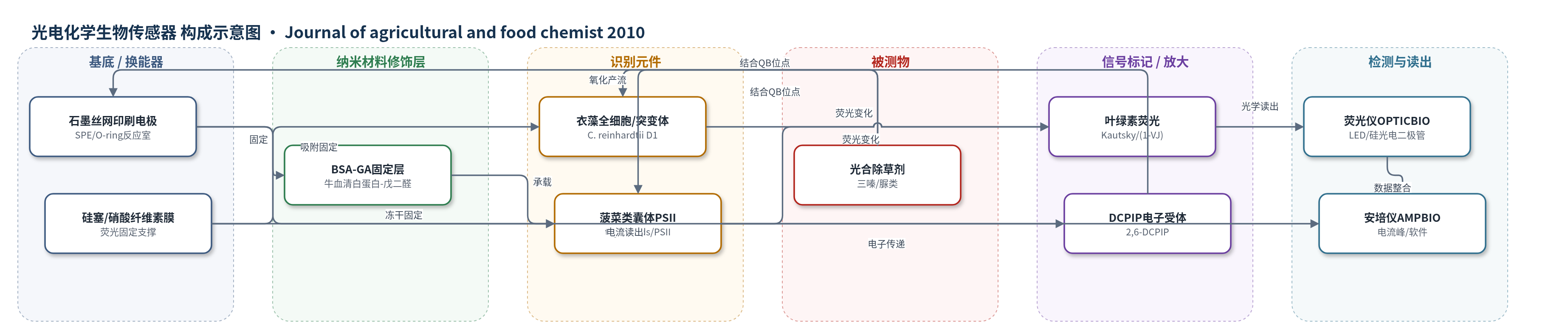
点击图片查看大图 · 依据论文自动绘制
传感器类型
光电化学生物传感器
检测对象
光合除草剂(photosynthetic herbicides),包括三嗪类(triazines:atrazine、prometryn、metribuzin、cyanazine、terbuthylazine、simazine、deethylterbuthylazine)和脲类(ureas:diuron、linuron);样品基质:环境水样(河水、泉水/地表水与地下水),文中亦提及果汁、均质蔬菜和橄榄油正在研究。
检测原理
除草剂与PSII D1蛋白QB位点结合,取代质体醌QB,阻断QA到QB的电子传递,抑制光合电子传递和水氧化。荧光通道中,LED激发叶绿素,正常光能主要用于光合;被抑制后过剩能量以叶绿素荧光释放,Kautsky瞬变的VJ降低、(1-VJ)升高,与除草剂浓度相关。安培通道中,光驱动PSII将电子传给DCPIP,DCPIP在SPE +0.200 V下氧化,产生与光合活性成正比的电流峰;除草剂使电流下降。突变体阵列通过不同D1突变对除草剂敏感性/抗性差异,比较荧光抑制模式识别类别。
检测灵敏度
LOD: 10^-10–10^-8 M(摘要);C. reinhardtii细胞荧光: atrazine 7.3×10^-10 M、diuron 2.3×10^-10 M、prometryn 3.5×10^-10 M;菠菜类囊体BSA-GA荧光: atrazine 1.6×10^-8 M、diuron 1.5×10^-9 M、metribuzin 1.0×10^-8 M、cyanazine 4.1×10^-8 M;SPE安培: atrazine 1.6×10^-9 M、diuron 7.3×10^-10 M、terbuthylazine 1.0×10^-9 M、linuron 1.2×10^-9 M、simazine 2.1×10^-9 M、deethylterbuthylazine 5.3×10^-9 M;标准浓度测试范围: 10^-5–10^-10 M
效应效果
该平台对三嗪类和脲类光合除草剂均能响应,安培法对atrazine和diuron的LOD比荧光法低约1000倍;BSA-GA类固定泄漏低,残余活性约70%,冻干类囊体可-20 ℃保存3个月。突变体阵列在加标自来水中可预测特定化合物,并用于识别除草剂类别。河水中的双价阳离子可能引起PSII过激活,作者认为可用内标法识别和量化。安培法易受天然样品中氧化还原物质干扰,荧光法对某些类别更特异,双模态互补可减少假阴性。未报告RSD和回收率。作者主张其作为低成本、快速预筛分工具,减少送GC/HPLC的样品数量。
传感器的构成
- 换能器/基底:石墨丝网印刷电极(SPE)与O-ring构成22 μL反应室,用于安培电流读出;硅塞(silicon septum)/硝酸纤维素膜(nitrocellulose membrane)作为荧光固定支撑
- 固定层:BSA-GA(牛血清白蛋白-戊二醛)共交联网络固定类囊体于SPE;吸附/冻干将细胞或类囊体固定于硅塞/硝酸纤维素膜
- 识别元件:衣藻(C. reinhardtii)野生型及D1蛋白突变体全细胞,或菠菜(S. oleracea)类囊体(thylakoids)中的光系统II(PSII)D1蛋白QB位点,识别三嗪/脲类除草剂
- 电子受体/介质:2,6-二氯酚吲哚酚(DCPIP, 30 μM)作为人工电子受体,在光驱动PSII电子传递中被还原并在SPE表面氧化产生电流
- 测量缓冲液:TAP(Tris-acetate-phosphate, pH 7.0)用于荧光;tricine/MgCl2/sucrose/NaCl(pH 7.2)用于安培,维持生物介质活性
- 光学模块:96个LED与24个硅光电二极管(silicon photodiodes)加带通滤光片,用于叶绿素荧光激发与检测;安培模块用470/650 nm LED提供光激发
- 读出系统:OPTICBIO-Multicell荧光仪和AMPBIO-SPE安培仪,通过软件计算(1-VJ)或电流峰变化,定量/定性除草剂
中文摘要
全球农业每年使用数百万吨农药,其中三嗪类和脲类等光合除草剂随农业径流进入土壤、地表水和地下水,对人类具有严重毒性。现有GC、HPLC等色谱方法可靠但昂贵且耗时,难以满足大量样品常规筛查需求。基于多年光合生物研究,作者开发了一种用于光合除草剂快速、低成本预筛分的生物传感器平台。该平台将安培与荧光两种高灵敏转导方式结合,利用衣藻全细胞或菠菜类囊体中的光系统II作为生物介质,通过测量除草剂抑制光合活性引起的电流下降或叶绿素荧光变化进行定量。利用基因改造衣藻突变体阵列,还可识别不同除草剂亚类。该平台已在环境水样中验证,可辅助实验室开展水污染控制,仅将阳性样品送GC/HPLC确证。
英文摘要
Millions of tons of pesticides are applied worldwide annually in agriculture. Among them, herbicides such as triazines and ureas, originating from agricultural runoff, can contaminate soils and surface and ground waters with severe toxic effects on humans. Nowadays, different analytical techniques are available for the detection of these chemicals; however, most of them are expensive and time-consuming, especially in the case of routine analyses. For this reason, on the basis of results collected through many years of experience in the field of photosynthetic organisms, we designed a biosensor platform intended for the easy, low-cost, and fast prescreening of photosynthetic herbicides. The platform combines the possibilities of amperometric and optical transduction systems, which have proven to be highly sensitive (limits of detection = 10(-10)-10(-8) M). The use of genetically modified algae strengthens the power of the platform, allowing different subclasses of herbicides to be recognized. The system has been validated for the analysis of environmental water and is proposed to support laboratories involved in the control of water pollution.