组成图示
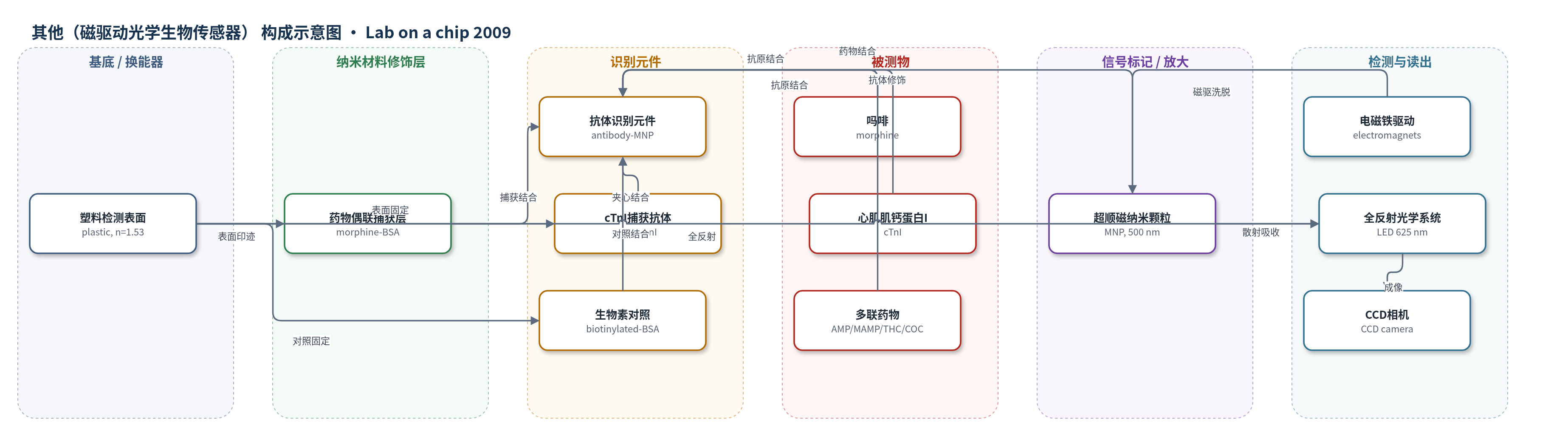
点击图片查看大图 · 依据论文自动绘制
传感器类型
其他(磁驱动光学生物传感器)
检测对象
吗啡(morphine)、安非他命(amphetamine)、甲基安非他命(methamphetamine)、四氢大麻酚(tetrahydrocannabinol, THC)、可卡因(cocaine)、心肌肌钙蛋白I(cardiac troponin I, cTnI);样品基质:全唾液(whole saliva)、人血清(human serum)、人血浆(human plasma)
检测原理
样品加入后,干燥的抗体修饰超顺磁纳米颗粒(MNP)快速再分散并捕获被测物。竞争法中,吗啡等药物与MNP表面抗体结合,抑制MNP与表面药物-BSA偶联物结合,表面MNP减少,f-TIR反射光强下降幅度减小;夹心法中,cTnI同时结合MNP抗体与表面抗cTnI抗体,使MNP聚集于检测表面。上下电磁铁通过切换磁场方向与强度,驱动MNP向表面聚集、随机取向并洗脱未结合颗粒。MNP在f-TIR倏逝场中吸收和散射光,降低反射光强,CCD相机成像定量,信号随表面MNP密度增加而增强。
检测灵敏度
LOD: 250 fM(cTnI,20% human serum);测量范围: 0.5–500 pM(cTnI,20% human serum);R^2 > 0.99(0.25–250 pM,power=1.19);LOD: 3 pM(cTnI,100% plasma);吗啡检测范围: 0.1–100 ng/mL(saliva)
效应效果
该传感器在100%全唾液中实现吗啡等滥用药物的一步法检测,总时间约1 min,吗啡检测范围0.1–100 ng/mL,可多联检测AMP、OPI、MAMP、THC、COC及对照;在20%人血清中cTnI检测LOD为250 fM,测量范围0.5–500 pM,500 pM时信号/空白比2300,多数点CV<5%、总体CV<10%;100%血浆干试剂法cTnI LOD为3 pM。系统无需液体清洗,使用低成本一次性塑料卡盒,作者认为适合床旁快速、多联、高灵敏诊断。
传感器的构成
- 基底/光学换能层:注塑塑料卡盒(plastic cartridge,n=1.53)与检测表面(sensor surface),构成f-TIR全反射界面并承载捕获分子。
- 磁驱动层:上下独立供电电磁铁(electromagnets),在1 mL反应微腔内产生可调大小和方向的磁场,用于驱动、聚集和洗脱纳米颗粒。
- 纳米信号标记层:超顺磁纳米颗粒(superparamagnetic magnetic nanoparticles, MNP,直径数百纳米,模型500 nm),作为可磁驱的光学信号标记。
- 识别元件(竞争法):MNP表面抗吗啡抗体(anti-morphine antibody)与检测表面吗啡-BSA偶联物(morphine–BSA conjugate),用于吗啡竞争抑制检测。
- 识别元件(夹心法):MNP表面抗cTnI抗体(anti-cTnI antibody)与检测表面抗cTnI抗体,用于心肌肌钙蛋白I夹心捕获。
- 多联识别阵列:墨滴打印(inkjet printing)的AMP、OPI、MAMP、THC、COC药物偶联物斑点及生物素-BSA对照(biotinylated-BSA)。
- 干试剂层:干燥MNP与干缓冲组分(dry buffer components)置于检测面上方腔体,样品加入后快速再分散并反应。
- 光学读出层:625 nm LED、f-TIR光学路径与CCD相机,通过MNP吸收/散射降低反射光强实现成像定量。
中文摘要
本文报道一种用于诊断的生物分子检测技术,即基于磁驱动纳米颗粒的光磁免疫分析生物传感器。该技术将超顺磁纳米颗粒在静止样品液中通过磁场动态操控,并以光学方式检测,从而将免疫分析的关键步骤(再分散、捕获、结合与清洗)集成于低成本一次性卡盒中。磁场控制赋予检测前所未有的速度、过程可控性和无缝集成能力;光学检测则实现高灵敏、多联及实时监测。作者证明,该光磁技术可在血液血清/血浆和全唾液中完成高灵敏一步法检测:滥用药物可在总检测时间约1分钟内达到亚纳克/毫升水平,心肌标志物肌钙蛋白I可在数分钟内达到亚皮摩尔/升水平。该技术适用于高性能集成检测,有望开创生物传感新范式。
英文摘要
The realization of biomolecular detection assays for diagnostic purposes is technologically very challenging because such tests demand full integration for ease of use and need to deliver a high analytical performance with cost-effective use of materials. In this article an optomagnetic immunoassay technology is described based on nanoparticles that are magnetically actuated and optically detected in a stationary sample fluid. The dynamic control of nanoparticles by magnetic fields impacts the key immunoassay process steps, giving unprecedented speed, assay control and seamless integration of the total test. The optical detection yields sensitive and multiplexed assays in a low-cost disposable cartridge. We demonstrate that the optomagnetic technology enables high-sensitivity one-step assays in blood serum/plasma and whole saliva. Drugs of abuse are detected at sub-nanogram per millilitre levels in a total assay time of 1 min, and the cardiac marker troponin I is detected at sub-picomole per litre concentrations in a few minutes. The optomagnetic technology is fundamentally suited for high-performance integrated testing and is expected to open a new paradigm in biosensing.