组成图示
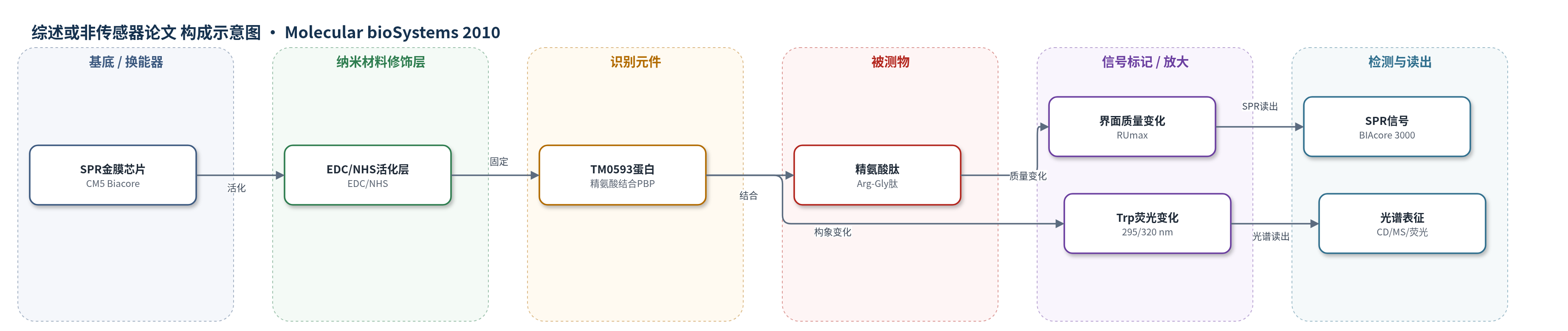
点击图片查看大图 · 依据论文自动绘制
传感器类型
综述或非传感器论文
检测对象
精氨酸(arginine, Arg)、精氨酸模型肽((Arg-Gly)2-Lys-(Gly)3-Cys-NH2)、谷氨酰胺模型肽((Gln-Gly)2-Lys-(Gly)3-Cys-NH2);样品基质为磷酸盐缓冲液、HBS-EDTA-TCEP 缓冲液及铵甲酸盐缓冲液等体外溶液。
检测原理
论文未构建完整传感器,但采用 SPR 表征 TM0593 与精氨酸的结合。TM0593 通过 EDC/NHS 化学固定于 CM5 SPR 芯片表面,形成识别层;当含精氨酸的模型肽流过芯片时,精氨酸残基与 TM0593 结合位点结合,引起界面质量与折射率变化,BIAcore 3000 以响应单位(RU)实时读出,RUmax 随肽浓度升高而增加,并拟合得到 EC50。CD 热变性显示精氨酸结合使蛋白熔解温度升高约 16 °C,表明结合增强构象稳定性;Trp 荧光与碘离子淬灭分析提示结合后 Trp 微环境溶剂可及性增加。该过程无额外信号放大,依赖蛋白-配体直接结合与光谱/SPR 换能。
检测灵敏度
未报告 LOD、线性范围、灵敏度斜率或相关系数。
效应效果
TM0593 表现出高选择性:CD 热变性中仅精氨酸使熔解温度升高约 16 °C,天冬氨酸、谷氨酸、天冬酰胺、赖氨酸、组氨酸无显著变化;nano-ESI-MS 仅检测到 TM0593 与精氨酸的 1:1 复合物,未检测到与天冬酰胺或组氨酸的复合物。SPR 对精氨酸肽的 EC50 为 23.4 ± 1.1 mM,对谷氨酰胺肽为 160 ± 1.0 mM,显示对精氨酸的优先结合;摘要报告精氨酸解离常数约 20 mM。蛋白单体约 27.7 kDa,天然态约 81 kDa,呈同三聚体,并在强变性条件下保留二聚/三聚体;估计转变温度约 116 °C,4 °C 可保存 4 个月以上。未报告 RSD、实际样品回收率或与 ELISA/HPLC/qPCR 的对比。
传感器的构成
- 识别元件:TM0593(Thermotoga maritima arginine-binding protein, PBP),负责特异性结合精氨酸(Arg)
- 换能/读出:SPR 传感器芯片(CM5 Biacore)与 BIAcore 3000,通过界面质量/折射率变化输出结合信号
- 荧光读出:TM0593 内源 Trp 荧光(295 nm 激发,约 320 nm 发射),用于监测结合相关构象与热稳定性变化
- 分析物/样品:精氨酸(Arg)及 (Arg-Gly)2-Lys-(Gly)3-Cys-NH2 模型肽,溶于磷酸盐或 HBS-EDTA-TCEP 缓冲液
- 封闭/钝化:乙醇胺(ethanolamine),用于淬灭 CM5 芯片剩余 EDC/NHS 活性基团
- 未构建传感器:无电极、纳米材料修饰层、电子供体或实际样品检测装置
中文摘要
周质结合蛋白超家族成员参与细菌细胞膜对配体的选择性转运。超嗜热真细菌 Thermotoga maritima 编码一种高度稳定且特异性的周质精氨酸结合蛋白 TM0593。去除信号肽后,TM0593 在大肠杆菌中过表达,并经热沉淀和亲和层析纯化。该蛋白单体分子量约 27.7 kDa,在强变性条件下仍可形成同二聚体和同三聚体,估计转变温度约 116 °C,提示四级结构可能有助于营养物质跨膜转运。纯化并复性后的 TM0593 通过荧光光谱、质谱和圆二色谱进行表征,证明其对精氨酸具有特异性,并阐明精氨酸结合伴随的结构变化。表面等离子共振测定显示该蛋白与精氨酸的结合解离常数约为 20 mM。由于其高热力学稳定性,TM0593 可作为构建稳健荧光生物传感器的支架。
英文摘要
Members of the periplasmic binding protein superfamily are involved in the selective passage of ligands through bacterial cell membranes. The hyperthermophilic eubacterium Thermotoga maritima was found to encode a highly stable and specific periplasmic arginine-binding protein (TM0593). Following signal sequence removal and overexpression in Escherichia coli, TM0593 was purified by thermoprecipitation and affinity chromatography. The ultra-stable protein with a monomeric molecular weight of 27.7 kDa was found to exist as both a homodimer and homotrimer at appreciable concentrations even under strongly denaturing conditions, with an estimated transition temperature of 116 degrees C. Its multimeric structure may provide further evidence of the importance of quaternary structure in the movement of nutrients across bacterial membranes. Purified and refolded TM0593 was further characterized by fluorescence spectroscopy, mass spectrometry, and circular dichroism to demonstrate the specificity of the protein for arginine and to elucidate structural changes associated with arginine binding. The protein binds arginine with a dissociation constant of 20 muM as determined by surface plasmon resonance measurements. Due to its high thermodynamic stability, TM0593 may serve as a scaffold for the creation of a robust fluorescent biosensor.