组成图示
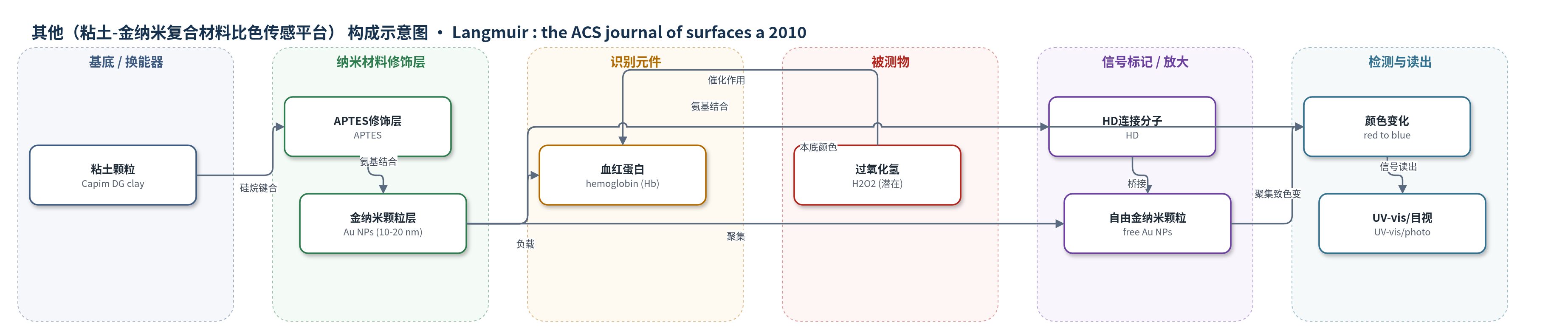
点击图片查看大图 · 依据论文自动绘制
传感器类型
其他(粘土-金纳米复合材料比色传感平台)
检测对象
过氧化氢 (H2O2);样品基质:未明确(仅体外纳米复合材料演示)
检测原理
该材料以粘土为无机载体,APTES 通过 Si-O-Si 键修饰粘土表面,其氨基端结合由 HAuCl4/柠檬酸钠原位生成的金纳米颗粒。金纳米颗粒的局域表面等离子体共振(LSPR)决定复合材料颜色;改变颗粒尺寸可使吸收峰和颜色变化。文中演示的传感机制是:己二胺(HD)先与 CAAu 表面金纳米颗粒结合,再桥接自由金纳米颗粒,使表面金纳米颗粒聚集,LSPR 红移,颜色由红变蓝。若负载血红蛋白,过氧化氢可被血红蛋白催化分解,可能改变界面状态并产生信号,但原文未给出浓度-信号定量关系。
检测灵敏度
原文未报告 LOD、线性范围、灵敏度斜率或相关系数。
效应效果
文中未报告选择性、抗干扰、重现性(RSD)、实际样品加标回收率或与 ELISA/HPLC/qPCR 等方法的对比。稳定性方面,CAAu 在 98% H2SO4、65% HNO3 和 2 M MgSO4 中无明显颜色或 TEM 形貌变化;3 M NaOH 下部分金纳米颗粒聚集,可能因 APTES 与粘土间 Si-O-Si 键断裂所致,但整体仍比胶体金更稳定。TEM 显示金纳米颗粒在粘土表面均匀分布,尺寸可随柠檬酸钠用量调节为约 10±1、15±2 和 20±2 nm。CAAuHAu 杂化后颜色由红变蓝,离心洗涤后仍保持,说明变化发生在粘土表面。作者认为该平台可用于无标记生物/化学传感及过氧化氢传感。
传感器的构成
- 基底/载体:Capim DG 粘土颗粒,提供无机支撑、高比表面积与吸附/催化性质。
- 硅烷修饰层:3-aminopropyltriethoxysilane (APTES),硅烷基端与粘土表面形成 Si-O-Si 键,氨基端结合金纳米颗粒。
- 金纳米颗粒层:Au nanoparticles,由 HAuCl4 与 sodium citrate 原位还原沉积,提供 LSPR 颜色信号。
- 连接分子:hexamethylene diamine (HD),连接 CAAu 表面金纳米颗粒与自由金纳米颗粒,诱导聚集。
- 信号/聚集元件:free Au nanoparticles,与 HD 结合后聚集,使颜色由红变蓝。
- 生物分子负载:hemoglobin (Hb),负载于 CAAu 表面,作为潜在过氧化氢传感的催化/识别元件。
中文摘要
本文报道了一种简单湿化学法合成粘土-3-氨基丙基三乙氧基硅烷-金(CAAu)纳米复合材料的方法,其中 APTES 作为连接分子,其硅烷基端与粘土表面形成 Si-O-Si 键,氨基端与金纳米颗粒结合。通过改变合成参数可调节金纳米颗粒尺寸,从而调控复合材料颜色。TEM 表征显示金纳米颗粒在粘土表面分布均匀。复合材料在强酸和高盐条件下稳定,而强碱 NaOH 可能因破坏 APTES 与粘土之间的 Si-O-Si 键而轻微影响金纳米颗粒状态。为展示无标记传感应用潜力,作者进一步制备了粘土-APTES-金-己二胺-金(CAAuHAu)杂化材料,其中己二胺连接 CAAu 与自由金纳米颗粒,形成后颜色由红变蓝。此外,血红蛋白被负载到 CAAu 上,显示其作为生物传感器的潜在应用。
英文摘要
Clay-based nanocomposites have been studied for several decades, mainly focusing on clay-polymer nanocomposites. Here, we report on a simple wet chemical method to synthesize clay-APTES-Au (CAAu) nanocomposites, where 3-aminopropyltriethoxysilane (APTES) acts as the linkage. The silane terminal of APTES formed bonds with the clay surface, while the other -NH(2) terminal bonds to gold nanoparticles. The color of clay changed when these CAAu nanocomposites were formed. By changing the size of the gold nanoparticles, the color of CAAu could be adjusted, simply by changing process parameters. TEM characterization of the synthesized nanocomposites showed an even distribution of gold nanoparticles on the clay surfaces. The nanocomposites were stable in strong acid and high concentration of salt conditions, while strong basic solution like NaOH could slightly influence the status of the gold nanoparticles due to the rupture of the Si-O-Si bonds between APTES and clay. To demonstrate the potential for label free sensing application of CAAu nanocomposites, we made hybrids of clay-APTES-Au-HD-Au (CAAuHAu), where hexamethylene diamine (HD) served as links between CAAu nanocomposites and the gold nanoparticles. The color of the composites changed from red to blue, when the hybrids were formed. Moreover, hemoglobin was loaded on the CAAu nanocomposites, which can potentially be used as a biosensor. These synthesized nanocomposites may combine the catalytic properties of clay and the well-known excellent properties of gold nanoparticles, such as the ability to anchor biological and chemical molecules. Furthermore, the color change of CAAu, when the CAAuHAu hybrids were observed, suggests the applications of these nanocomposites in biochemical and chemical sensing.