组成图示
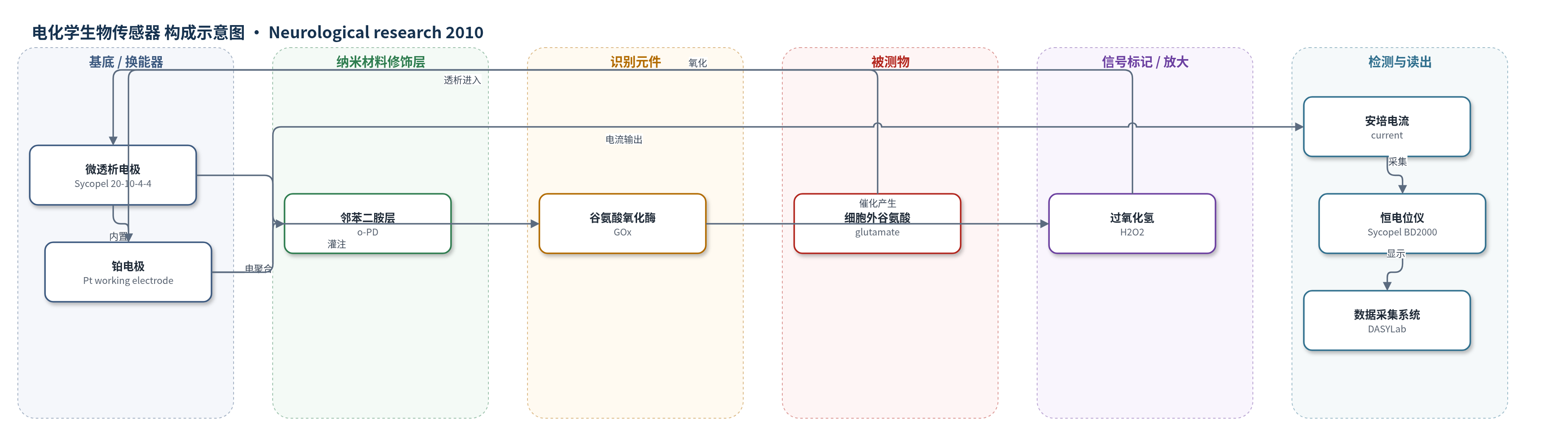
点击图片查看大图 · 依据论文自动绘制
传感器类型
电化学生物传感器
检测对象
细胞外谷氨酸(glutamate, Glu);样品基质:大鼠脑皮层细胞外液/微透析液
检测原理
该传感器基于微透析-酶-安培原理。大鼠脑皮层细胞外液中的谷氨酸(glutamate, Glu)经微透析电极进入灌注通道,与谷氨酸氧化酶(GOx)发生特异性催化反应,生成α-酮戊二酸和过氧化氢(H2O2)。H2O2在邻苯二胺(o-PD)修饰的铂电极表面于0.65 V下发生氧化,产生与谷氨酸浓度成正比的安培电流。恒电位仪在固定电位下采集电流,经DASYLab系统实时显示,实现每秒256个样本的动态监测。该过程无额外核酸或酶级联放大,信号放大主要依赖酶催化产生H2O2及微透析持续输送。
检测灵敏度
线性范围: 50–450 μM;灵敏度: 0.22 nA/μM;R^2 = 0.998
效应效果
该微透析安培生物传感器在50–450 μM标准谷氨酸范围内线性良好,灵敏度为0.22 nA/μM,R^2=0.998,可实时以256样本/秒监测脑内细胞外谷氨酸。在大鼠11血管闭塞模型中,对照组缺血期谷氨酸变化为135.19±23.76 μM,针灸组为72.20±27.15 μM,p<0.01;再灌注期分别为138.63±20.00 μM和72.30±30.22 μM,p<0.01。脑血流和脑电图组间无显著差异,提示针灸降低谷氨酸释放并非主要通过改变血流或脑电活动。作者认为该实时监测系统可快速、精确反映缺血/再灌注谷氨酸动态,为针灸调控谷氨酸兴奋性毒性提供证据。
传感器的构成
- 换能器电极:铂电极(Pt electrode),作为安培检测工作电极,检测过氧化氢氧化电流
- 修饰层:邻苯二胺(o-phenylenediamine, o-PD)电聚合物,在0.65 V下电聚合于铂电极表面,形成修饰层
- 识别/催化元件:谷氨酸氧化酶(glutamate oxidase, GOx),以PBS灌注于微透析电极内,催化谷氨酸氧化产生H2O2
- 微透析/灌注层:微透析电极(microdialysis electrode, Sycopel general 20-10-4-4),以PBS持续灌注,实现脑内谷氨酸实时透析
- 读出系统:恒电位仪(Sycopel BD2000 potentiostat)与DASYLab数据采集系统,记录电流信号
中文摘要
针灸被认为对缺血性卒中有效,而谷氨酸兴奋性毒性是神经元死亡的重要因素。本研究考察针灸对大鼠全脑缺血模型细胞外谷氨酸水平的影响。采用11血管闭塞法诱导大鼠全脑缺血,随机分为对照组(n=5,仅闭塞)和针灸组(n=5,闭塞加针灸)。使用颅内生物传感器系统以每秒256个样本实时测定细胞外谷氨酸水平,同时监测脑血流和脑电图。实验包括10分钟基线、10分钟闭塞和30分钟随访监测;闭塞期间对GB34(阳陵泉)和GB39(悬钟)进行针刺。结果显示,对照组细胞外谷氨酸水平较基线变化为135.19±23.76 μM,针灸组升高被抑制为72.20±27.15 μM,与对照组比较p<0.01;两组脑血流和脑电图变化无显著差异。结果提示针灸效应可能与缺血条件下调节脑谷氨酸释放密切相关。
英文摘要
OBJECTIVES: Acupuncture has been known to be effective in ischemia, and glutamate excitotoxicity is an important factor for the neuronal cell death. We examined the effect of acupuncture on glutamate level in the ischemic stroke model.
METHODS: A global ischemia was induced using the method of 11-vessel occlusion in rat. Rats were randomly divided into two groups: the control group (n=5, with 11-vessel occlusion) and the acupuncture group (n=5, with 11-vessel occlusion + acupuncture). The extracellular glutamate level was assessed using an intracerebral biosensor system measuring 256 samples per second. Simultaneously, the cerebral blood flow was measured and the electroencephalogram data were recorded. The time schedule of the experiment was as follows: 10 minutes of baseline measurement, 10 minutes of occlusion and 30 minutes of follow-up monitoring. Acupuncture stimulation was applied to the acupuncture points GB34 (Yangneungcheon) and GB39 (Hyeonjong) during the occlusion period.
RESULTS: In the control group, the extracellular glutamate level was changed as 135.19 +/- 23.76 microM (mean +/- standard deviation) from the baseline level. However, this increase was suppressed in the acupuncture group (72.20 +/- 27.15 microM, p<0.01 versus the control group). The changes of cerebral blood flow and electroencephalogram were not significantly different between the groups.
DISCUSSION: This result suggests that the effect of acupuncture might be closely associated with modulation of the brain glutamate release in the ischemic condition.