组成图示
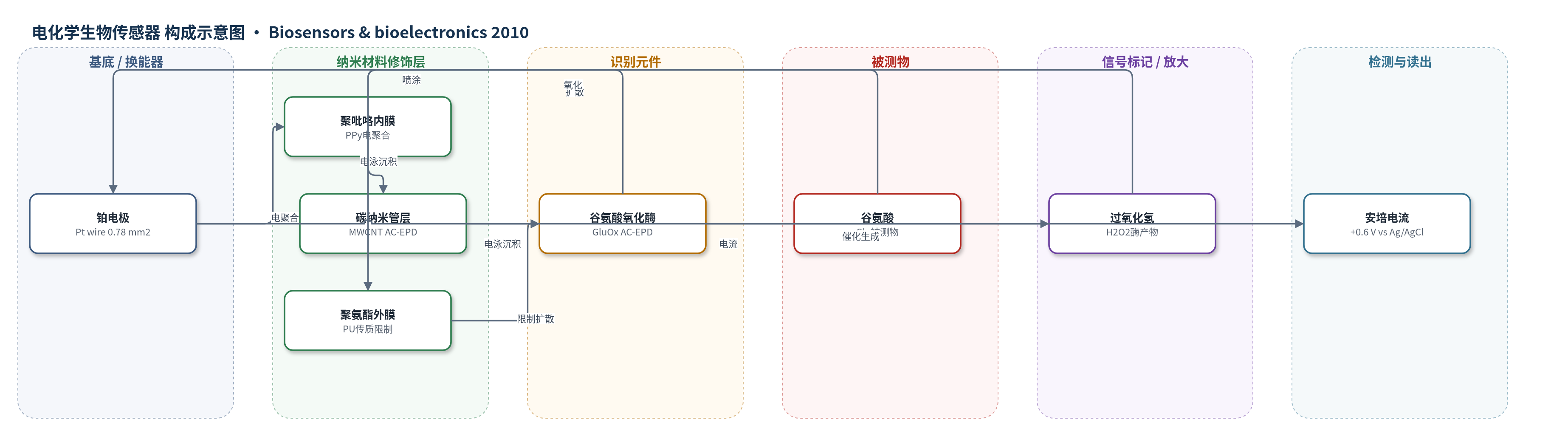
点击图片查看大图 · 依据论文自动绘制
传感器类型
电化学生物传感器
检测对象
谷氨酸(glutamate, Glu);实验样品基质为磷酸盐缓冲盐水(pH 7.4),文中提及脑脊液与食品应用
检测原理
谷氨酸(Glu)在谷氨酸氧化酶(GluOx)催化下与氧气和水反应,生成2-酮戊二酸、氨和过氧化氢(H2O2)。产生的H2O2在+0.6 V vs Ag/AgCl下于铂电极(Pt)表面发生氧化,产生与谷氨酸浓度相关的安培电流。聚吡咯(PPy)内选择性膜排斥抗坏血酸、尿酸和对乙酰氨基酚等可氧化干扰物,并部分限制H2O2,提高选择性;多壁碳纳米管(MWCNT)通过非对称交流电泳沉积(AC-EPD)形成三维网络,增大有效表面积、促进电子传递并负载更多GluOx,实现灵敏度放大;聚氨酯(PU)外膜限制谷氨酸传质,使响应受底物扩散控制,缓解高浓度下氧限制,从而扩展线性范围并提高稳定性。
检测灵敏度
LOD: <0.3 μM Glu (S/N = 3);线性范围: 0.3–140 μM Glu;灵敏度: 3.02 ± 0.04 nA/μM Glu;灵敏度: 3.84 nA/(μM mm2);PU外层传感器: 线性范围至约500 μM,灵敏度 2.5 nA/(μM mm2)
效应效果
无PU膜传感器对250 μM尿酸、抗坏血酸、对乙酰氨基酚响应可忽略,谷氨酸/干扰电流比约70,响应时间7±1 s,线性至140 μM,检出限<0.3 μM;30天稳定性下降约30%。加PU外膜后干扰响应基本为零,线性扩展至约500 μM,灵敏度2.5 nA/(μM mm2),响应时间约15 s,稳定性显著改善,重现性约90%。其灵敏度高于多数报道的谷氨酸氧化酶传感器(1.35 pA/(μM mm2)–1.46 nA/(μM mm2)),AC-EPD沉积酶层对20 μM谷氨酸电流约为常规电沉积的600倍,作者认为适合谷氨酸测量及潜在体内应用。
传感器的构成
- 基底/换能器电极:铂丝电极(Pt),直径250 μm,活性面积约0.78 mm2,作为安培检测换能器
- 内选择性膜:电聚合聚吡咯(PPy),在pH 7.4磷酸缓冲液中+1.1 V vs Ag/AgCl沉积,排斥抗坏血酸、尿酸、对乙酰氨基酚等干扰物
- 纳米材料修饰层:多壁碳纳米管(MWCNT),通过非对称交流电泳沉积(AC-EPD)从超纯水悬浮液沉积,增大有效表面积并作为酶支撑
- 识别元件:谷氨酸氧化酶(GluOx),通过AC-EPD从0.2 mg/0.5 mL超纯水溶液沉积,催化谷氨酸氧化生成过氧化氢(H2O2)
- 外传质限制膜:聚氨酯(PU),喷涂3次,限制谷氨酸扩散、进一步排斥干扰并提高稳定性
中文摘要
本文报道了一种基于聚吡咯(PPy)、多壁碳纳米管(MWCNT)和谷氨酸氧化酶(GluOx)修饰铂电极(Pt)的高灵敏、高选择性谷氨酸微生物传感器。传感器首先通过电聚合在Pt电极上形成PPy内选择性膜,用于排斥抗坏血酸、尿酸和对乙酰氨基酚等干扰物;随后采用非对称交流电泳沉积(AC-EPD)依次沉积MWCNT层和GluOx层。MWCNT增大有效表面积并作为酶支撑,GluOx催化谷氨酸氧化生成过氧化氢。无聚氨酯(PU)外膜时,传感器灵敏度为3.84 nA/(μM mm2),响应时间7 s,检出限约0.3 μM,线性范围140 μM,稳定性较好。为扩展线性范围并提高稳定性,在传感器表面喷涂薄PU外膜,使线性范围增至约500 μM,稳定性更好,但灵敏度降至2.5 nA/(μM mm2),响应时间增至15 s。
英文摘要
A highly sensitive and selective glutamate microbiosensor based on polypyrrole (PPy), multiwalled carbon nanotubes (MWCNT) and glutamate oxidase (GluOx) deposited on the transducer platinum electrode (Pt) is described. The sensor consists of a permselective membrane of polypyrrole for the rejection of interferences, followed by a layer of multiwalled carbon nanotubes and glutamate oxidase deposited by asymmetrical alternating current electrophoretic deposition (AC-EPD). The biosensor has a high sensitivity (3.84 nA/(microMmm(2))), low response to interferences such as ascorbic acid, uric acid and acetaminophen, a fast response time (7s), low detection limit (approximately 0.3 microM), a linear range of 140 microM and a satisfactory stability. In order to improve the linear range and the stability, a thin layer of polyurethane (PU) was applied to the Pt/PPy/MWCNT/GluOx sensor. The resulting sensor with the PU outer membrane showed an increase in the linear range up to approximately 500 microM glutamate and has a better stability at the expense of a decrease in sensitivity (2.5 nA/(microMmm(2))) and an increase in the response time (15s).