组成图示
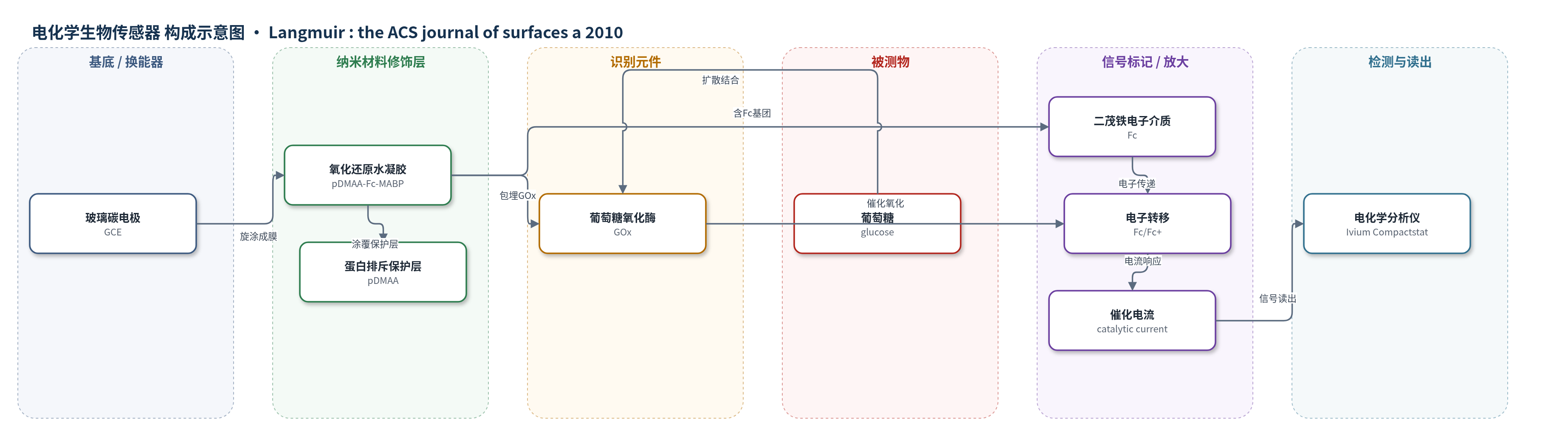
点击图片查看大图 · 依据论文自动绘制
传感器类型
电化学生物传感器
检测对象
葡萄糖(glucose, Glc),样品基质为醋酸盐缓冲液(acetate buffer, pH 5.2)或PBS缓冲液中的葡萄糖溶液
检测原理
葡萄糖扩散进入光交联氧化还原水凝胶,被包埋的葡萄糖氧化酶(GOx)识别并催化氧化,GOx辅基FAD被还原为FADH2。还原态FADH2将电子传递给聚合物侧链上的二茂铁(Fc)介质,Fc在电极/溶液界面发生可逆氧化还原,形成电化学催化电流。由于Fc在凝胶内形成连续电子导线,电子从酶活性中心到电极的传递效率高,电流随葡萄糖浓度增加而增大,并在高浓度下趋于饱和,呈Michaelis–Menten型响应。苯甲酮(MABP)光交联将GOx和Fc固定于水凝胶中,减少泄漏;外层pDMAA蛋白排斥层降低蛋白吸附,维持界面通透性。无额外化学放大,主要依靠酶催化与氧化还原聚合物电子传递。
检测灵敏度
灵敏度: 75.5 ± 5.2 μA mM-1 cm-2(5 mM 葡萄糖处)
效应效果
5 mM葡萄糖处灵敏度75.5 ± 5.2 μA mM-1 cm-2,KM 11.5 ± 1.2 mM,jmax 1193 ± 75 μA cm-2,与文献最高二茂铁基葡萄糖电极1.2 mA cm-2相当,高于聚酰胺13.5 μA cm-2和聚烯丙胺60 μA cm-2。PBS pH 7中3 h测试仅余16%初始电流,醋酸盐或PBS pH 5.2中3 h损失约10%,48 h 4 °C储存后响应降至约60%;HPO4^2-与氧化态Fc相互作用会加速失活。加入1 mg/mL纤维蛋白原后,无保护层电极2 h内电流降至约3/4,pDMAA保护层电极基本稳定。作者认为适合制备高活性、可微结构化的葡萄糖传感器和生物燃料电池。
传感器的构成
- 基底/换能器电极:玻璃碳电极(glassy carbon electrode, GCE),提供电子转移动态界面
- 氧化还原聚合物骨架:含苯甲酮(benzophenone, MABP)的聚(N,N-二甲基丙烯酰胺)(poly(dimethylacrylamide), pDMAA)共聚物,UV光交联成水凝胶,固定酶并允许离子/底物扩散
- 电子介质:二茂铁基团(ferrocene, Fc),共价连接于聚合物侧链,在GOx活性中心与电极间传递电子
- 识别元件:葡萄糖氧化酶(glucose oxidase, GOx),与聚合物共沉积并包埋/共价连接,催化葡萄糖氧化
- 保护层:共价连接的聚(N,N-二甲基丙烯酰胺)(pDMAA)或p(DMAA-2.5% MABP)蛋白排斥水凝胶,减少蛋白吸附
- 电解液:醋酸盐缓冲液(acetate buffer, pH 5.2)或PBS,提供离子导电与酶反应环境
中文摘要
本文提出一种光化学方法制备可微结构化的含酶氧化还原水凝胶,并评估其在生物传感器和生物燃料电池中的应用潜力。作者合成同时含电活性二茂铁基团和光反应性苯甲酮基团的聚(N,N-二甲基丙烯酰胺)聚合物,将其旋涂成薄膜于玻璃碳电极表面。经短紫外光照射后,苯甲酮与邻近C-H发生光交联,使聚合物层牢固附着于电极。若在成膜前将葡萄糖氧化酶混入聚合物溶液,则得到具有极高催化电流响应的葡萄糖氧化电极。研究考察多价离子和蛋白质对电催化膜性能的影响:双价磷酸根HPO4^2-与氧化态氧化还原基团相互作用可显著缩短电极寿命,而单离子存在及介质处于还原态时电极较稳定。在氧化还原聚合物网络外再涂覆一层共价连接的聚(N,N-二甲基丙烯酰胺)保护层,可显著减少蛋白吸附并提高生理环境中电极长期稳定性。由于蛋白吸附是生物电极失效主要原因之一,该策略有助于设计更生物稳定的传感器和燃料电池。
英文摘要
A photochemical approach to the generation of (microstructured) redox hydrogels with incorporated enzymes is presented and evaluated with respect to its potential in biosensor and biofuel cell applications. For this, poly(dimethylacrylamide) polymers containing both electroactive ferrocene moieties and photoreactive benzophenone groups are synthesized and deposited as thin films on electrode surfaces. Upon short irradiation with UV light, the polymer layer cross links and becomes firmly adhered to the glassy carbon electrodes. If glucose oxidase is mixed into the polymer solution prior to coating, then glucose-oxidizing electrodes with very high catalytic current responses are obtained. The influence of multivalent ions and proteins on the performance of the electrocatalytic films is studied. It is found that the interaction between bivalent HPO(4)(2-) and the oxidized redox moieties can shorten the lifetime of the redox electrodes significantly whereas the same electrodes are quite stable in the presence of monovalent ions and the reduced form of the mediator. Coating a thin, covalently attached poly(dimethylacrylamide) protective layer onto the redox polymer networks can greatly reduce the adsorption of proteins onto the surfaces and improve the long-term stability of the electrodes in physiological environments. Because the adsorption of proteins onto unprotected surfaces is one of the major causes of bioelectrode failure, this aspect is expected to contribute to the design of more biostable sensors and fuel cells.