组成图示
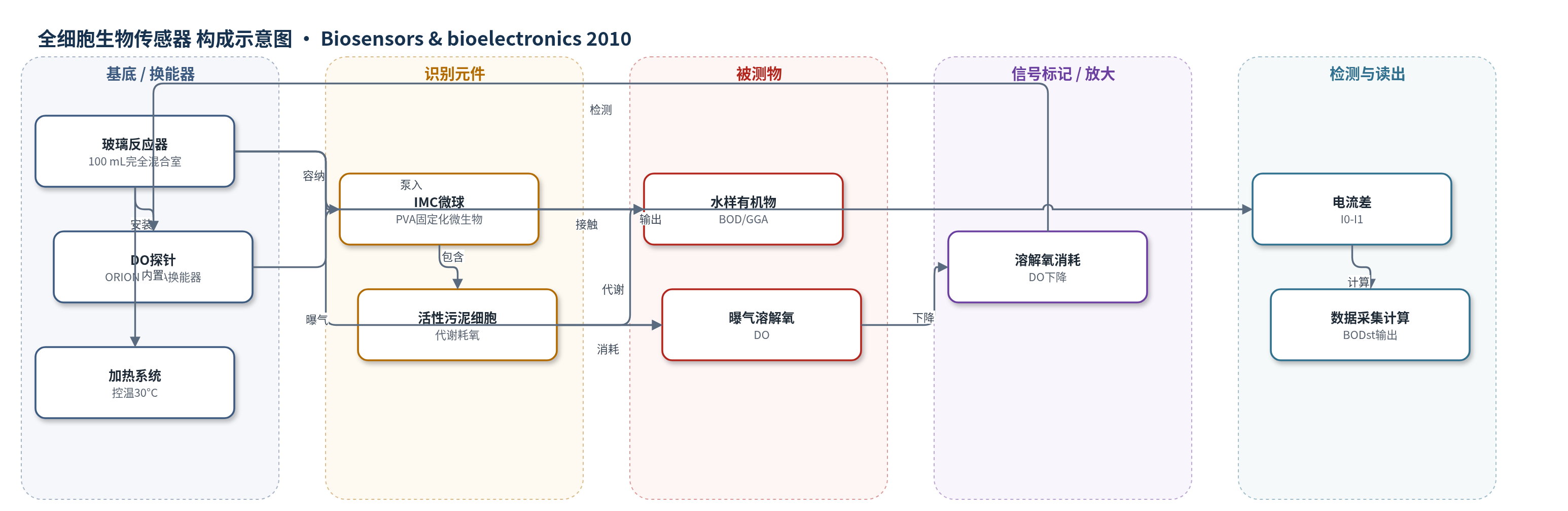
点击图片查看大图 · 依据论文自动绘制
传感器类型
全细胞生物传感器
检测对象
生化需氧量(BOD/BOD5,短期BOD BODst);样品基质:水样、废水、市政污水及葡萄糖-谷氨酸(GGA)标准溶液
检测原理
样品泵入玻璃反应器并曝气,DO探针先记录稳态电流I0作为基线。随后升降机构将PVA固定化微生物细胞(IMC)微球笼降入水样,微球中的活性污泥细胞代谢可生物降解有机物并消耗溶解氧,使反应器内DO下降,DO探针电流降至I1。响应值取ΔI=I0-I1,BOD越高,有机物代谢耗氧越多,DO下降越大,电流差越大。该传感器采用完全混合反应器,IMC微球悬浮分散,降低DO与有机物传质阻力,提高响应灵敏度;30℃下反应较快,无需外源标记或酶促放大,直接以生物耗氧实现BOD快速测定。
检测灵敏度
线性范围: 5–100 mg l−1;灵敏度: 0.0592 μA/(BOD5 mg l−1);R^2 = 0.9974
效应效果
该传感器在30℃下对50 mg l−1 GGA标准液检测时间约15 min,灵敏度约为0.0592 μA/(BOD5 mg l−1),较此前纯培养识别元件提高近4倍。重复性标准偏差为±3.6%至±6.4%,重现性标准偏差为±3.45%至±4.87%,优于膜型BOD传感器的±6.5%至±9.8%。IMC微球在每天检测8次条件下可保持约70 d生物活性。对市政污水样品,传感器BOD与标准BOD5差异分别为10.4%、5.1%和4.0%,一致性良好,作者认为其可满足BOD快速测定和水质监测应用。
传感器的构成
- 换能器:ORION 850A溶解氧(DO)探针,置于反应器中心,将溶解氧变化转换为电流信号
- 测定室:约100 mL玻璃完全混合反应器,内置底部加热系统,用于样品曝气、控温与生化反应
- 识别元件:PVA固定化微生物细胞(IMC)微球,平均直径3 mm,由活性污泥细胞经PVA/硼酸交联成球,悬浮于水样中代谢有机物并耗氧
- 样品基质:水样/废水,泵入反应器并曝气,提供溶解氧与可生物降解有机物
- 信号标记物:无外源标记物,以DO探针稳态电流下降(I0-I1)作为BOD响应信号
- 系统单元:样品制备、控制、数据采集与计算单元,用于泵样、升降IMC笼、记录电流并计算BOD
中文摘要
生化需氧量(BOD)是表征水体和废水有机污染的重要参数。本文报道了一种用于快速测定BOD的新型反应器型生物传感器,以固定化微生物细胞(IMC)微球作为识别生物元件,置于完全混合反应器测定室中,替代传统膜型BOD传感器中的生物膜。IMC微球悬浮于水样中,显著降低溶解氧和有机物的传质阻力,并可方便调节微生物用量,克服了传统膜型传感器中生物量与膜厚不可调和的矛盾。实验表明,反应器内生化反应最适温度为30℃,IMC微球在每天检测8次的条件下可保持约70 d生物活性;重复性标准偏差在±6.4%以内,重现性标准偏差在±5.0%以内,满足BOD快速测定要求。
英文摘要
Biochemical oxygen demand (BOD) is one of the most important and widely used parameters for characterizing the organic pollution of water and wastewater. In this paper, a novel reactor-type biosensor for rapid measurement of BOD was developed, based on using immobilized microbial cell (IMC) beads as recognition bio-element in a completely mixed reactor which was used as determining chamber, replacing the traditionally used membrane as recognition bio-element. The IMC beads were freely suspended in the aqueous solution, so the mass transfer resistance for dissolved oxygen and organic compounds significantly reduced, and the quantity of the microbial cells used as recognition element can be easily adjusted, in comparison with the traditional membrane-type BOD biosensor, in which exists a unadjustable contradiction between the quantity of biomass and the thickness of the bio-membrane, thus limiting the stability and the detection limit. This novel kind of BOD biosensor significantly increased the sensitivity of the response, the detecting precision and prolonged the life time of the recognition element. The experimental data showed that the most appropriate temperature for biochemical reaction in the reactor was 30 degrees C, and the IMC beads could keep the bioactivity for about 70d at the detecting frequency of 8 times every day. The standard deviation of repeatability and the reproducibility of responses were within +/-6.4% and +/-5.0%, respectively, which are within acceptable bias limits, and meet the requirement of BOD rapid measurement.