组成图示
点击图片查看大图 · 依据论文自动绘制
传感器类型
综述或非传感器论文
检测对象
细胞内氯离子(intracellular chloride, Cl−/[Cl−]i)、甘氨酸受体通道活性(glycine receptor channel activity, GlyR);样品基质:活细胞、细胞培养物、脑片、视网膜片、CHO/HEK/BHK细胞
检测原理
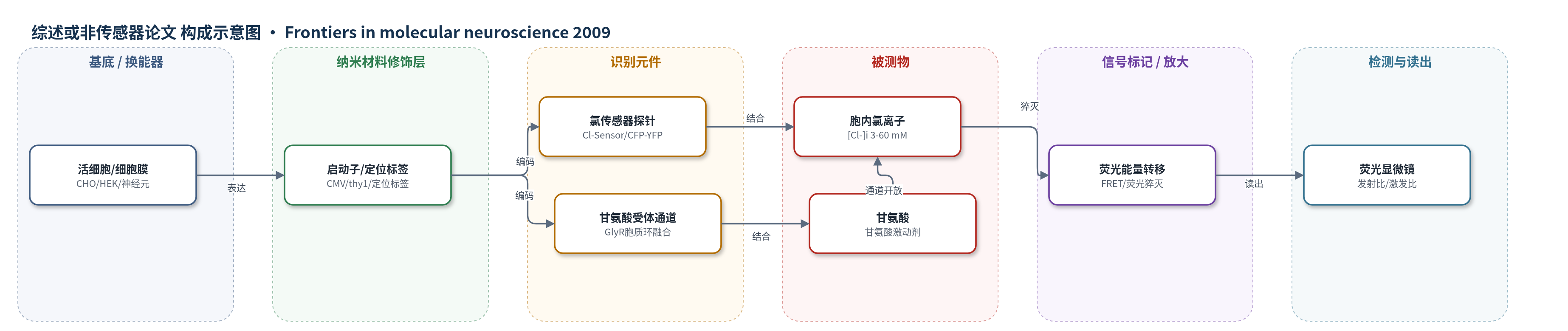
基因编码氯探针在细胞内表达后,YFP/CFP–TFP模块的卤素结合位点与Cl−结合,改变发色团电离状态或FRET效率。Clomeleon/Cl-Sensor中,Cl−结合TFP/YFP使其发射降低,CFP供体到TFP/YFP受体的FRET效率下降,导致发射比或激发比随[Cl−]i变化,实现比率读出。BioSensor-GlyR将Cl-Sensor插入GlyR胞质环,甘氨酸结合并开放氯选择性通道,Cl−内流改变通道周围局部[Cl−]i,进而引起Cl-Sensor荧光变化;荧光幅度与方向与甘氨酸诱导电流相关,从而将通道激活事件转换为光学信号。
检测灵敏度
EC50: Cl-Sensor 28 ± 5 mM;Clomeleon 167 ± 13 mM;YFP-H148Q 154 mM (pH 7.5)
效应效果
YFP基探针以可见光激发,光漂白和细胞损伤低于喹啉鎓染料,胞内浓度仅数微摩尔,不缓冲Cl−,分子量大不易泄漏,可长时间成像。Clomeleon 2 h记录无明显漂白,转基因小鼠中稳定9个月,2年无行为异常;Cl-Sensor灵敏度约为Clomeleon的5倍,生理[Cl−]i范围动态范围较好。BioSensor-GlyR保留野生型GlyR动力学、激动剂敏感性和Cl−选择性,荧光幅度与方向同甘氨酸诱导电流相关。局限为pH敏感、Cl−结合/解离较慢(YFP-H148Q/V163S τ=1900 ms;YFP-H148Q/I152L τ=52 ms但EC50=85 mM)及神经元转染效率低。
传感器的构成
- 表达基底:活细胞(CHO、HEK、BHK、神经元、视网膜细胞)及细胞膜/胞质,承载基因编码探针表达与定位
- 定位修饰:CMV、thy1、ubiquitin启动子或细胞器/膜定位标签,实现特定细胞类型或区室表达
- 识别元件:YFP及其突变体(YFP-H148Q/I152L/V163S)或CFP–TFP融合蛋白(Clomeleon/Cl-Sensor),通过卤素结合位点识别Cl−
- 信号标记物:CFP供体与TFP/YFP受体构成FRET对,或YFP荧光猝灭,将Cl−结合转化为荧光比变化
- 通道融合元件:氯选择性甘氨酸受体(GlyR)胞质环,用于BioSensor-GlyR监测通道激活引起的局部Cl−变化
- 读出系统:荧光显微镜/光谱仪,测量发射比(F527/F485)或激发比(F480/F440)
中文摘要
本综述简要讨论监测细胞内氯离子(Cl−,[Cl−]i)这一最重要生理阴离子的主要方法。由于Cl−跨膜比低(约10:1)且驱动力小,其反转电位通常接近静息电位,可靠监测需要高灵敏度探针。在多种方法中,基因编码氯指示剂最具前景。近年进展基于黄色荧光蛋白(YFP)对卤素的敏感性,YFP探针已用于不同细胞中Cl−转运的定量分析和氯选择性通道调节剂的高通量筛选。比率型基因编码探针Clomeleon提供了非侵入估算胞内Cl−浓度的工具,但其灵敏度较低(EC50约160 mM),仍可用于多种细胞。近期发展的CFP–YFP探针Cl-Sensor对Cl−灵敏度较高(EC50约30 mM),可通过荧光激发比进行比率监测。将Cl-Sensor插入氯选择性甘氨酸受体(GlyR)胞质域形成的BioSensor-GlyR已在细胞系中表达,为筛选药物、分析Cl−稳态及氯选择性通道功能提供新手段。
英文摘要
This review briefly discusses the main approaches for monitoring chloride (Cl(-)), the most abundant physiological anion. Noninvasive monitoring of intracellular Cl(-) ([Cl(-)]i) is a challenging task owing to two main difficulties: (i) the low transmembrane ratio for Cl(-), approximately 10:1; and (ii) the small driving force for Cl(-), as the Cl(-) reversal potential (E(Cl)) is usually close to the resting potential of the cells. Thus, for reliable monitoring of intracellular Cl(-), one has to use highly sensitive probes. From several methods for intracellular Cl(-) analysis, genetically encoded chloride indicators represent the most promising tools. Recent achievements in the development of genetically encoded chloride probes are based on the fact that yellow fluorescent protein (YFP) exhibits Cl(-)-sensitivity. YFP-based probes have been successfully used for quantitative analysis of Cl(-) transport in different cells and for high-throughput screening of modulators of Cl(-)-selective channels. Development of a ratiometric genetically encoded probe, Clomeleon, has provided a tool for noninvasive estimation of intracellular Cl(-) concentrations. While the sensitivity of this protein to Cl(-) is low (EC(50) about 160 mM), it has been successfully used for monitoring intracellular Cl(-) in different cell types. Recently a CFP-YFP-based probe with a relatively high sensitivity to Cl(-) (EC(50) about 30 mM) has been developed. This construct, termed Cl-Sensor, allows ratiometric monitoring using the fluorescence excitation ratio. Of particular interest are genetically encoded probes for monitoring of ion channel distribution and activity. A new molecular probe has been constructed by introducing into the cytoplasmic domain of the Cl(-)-selective glycine receptor (GlyR) channel the CFP-YFP-based Cl-Sensor. This construct, termed BioSensor-GlyR, has been successfully expressed in cell lines. The new genetically encoded chloride probes offer means of screening pharmacological agents, analysis of Cl(-) homeostasis and functions of Cl(-)-selective channels under different physiological and pathological conditions.