组成图示
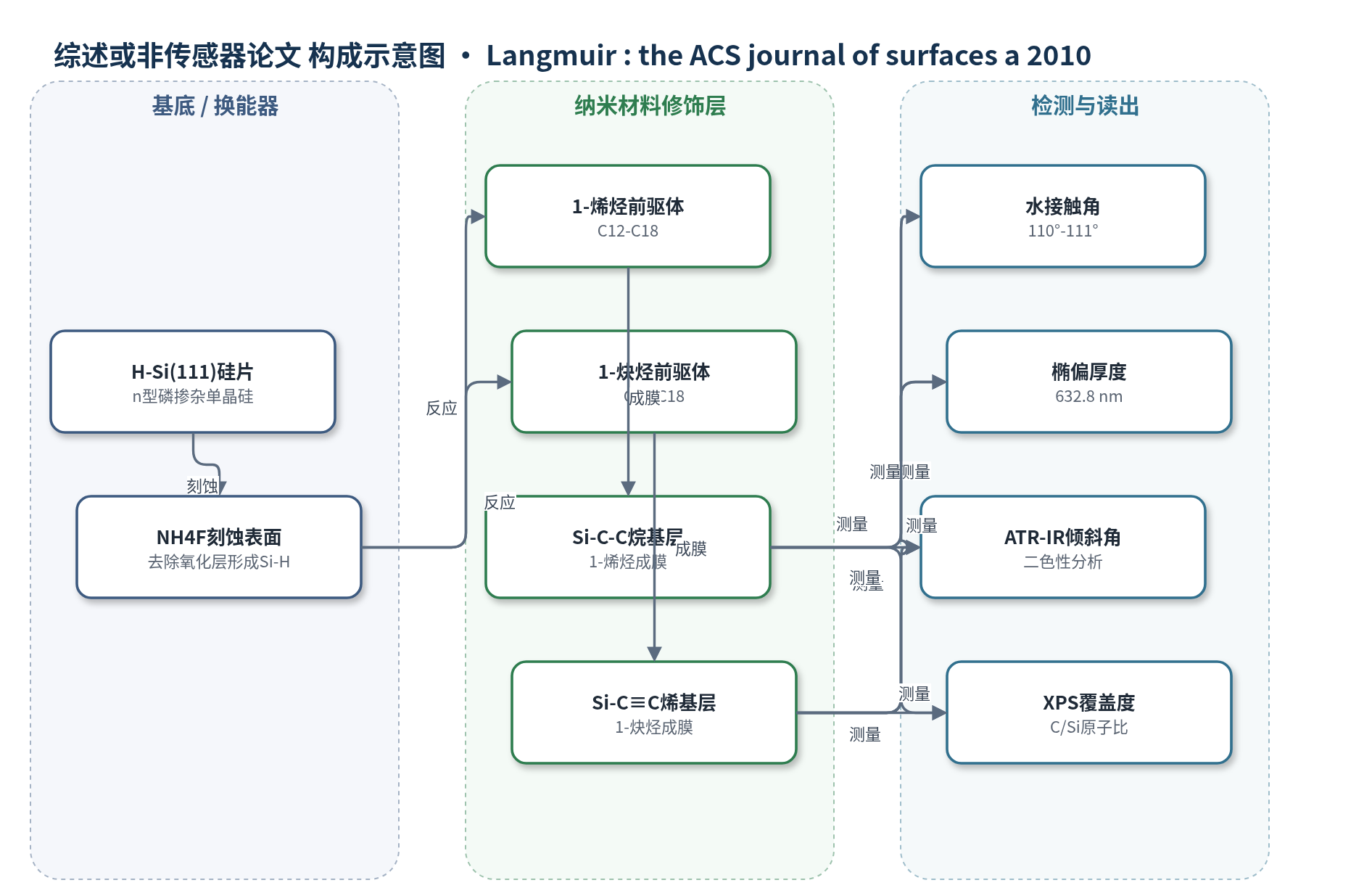
点击图片查看大图 · 依据论文自动绘制
传感器类型
综述或非传感器论文
检测对象
无(非传感检测论文;研究样品为 H-Si(111) 硅片表面 1-烯烃/1-炔烃单分子层)
检测原理
本文并非传感检测,而是研究无氧化硅表面有机单分子层的形成与结构。氢端化 Si(111) 表面的 Si-H 位点与 1-烯烃或 1-炔烃在惰性气氛中发生自由基链反应,分别生成 Si-C-C 烷基单分子层和 Si-C≡C 烯基单分子层。Si-C≡C 连接基具有更小范德华半径、更高反应性和抗氧化能力,使链间堆积更紧密、倾斜角更小、厚度更大。表面覆盖度通过 ATR-IR 二色性厚度与 XPS 定量 C/Si 比换算得到,并与金上烷基硫醇单分子层参考密度比较。该过程不涉及识别元件、信号放大或分析物浓度响应。
检测灵敏度
无(原文未报告 LOD、线性范围、灵敏度斜率或相关系数)
效应效果
所有单分子层均呈疏水性,静态水接触角为 110°–111°,且不受链长和连接基类型明显影响。烷基单分子层的厚度、倾斜角和堆积密度与文献一致;烯基单分子层厚度更高、倾斜角更低、有序性更强。表面覆盖度方面,1-烯烃单分子层为 50%–55%,1-炔烃单分子层随链长增加,从 C12 的约 55% 提高到 C18 的约 65%,接近 H-Si(111) 理论最大值 69%。作者认为 Si-C≡C 连接基可抑制硅表面氧化,提高单分子层-硅界面稳定性,有利于分子电子和生物传感器器件中无氧化硅单分子层的应用。
传感器的构成
- 基底:H-Si(111) 单晶硅片,经 NH4F 刻蚀提供无氧化 Si-H 反应表面
- 单分子层前驱体:1-烯烃(C12-C18)与 1-炔烃(C12-C18),分别与 Si-H 反应形成不同连接基
- 连接基层:1-烯烃形成 Si-C-C 烷基连接基;1-炔烃形成 Si-C≡C 烯基连接基
- 有机链层:C12-C18 烷基/烯基链,形成疏水有序单分子层,水接触角 110°-111°
- 表征读出:静态水接触角、椭偏仪、ATR-IR 和 XPS 用于厚度、倾斜角、堆积密度与覆盖度分析,非传感信号标记
中文摘要
在氢端化 Si(111) 表面,1-烯烃通过 Si-C-C 连接基形成烷基单分子层,1-炔烃则通过 Si-C≡C 连接基形成烯基单分子层。为研究不同连接基对最终单分子层结构的影响,作者制备了链长 C12 至 C18 的 1-烯烃和 1-炔烃单分子层,并采用静态水接触角、椭偏仪、衰减全反射红外光谱(ATR-IR)和 X 射线光电子能谱(XPS)进行表征。结果表明,烷基单分子层的厚度、倾斜角和堆积密度与文献值一致;烯基单分子层则表现出更大厚度、更小倾斜角和更高堆积密度。烷基单分子层表面覆盖度为 50%–55%,烯基单分子层覆盖度随链长增加,从 C12 的约 55% 提高到 C18 的约 65%,接近 H-Si(111) 理论最大值 69%。这种更高质量单分子层以及 Si-C≡C 连接基的抗氧化特性,提高了无氧化硅上有机单分子层在分子电子和生物传感器器件中成功应用的可能性。
英文摘要
On H-Si(111), monolayer assembly with 1-alkenes results in alkyl monolayers with a Si-C-C linkage to the silicon substrate, while 1-alkynes yield alkenyl monolayers with a Si-C=C linkage. To investigate the influence of the different linkage groups on the final monolayer structure, organic monolayers were prepared from 1-alkenes and 1-alkynes with chain lengths from C(12) to C(18), and the final monolayer structures were studied in detail by static water contact angles measurements, ellipsometry, attenuated total reflectance infrared (ATR-IR) spectroscopy, and X-ray photoelectron spectroscopy (XPS). The thicknesses, tilt angles, and packing densities of the alkyl monolayers are in good agreement with literature values, whereas increased thicknesses, reduced tilt angles, and improved packing densities were observed for the alkenyl monolayers. Finally, the surface coverages for alkyl monolayers were determined to be 50-55% (in line with literature values), while those for the alkenyl monolayers increased with the chain length from 55% for C(12) to as high as 65% for C(18)! The latter value is very close to the theoretical maximum of 69% obtainable on H-Si(111). Such enhanced monolayer quality and increased surface coverage of the alkenyl monolayers, in combination with the oxidation-inhibiting nature of the Si-C=C linkage, significantly increases the chance of successful implementation of organic monolayers on oxide-free silicon in molecular electronic and biosensor devices, especially in view of the importance of a defect-free monolayer structure and the corresponding stability of the monolayer-silicon interface.