组成图示
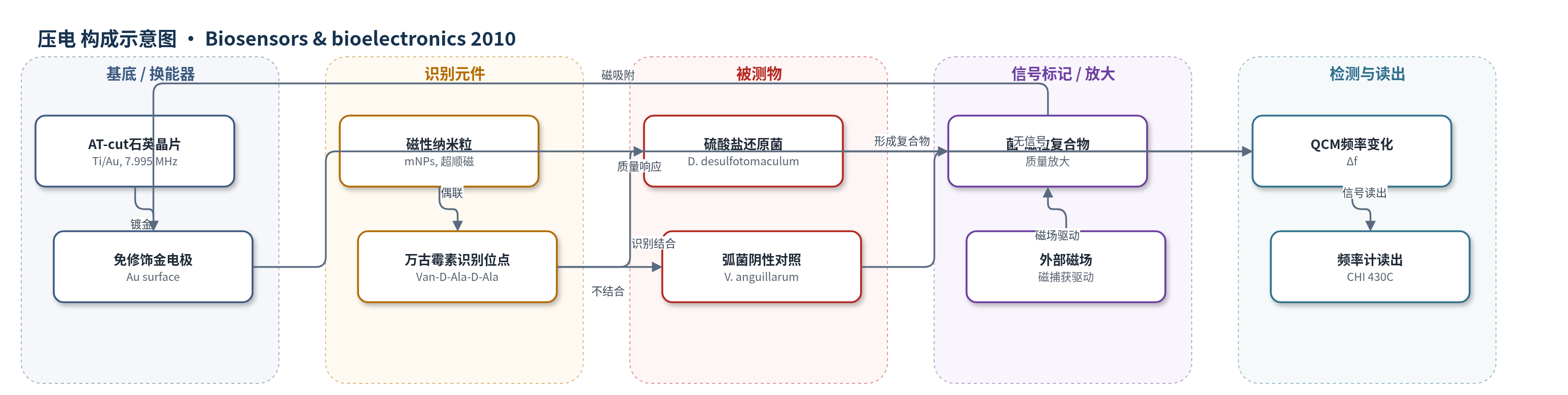
点击图片查看大图 · 依据论文自动绘制
传感器类型
压电(QCM)生物传感器
检测对象
硫酸盐还原菌(sulphate-reducing bacteria, SRB;D. desulfotomaculum)、弧菌(Vibrio anguillarum,阴性对照);样品基质:PBS 细菌悬液(海洋淤泥分离培养)
检测原理
万古霉素功能化磁性纳米粒(Van-mNPs)表面的万古霉素通过五重氢键特异性识别万古霉素敏感菌细胞壁肽聚糖前体末端的 D-Ala-D-Ala,形成细菌–磁粒复合物。经磁分离和洗涤后,将复合物加入 QCM 检测池;在外部磁场作用下,磁粒复合物被快速吸附到免修饰金电极表面,使石英晶体表面质量增加。依据 Sauerbrey 方程,质量增加导致谐振频率下降,频率变化 Δf 随细菌浓度对数增大。磁性纳米粒提供多重质量放大,外部磁场实现快速磁捕获,因此响应在约 100 s 内达到稳定,优于传统单分子识别 QCM。
检测灵敏度
线性范围: 1.8 × 10^4–1.8 × 10^7 cfu/ml;灵敏度斜率: 68.31(ΔF = 68.31 logN_SRB − 203.8);R^2 = 0.999
效应效果
该传感器对 1.8×10^7 cfu/ml 的 D. desulfotomaculum 产生 275±21 Hz 的频率响应,约 100 s 内达到稳定;对万古霉素耐药的 V. anguillarum 仅 11±5 Hz,空白为 0±6 Hz,背景信号 50±7 Hz,显示良好选择性。孵育 30 min 后响应达到平台,pH 7.0 时响应最佳。与需要蛋白 A、戊二醛或 MPA 固定抗体的传统 QCM 相比,本方法无需电极修饰,避免了超过 24 h 的制备过程,且磁捕获使响应远快于至少 60 min 的经典识别过程。误差棒为 n=3 的标准偏差,作者认为该体系可用于病原菌快速检测,并可进一步集成。
传感器的构成
- 基底/换能器:AT-cut 石英晶片(Ti/Au 镀层,7.995 MHz),提供压电换能与频率读出。
- 电极表面:免修饰金电极(Au),直接作为磁粒复合物吸附界面,无需固定识别层。
- 纳米探针:超顺磁性纳米粒(mNPs,Fe 基磁核),提供磁响应与质量放大。
- 表面修饰:TEOS 二氧化硅层(SiO2)与 APTMS 氨基硅烷,保护磁核并提供氨基偶联位点。
- 识别元件:万古霉素(Van),经 DSS 与氨基共价偶联,识别细菌细胞壁 D-Ala-D-Ala。
- 信号放大:菌–磁粒复合物(bacteria-mNPs conjugates),在磁场下聚集吸附,增加晶体表面质量。
中文摘要
本文报道了一种快速、灵敏且可靠的石英晶体微天平(QCM)生物传感器,用于选择性检测海洋致病性硫酸盐还原菌(SRB)D. desulfotomaculum。该传感器利用万古霉素功能化磁性纳米粒(Van-mNPs)作为识别探针,在外部磁场作用下,使细菌–磁粒复合物吸附于金电极表面,从而实现质量信号放大。QCM 对万古霉素敏感的 D. desulfotomaculum 产生明显响应,而对万古霉素耐药的 Vibrio anguillarum 无明显响应。研究优化了孵育时间和 pH 条件,结果表明细菌与 Van-mNPs 孵育 30 min 可获得最佳响应。在 1.8×10^4–1.8×10^7 cfu/ml 范围内,QCM 响应与细菌浓度对数呈线性关系。该体系为病原菌快速检测提供了简便方法,具有进一步应用潜力。
英文摘要
A fast, sensitive and reliable quartz crystal microbalance (QCM) biosensor is described for the selective detection of the marine pathogenic sulphate-reducing bacterium (SRB), D. desulfotomaculum. Based on the amplification of the response of vancomycin-functionalized magnetic nanoparticles (Van-mNPs), under an external magnetic field, the bacteria-mNPs conjugates attach to the surface of an Au electrode. The QCM biosensor gave a distinct response to the vancomycin-sensitive, D. desulfotomaculum, but had no obvious response to the vancomycin-resistant bacterium, Vibrio anguillarum. The effects of the optimization conditions such as the incubation time and pH on the detection were also investigated, respectively. Optimised assays showed that the biosensor could obtain the best response with a 30 min incubation of the bacteria with the Van-mNPs. A linear relationship between the QCM response and the logarithm of the bacterial concentration was observed in the range of 1.8 x 10(4) to 1.8 x 10(7)cfu/ml. The sensor system has a potential for further applications and provides a facile and sample method for detection of pathogenic bacteria.