组成图示
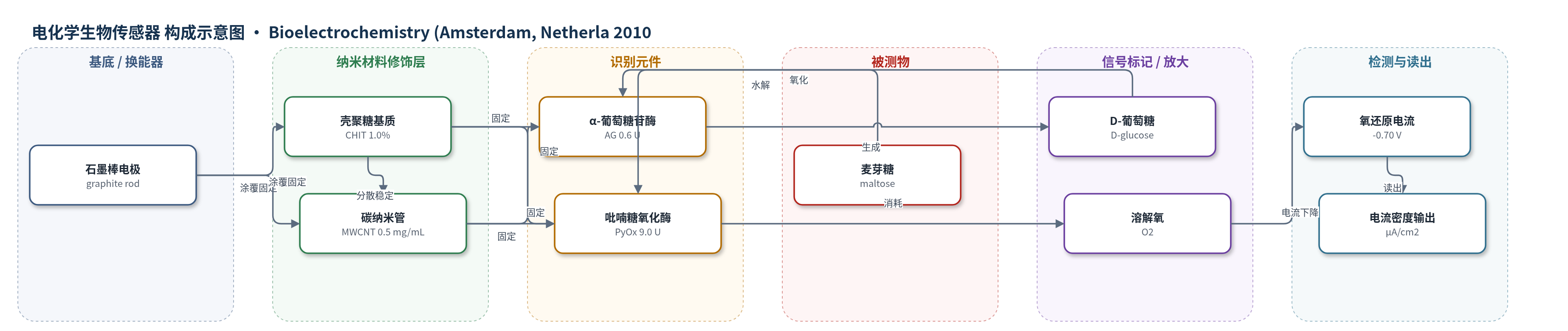
点击图片查看大图 · 依据论文自动绘制
传感器类型
电化学生物传感器
检测对象
麦芽糖(maltose);样品基质:啤酒样品(beer samples),亦用磷酸盐缓冲液标准溶液
检测原理
麦芽糖进入生物活性层后,首先被α-葡萄糖苷酶(AG)水解为2分子D-葡萄糖;随后吡喃糖氧化酶(PyOx)对D-葡萄糖进行C-2区域选择性氧化,生成2-酮-D-葡萄糖,同时将溶解氧还原为过氧化氢。由于PyOx对葡萄糖无异常特异性,α-和β-D-葡萄糖均可被氧化,因此无需变旋酶。在-0.70 V下,电极监测溶解氧还原电流;麦芽糖浓度越高,酶促反应消耗O2越多,氧还原电流下降越大,电流密度变化与麦芽糖浓度呈线性关系。
检测灵敏度
线性范围: 0.25–2.0 mM;AG/PyOx/CHIT: y=0.844x+0.029 (R^2=0.999),灵敏度斜率 0.844 μA/cm2/mM;AG/PyOx/CHIT–CNT: y=0.882x+0.0625 (R^2=0.996),灵敏度斜率 0.882 μA/cm2/mM
效应效果
传感器对甘露糖、果糖、N-乙酰氨基葡萄糖、乳糖、纤维二糖无响应;葡萄糖、半乳糖、木糖、蔗糖共存时麦芽糖回收率99–106%;扑热息痛、抗坏血酸、尿酸无干扰。1.0 mM麦芽糖10次重复CV为4.4%(CHIT)和1.75%(CHIT–CNT)。操作5 h响应下降15%和13%,4 °C保存20 d无下降。啤酒样品与DNS法一致:Brand I 1.435±0.007 g/L(DNS 1.335±0.049),Brand II 0.973±0.003 g/L(DNS 0.945±0.021);标准加入回收率94–100%。可用于啤酒发酵监测。
传感器的构成
- 工作电极基底:光谱石墨棒(spectrographic graphite rods),作为电化学换能器/工作电极
- 固定化基质:壳聚糖(CHIT,1.0%),固定酶并维持酶微环境
- 纳米材料修饰层:多壁碳纳米管(MWCNT,0.5 mg/mL),分散于壳聚糖中,促进电子传递并提高固定化稳定性
- 识别元件:α-葡萄糖苷酶(AG,0.6 U)与吡喃糖氧化酶(PyOx,9.0 U),共固定,分别催化麦芽糖水解和D-葡萄糖氧化
- 交联剂:戊二醛(glutaraldehyde,1.0%),交联酶与壳聚糖氨基,形成稳定生物活性层
- 信号介质:溶解氧(O2),被PyOx消耗并生成H2O2,用于安培法监测氧还原电流变化
- 读出方式:恒电位计时电流法,在-0.70 V下记录电流密度(μA/cm2)
中文摘要
本文报道了一种用于麦芽糖分析的新型双酶电化学生物传感器。将α-葡萄糖苷酶(AG)与吡喃糖氧化酶(PyOx)共固定于壳聚糖(CHIT)/多壁碳纳米管(MWCNT)基质中,并用戊二醛交联,修饰在光谱石墨棒工作电极上。通过优化酶量、CHIT与戊二醛用量、CNT含量以及pH、温度和工作电位,得到最佳条件:pH 6.0、35 °C、-0.70 V。在0.25–2.0 mM范围内,传感器对麦芽糖呈快速线性响应;AG/PyOx/CHIT与AG/PyOx/CHIT–CNT的线性方程分别为y=0.844x+0.029(R^2=0.999)和y=0.882x+0.0625(R^2=0.996)。CNT的加入未显著改变响应特性,但可改善固定化平台。啤酒样品中麦芽糖测定结果与DNS比色法一致,表明该传感器可用于啤酒样品中麦芽糖的直接检测。
英文摘要
A new bi-enzymatic system was designed by co-immobilization of alpha-glucosidase (AG) and pyranose oxidase (PyOx) for maltose analysis. The immobilization was carried out by cross-linking enzyme mixture, chitosan (CHIT) and carbon nanotube (CNT) via glutaraldehyde. The structure of biosensor including enzyme, CHIT, glutaraldehyde and CNT amount together with operational conditions like pH, temperature and applied potential were optimized. Then analytical characterization was performed. A fast linear response of the biosensor was observed for maltose in the concentration range from 0.25 to 2.0 mM at 35 degrees C and pH 6.0. The effect of CNT addition into the immobilization matrix was also investigated. The linear relationships between sensor response (y; microA/cm(2)) and substrate concentration (x; mM) were defined by the equations of y=0.844x+0.029 (R(2)=0.999) and y=0.882x+0.0625 (R(2)=0.996) for AG/PyOx/CHIT and AG/PyOx/CHIT-CNT biosensors, respectively. All other data were also given as comparison of two systems one with CNT-modified and CNT-free. Finally, for the sample application, maltose was analyzed in beer samples. As a result, it has been found that; complex matrix of natural beer samples had no influence on the biosensing response. Also the results were in good agreement with those obtained by spectrophotometric measurements.