组成图示
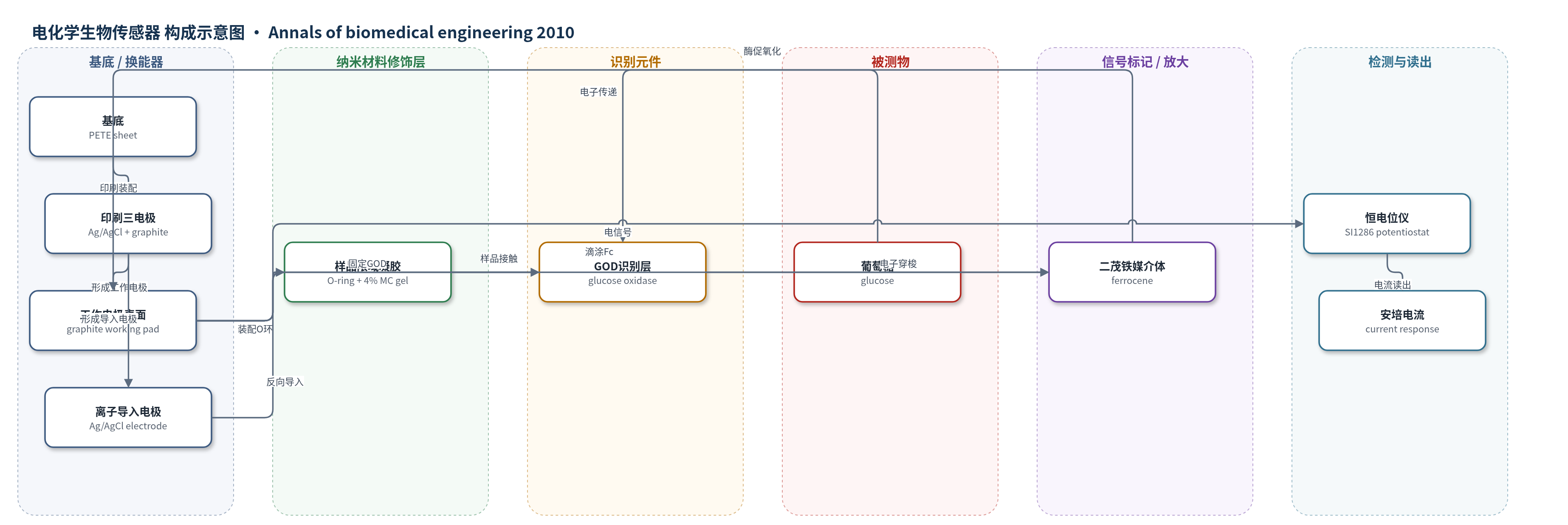
点击图片查看大图 · 依据论文自动绘制
传感器类型
电化学生物传感器
检测对象
葡萄糖(glucose, Glc);样品基质为反向离子导入提取的经皮组织间液模型(扩散细胞中 PBS 葡萄糖溶液)
检测原理
葡萄糖氧化酶(GOD)催化葡萄糖氧化为葡萄糖酸内酯,同时 GOD 被还原。二茂铁(ferrocene)作为电子媒介体替代氧气,接受还原态 GOD 的电子,并在石墨工作电极表面发生可逆氧化还原,从而在 200 mV(vs. Ag/AgCl)恒电位下产生安培电流。电流大小与葡萄糖浓度成正比,线性范围为 0–4 mM。反向离子导入部分通过 Ag/AgCl 离子导入电极施加双极电流(0.3 mA/cm2),驱动葡萄糖从皮肤或扩散细胞膜迁移至甲基纤维素凝胶/传感器反应区,使低浓度经皮葡萄糖进入 GOD/二茂铁层。低工作电位有助于降低尿酸等电活性干扰物的氧化,提高选择性。
检测灵敏度
线性范围: 0–4 mM;灵敏度: 87.7 nA/mM;R^2 = 0.9913;反向离子导入模型线性范围: 3–15 mM;R^2 = 0.9876(r2 = 0.99)
效应效果
该传感器响应时间约 10 s,达到稳态电流 95%。换能器批次重现性约 6%(n=3),生物传感器灵敏度相对标准偏差约 7%(n=3),不同 GOD/二茂铁组合的 RSD 为 0.1%–6.9%。使用二茂铁媒介体后灵敏度显著高于无媒介体传感器(p<0.05),最优组合为 12.5 mg/mL GOD 配 0.1 或 0.2 M 二茂铁。工作电位仅 200 mV,低于 GlucoWatch 的 420 mV,预期可减少尿酸等电活性物质干扰。反向离子导入模型中 3–15 mM 葡萄糖与电流呈线性(R^2=0.9876),可覆盖低血糖、正常和高血糖模拟浓度;作者认为其可用于无创经皮葡萄糖监测,但文中未报告真实人体样品回收率。
传感器的构成
- 基底:PETE 片,提供透明柔性支撑。
- 导电轨道:silver paste,印刷形成电极互连。
- 绝缘层:polyurethane insulating paste,隔离导电轨道。
- 电极层:Ag/AgCl paste 与 graphite paste,分别形成参考/离子导入电极和工作/辅助电极。
- 识别元件:glucose oxidase (GOD),经 1-cyclo-hexyl-3-(2-morpholinoethyl)carbodiimide-p-methyltoluenesulphate 固定于石墨工作电极,催化葡萄糖氧化。
- 电子媒介体:ferrocene (Fc),滴涂于 GOD 层,介导 GOD 与电极间电子转移。
- 样品限域层:silicon O-ring 与 4% methylcellulose (MC) gel,限定反应区并承载反向离子导入提取液。
- 检测读出:potentiostat SI1286,施加 200 mV vs Ag/AgCl 并记录安培电流。
中文摘要
本研究旨在开发一种用于反向离子导入的葡萄糖氧化酶-二茂铁介导葡萄糖生物传感器,以实现无创经皮葡萄糖监测。作者采用丝网印刷技术在聚对苯二甲酸乙二醇酯(PETE)基底上制备三电极平面安培换能器,包括银导电轨道、聚氨酯绝缘层、Ag/AgCl 参考/离子导入电极和石墨工作/辅助电极。将不同负载量的葡萄糖氧化酶(GOD)和二茂铁(ferrocene)依次滴涂于工作电极表面,并以硅 O 环限定反应区。循环伏安法显示换能器峰电位差约 70 mV、阳极/阴极峰电流比约 0.89,接近理想安培换能器。在 200 mV(vs. Ag/AgCl)下,传感器对葡萄糖呈 0–4 mM 线性响应,响应时间约 10 s。结合反向离子导入装置后,扩散细胞模型中葡萄糖浓度与电流响应呈良好线性(r2=0.99),表明该传感器可用于无创葡萄糖监测。
英文摘要
The objective of this study was to develop a ferrocene mediated glucose biosensor for reverse iontophoresis. An amperometric ferrocene mediated glucose biosensor based on a three electrodes planar configuration was constructed using screen printing technique. Different combinations of glucose oxidase and ferrocene loading were drop coated onto the surface of the amperometric transducer. The amperometric transducer was characterized electrochemically using cyclic voltammetry and its electrochemical characteristics (DeltaE(p) = 70 mV, I(pa)/I(pc) = 0.89) were found close to an ideal amperometric transducer. The biosensor on the detection of glucose at 200 mV (vs. Ag/AgCl) showed a linear response range (0-4 mM). The response time of the biosensor was about 10 s. Finally, the biosensor was used together with reverse iontophoresis technique. By the use of an actual model for evaluation, an excellent linear relationship (r(2) = 0.99) was found between the glucose concentration of the actual model and the biosensor current response. In conclusion, a ferrocene mediated glucose biosensor incorporated with reverse iontophoresis function was developed.