组成图示
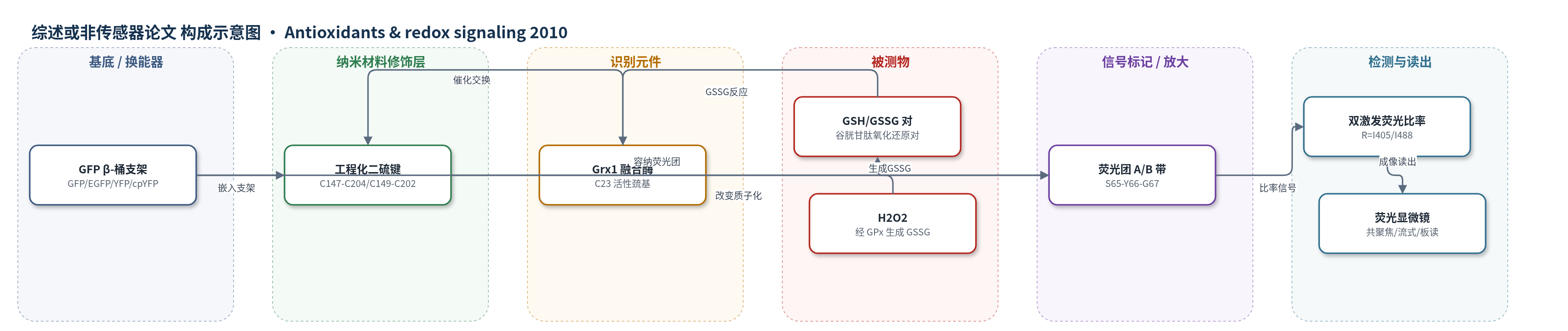
点击图片查看大图 · 依据论文自动绘制
传感器类型
综述或非传感器论文
检测对象
谷胱甘肽氧化还原电位(EGSH,GSH/GSSG)、过氧化氢(H2O2)、超氧阴离子(O2•−)、硫氧还蛋白氧化还原状态(ETrx1,Trx1);样品基质为活细胞、组织、转基因模式生物及细胞质、内质网、线粒体、叶绿体等亚细胞区室。
检测原理
以 roGFP2 为例,细胞内 GSSG 在 Grx1 催化下与探针 C147-C204 双硫键发生可逆硫醇-二硫键交换;二硫键形成使 β-桶局部构象改变,影响 Y66 与 E222 之间的激发态质子转移及 π 堆积,从而改变 405 nm 与 488 nm 激发光谱。双激发荧光强度比 R=I405/I488 随探针氧化度 OxD 变化,经 Nernst 方程换算为 EGSH。Grx1 融合大幅提高局部催化浓度,使探针快速平衡并放大纳摩尔 GSSG 变化;HyPer 则通过 H2O2 氧化 cpYFP 工程化位点产生比率荧光响应。
检测灵敏度
—
效应效果
综述指出,rxYFP 动态范围约 2.2;roGFP1 在 405/488 nm 约 2.58、400/475 nm 约 6.1;roGFP2 在 405/488 nm 约 9.23、400/490 nm 约 5.8。roGFP2 有效测量窗约 -320 至 -240 mV,适合细胞质、线粒体等还原区室,内质网中常呈完全氧化。Grx1-roGFP2 可在毫摩尔 GSH 背景下检测纳摩尔 GSSG 变化,低微摩尔 H2O2 单次刺激可产生可重复响应;比率在 pH 5.5–8.0 基本不受影响,且氧化还原响应可逆。相比 H2DCF 等染料,其具有区室特异性、定量与动态优势,可用于活细胞、组织与转基因模式生物。
传感器的构成
- 荧光蛋白支架:GFP、EGFP、YFP、cpYFP 及 roGFP1/2、rxYFP、HyPer,形成 β-桶状蛋白骨架并容纳荧光团
- 荧光团:由 S65-Y66-G67 环化形成的共轭发色团,产生 A/B 双激发带与绿色/黄色发射
- 氧化还原感应二硫键:roGFP2 的 C147-C204、rxYFP 的 C149-C202,氧化形成二硫键后改变 Y66 质子化与 π 堆积
- 候选融合氧化还原酶:人源 Grx1、Trx1 或过氧化物酶 Orp1,作为 redox relay 用于提高与 GSH/GSSG 或 H2O2 的平衡速率与特异性
- 亚细胞定位/膜融合:将探针靶向细胞质、内质网、线粒体、叶绿体等区室,或融合膜蛋白 N/C 端用于 ReTA 拓扑分析
- 比率读出参数:405/488 nm 双激发荧光强度比 R=I405/I488,用于计算探针氧化度 OxD 与氧化还原电位 E
中文摘要
氧化还原生化过程日益被认为是细胞信号处理与细胞命运决定的重要组成部分,但在活细胞、组织或生物体的自然环境中观察和定量明确定义的氧化还原过程仍十分有限。目前最先进且最有前景的工具是源自绿色荧光蛋白(GFP)的遗传编码氧化还原探针。自问世以来,氧化还原敏感黄色荧光蛋白(rxYFP)、氧化还原敏感 GFP(roGFPs)和 HyPer 迅速引起广泛关注,被用于在体内监测动态氧化还原变化。作为遗传编码探针,这些生物传感器可特异性靶向不同亚细胞区室。roGFPs 和 HyPer 的关键优势是比率型荧光响应。此外,rxYFP 和 roGFPs 的蛋白支架易于分子工程改造,为后续发展提供广阔前景;特别是将 roGFPs 与氧化还原酶偶联构建氧化还原中继,可调控探针特异性并提高灵敏度。遗传编码氧化还原探针可用于分析单个蛋白在细胞氧化还原稳态中的功能,而氧化还原生物传感器转基因模式生物则为动态体内成像提供了更广阔机会。
英文摘要
Redox biochemistry is increasingly recognized as an integral component of cellular signal processing and cell fate decision making. Unfortunately, our capabilities to observe and measure clearly defined redox processes in the natural context of living cells, tissues, or organisms are woefully limited. The most advanced and promising tools for specific, quantitative, dynamic and compartment-specific observations are genetically encoded redox probes derived from green fluorescent protein (GFP). Within only few years from their initial introduction, redox-sensitive yellow FP (rxYFP), redox-sensitive GFPs (roGFPs), and HyPer have generated enormous interest in applying these novel tools to monitor dynamic redox changes in vivo. As genetically encoded probes, these biosensors can be specifically targeted to different subcellular locations. A critical advantage of roGFPs and HyPer is their ratiometric fluorogenic behavior. Moreover, the probe scaffold of redox-sensitive fluorescent proteins (rxYFP and roGFPs) is amenable to molecular engineering, offering fascinating prospects for further developments. In particular, the engineering of redox relays between roGFPs and redox enzymes allows control of probe specificity and enhancement of sensitivity. Genetically encoded redox probes enable the functional analysis of individual proteins in cellular redox homeostasis. In addition, redox biosensor transgenic model organisms offer extended opportunities for dynamic in vivo imaging of redox processes.