组成图示
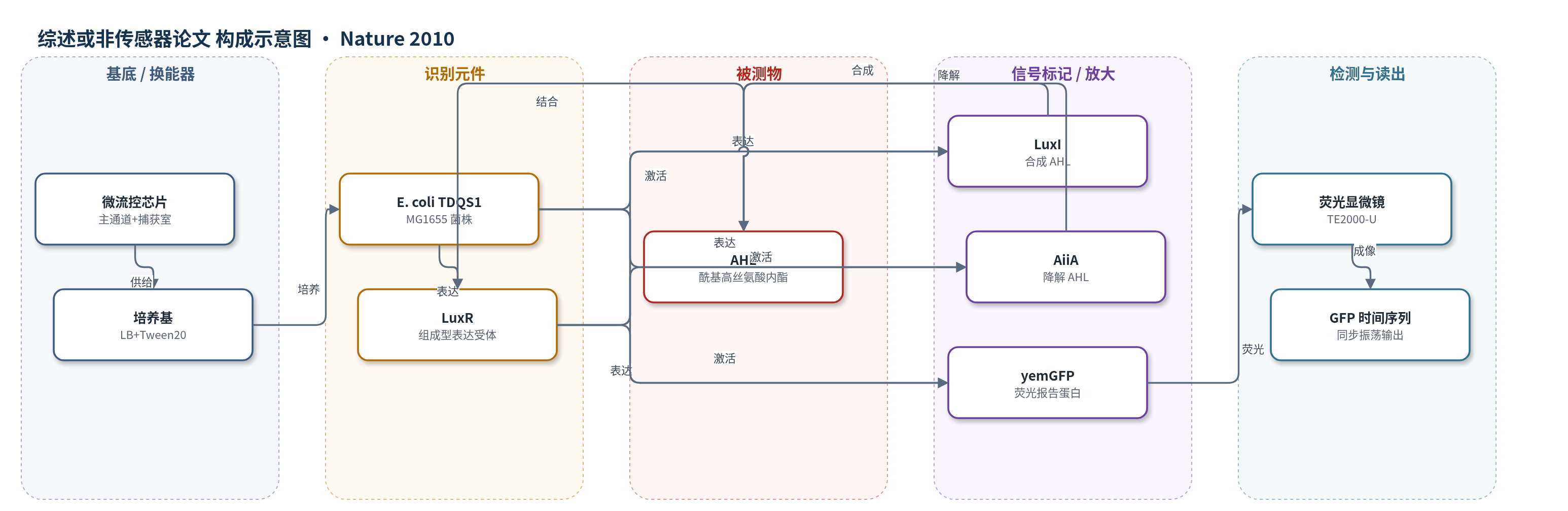
点击图片查看大图 · 依据论文自动绘制
传感器类型
综述或非传感器论文
检测对象
未报道明确外部被测物;内部耦合分子:AHL(acyl-homoserine lactone),样品基质:微流控培养基中的 E. coli 群体/菌落。
检测原理
该系统的信号产生不依赖外部分析物,而由基因回路自激振荡与胞间 AHL 耦合共同决定。LuxI 催化合成 AHL,AHL 跨膜扩散并在群体中积累;当 AHL 达到阈值时,LuxR–AHL 复合物激活 luxI 启动子,使 LuxI、AiiA 和 yemGFP 表达爆发。AiiA 随后降解 AHL,使启动子失活,蛋白水平下降,AHL 再次积累,形成 degrade-and-fire 式振荡。由于 AHL 在细胞间扩散,单个细胞的振荡被耦合为群体同步振荡。微流控流速改变 AHL 的稀释和有效降解速率,从而调节振荡周期与振幅;yemGFP 荧光强度作为时间序列读出,反映群体同步状态。
检测灵敏度
未报告 LOD、线性范围、灵敏度斜率或 R^2。
效应效果
实验显示,TDQS1 群体在达到临界密度后出现稳定的同步 GFP 振荡。高流速下平均周期为 90±6 min,平均振幅为 54±6 GFP 任意单位;低流速下周期为 55±6 min,振幅为 30±9 任意单位。流速从 180 到 296 μm/min 扫描时,周期在 52–90 min 范围内变化,且振幅与周期近似成正比。二维单层中观察到自发传播的荧光波,波速约 8–35 μm/min,并出现波碰撞湮灭;三维菌落直径约 100 μm 时出现中心/边缘荧光爆发。延迟微分方程模型能复现周期、振幅、波速和三维爆发现象。论文未报告选择性、抗干扰、RSD 或实际样品回收率,但提出该同步时钟可作为宏观微生物生物传感器和群体协调行为研究模型。
传感器的构成
- 微流控基底:主营养液通道与矩形/扩展捕获室,用于供给培养基、维持 E. coli 单层或三维菌落并控制 AHL 稀释
- 培养介质:LB 培养基、抗生素(Amp/Kan)及 0.075% Tween20,用于细胞接种与生长
- 细胞识别/振荡单元:E. coli MG1655 菌株 TDQS1,携带 pTD103luxI/GFP 与 pTD103aiiA 质粒,表达 luxI、aiiA、yemGFP
- 转录调控模块:luxI 启动子驱动 luxI、aiiA、yemGFP 三个相同转录盒,构成正反馈与负反馈振荡核心
- 胞间耦合识别元件:LuxR 受体与 AHL(acyl-homoserine lactone)结合,激活 luxI 启动子,介导群体同步
- 负调控元件:AiiA 内酯酶,降解 AHL,形成负反馈并决定振荡周期
- 荧光信号与读出:yemGFP 作为报告蛋白,经倒置荧光显微镜(TE2000-U)时间序列成像读取同步振荡
中文摘要
本文报道了一种具有全局胞间耦合的工程化基因网络,可在生长中的大肠杆菌群体中产生同步振荡。作者基于费氏弧菌和苏云金芽孢杆菌的群体感应元件,将 luxI、aiiA 和 yemGFP 三个基因置于相同的 luxI 启动子控制下:LuxI 合成可跨膜扩散的酰基高丝氨酸内酯(AHL),AHL 与组成型表达的 LuxR 结合后激活 luxI 启动子;AiiA 则通过降解 AHL 提供负反馈。利用不同几何尺度的微流控装置,作者维持了单层和三维大肠杆菌菌落,并观察了群体水平同步振荡及毫米尺度时空波。计算模型定量解释了振荡周期和振幅对微流控流速的依赖关系。该同步基因时钟为开发具有振荡输出的宏观微生物生物传感器奠定基础,也为研究菌落层面涌现协调行为提供了模型系统。
英文摘要
The engineering of genetic circuits with predictive functionality in living cells represents a defining focus of the expanding field of synthetic biology. This focus was elegantly set in motion a decade ago with the design and construction of a genetic toggle switch and an oscillator, with subsequent highlights that have included circuits capable of pattern generation, noise shaping, edge detection and event counting. Here we describe an engineered gene network with global intercellular coupling that is capable of generating synchronized oscillations in a growing population of cells. Using microfluidic devices tailored for cellular populations at differing length scales, we investigate the collective synchronization properties along with spatiotemporal waves occurring at millimetre scales. We use computational modelling to describe quantitatively the observed dependence of the period and amplitude of the bulk oscillations on the flow rate. The synchronized genetic clock sets the stage for the use of microbes in the creation of a macroscopic biosensor with an oscillatory output. Furthermore, it provides a specific model system for the generation of a mechanistic description of emergent coordinated behaviour at the colony level.