组成图示
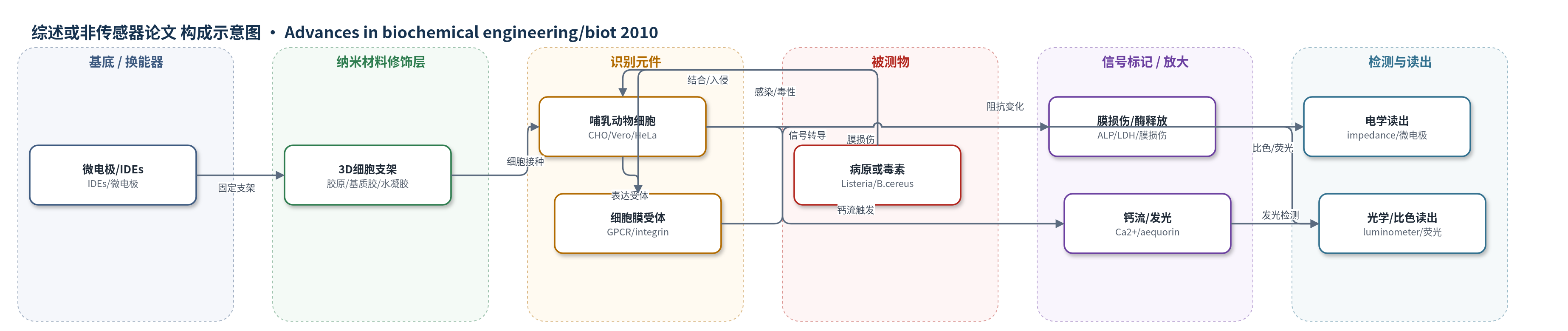
点击图片查看大图 · 依据论文自动绘制
传感器类型
综述或非传感器论文
检测对象
病原菌(沙门氏菌 Salmonella、大肠杆菌 E. coli、志贺氏菌 Shigella、弯曲杆菌 Campylobacter、耶尔森菌 Yersinia、弧菌 Vibrio、单核细胞增生李斯特菌 Listeria monocytogenes、蜡样芽孢杆菌 Bacillus cereus)、毒素(李斯特菌溶素O LLO、B. cereus毒素、组胺 histamine)、重金属(汞 Hg、铅 Pb、镉 Cd);样品基质:食品、临床、环境样品。
检测原理
细胞基传感器以活细胞或细胞组分作为识别元件。病原菌、毒素或毒物进入食品、临床或环境样品后,与细胞膜受体、黏附分子或细胞表面抗体结合,或直接侵入细胞,引起受体构象变化、离子通道开放、胞内钙流、信号级联、代谢改变或膜损伤。电学平台将细胞膜视为电容,细胞铺展、贴附、运动或屏障功能改变会改变微电极/IDEs阻抗,或使微电极记录到动作电位与离子流;光学平台则利用膜损伤染料、释放的ALP/LDH、MTT/WST-1显色或钙响应aequorin发光。被测物活性浓度越高,酶释放量、发光强度、荧光或阻抗变化越大,从而实现功能检测。
检测灵敏度
—
效应效果
作者强调CBB可提供功能信息,区分活病原/活性毒素与死菌/失活毒素,弥补核酸或免疫方法仅识别分子特征的不足。Ped-2E9杂交瘤B细胞受李斯特菌或蜡样芽孢杆菌感染/毒素作用后释放ALP,可在1–6 h内比色检测,反映毒力。ECIS能实时监测细胞形态、屏障功能、膜电容和运动性;BERA通过膜电位变化检测抗原或病毒结合,已有商业化;CANARY工程化B细胞结合抗原后钙流触发aequorin发光,可检测E. coli O157:H7。综述同时指出特异性、稳健性、稳定性、货架期和成本仍是限制,需3D支架、蛋白酶/细胞周期抑制剂和冻存优化。
传感器的构成
- 基底/换能器:微电极阵列、互指电极结构(IDEs)、LAPS、ISFET、Clark电极,用于记录电位、阻抗、离子或氧信号
- 修饰/培养层:胶原、基质胶(matrigel)、水凝胶(hydrogel)、藻酸盐凝胶(alginate gel)等3D支架,维持细胞生理状态
- 识别元件:哺乳动物细胞(CHO、Vero、HeLa、Caco-2、HUVEC、Ped-2E9杂交瘤B细胞)或细胞膜/受体(GPCR、integrin、E-cadherin、Hsp60)
- 信号标记物:碱性磷酸酶(ALP)、乳酸脱氢酶(LDH)、钙响应发光蛋白(aequorin)、荧光染料(trypan blue、propidium iodide)、MTT/WST-1
- 读出装置:光度计、荧光计、阻抗仪、微电极记录系统,输出发光、荧光、比色或电学信号
中文摘要
利用活细胞或细胞组分构建生物传感器正受到广泛关注,并开辟了功能诊断新领域。所谓哺乳动物细胞基生物传感器(CBB),是指以哺乳动物细胞作为生物识别元件的传感系统。细胞基检测如高通量筛选(HTS)和细胞毒性试验,已成为评估化合物功能或毒性、探测临床、环境或食品样品中病原或产毒物质的重要方法。外部刺激或细胞微环境变化会扰动哺乳动物细胞正常生理活动,使CBB能够筛选、监测并量化分析物诱导的变化。其优势在于可报告活性成分(如活病原或活性毒素)的存在与否。部分系统利用哺乳动物细胞或质膜作为电学电容,通过电导或阻抗测量细胞-细胞及细胞-基底接触;另一些系统通过荧光或发光光学装置检测病原或毒素诱导的凋亡、坏死等细胞病变效应。本章重点综述不同哺乳动物细胞基传感器系统的类型与应用。
英文摘要
Use of living cells or cellular components in biosensors is receiving increased attention and opens a whole new area of functional diagnostics. The term "mammalian cell-based biosensor" is designated to biosensors utilizing mammalian cells as the biorecognition element. Cell-based assays, such as high-throughput screening (HTS) or cytotoxicity testing, have already emerged as dependable and promising approaches to measure the functionality or toxicity of a compound (in case of HTS); or to probe the presence of pathogenic or toxigenic entities in clinical, environmental, or food samples. External stimuli or changes in cellular microenvironment sometimes perturb the "normal" physiological activities of mammalian cells, thus allowing CBBs to screen, monitor, and measure the analyte-induced changes. The advantage of CBBs is that they can report the presence or absence of active components, such as live pathogens or active toxins. In some cases, mammalian cells or plasma membranes are used as electrical capacitors and cell-cell and cell-substrate contact is measured via conductivity or electrical impedance. In addition, cytopathogenicity or cytotoxicity induced by pathogens or toxins resulting in apoptosis or necrosis could be measured via optical devices using fluorescence or luminescence. This chapter focuses mainly on the type and applications of different mammalian cell-based sensor systems.