组成图示
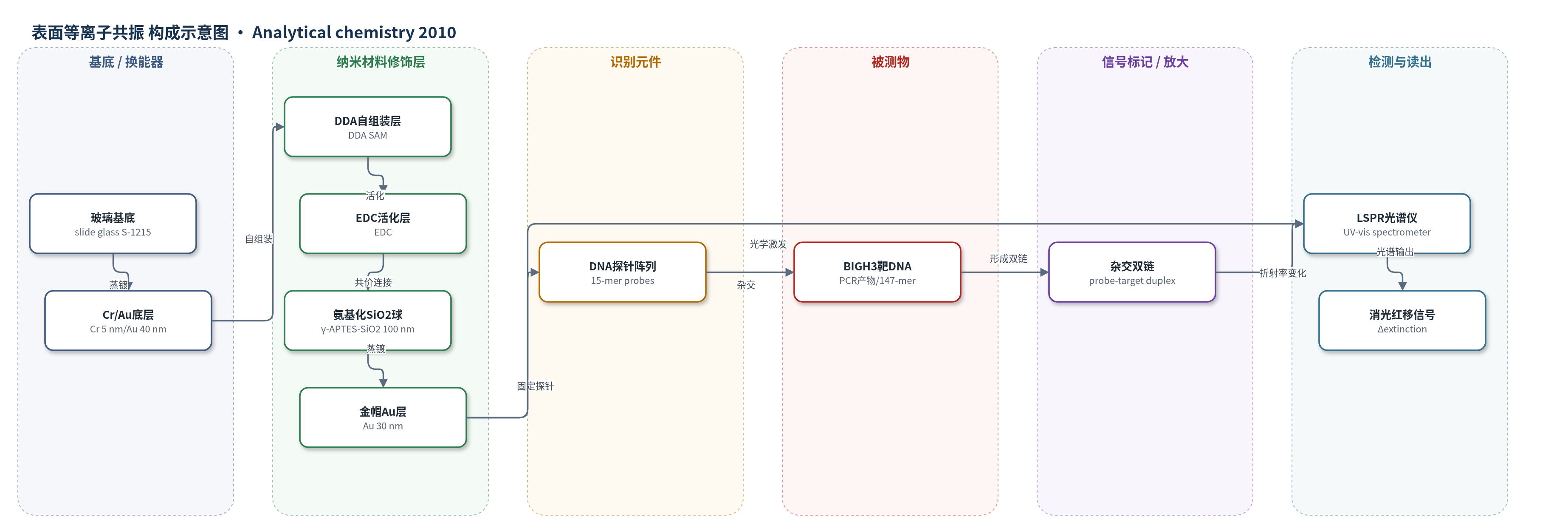
点击图片查看大图 · 依据论文自动绘制
传感器类型
表面等离子共振(SPR)生物传感器
检测对象
BIGH3 基因外显子4点突变靶DNA(ACD/RBCD/LCD);样品基质:外周血基因组DNA的PCR扩增产物(杂交缓冲液)
检测原理
芯片表面固定 15-mer DNA 探针,分别对应正常、ACD、RBCD 和 LCD 的 BIGH3 外显子 4 序列。加入含突变或正常序列的靶 DNA 后,互补探针与靶 DNA 杂交形成双链,使金帽纳米颗粒表面附近生物分子层厚度增加,局部折射率升高。该界面变化改变金帽纳米颗粒的 LSPR 消光峰波长和强度,通常表现为峰位红移和消光增强。信号大小随靶 DNA 浓度增加而增大,在 1 pM–1 µM 范围内线性。系统无需荧光或酶标记,依靠 DNA 杂交引起的折射率变化直接光学读出;短探针结合严格杂交条件可区分单碱基错配,实现点突变选择性检测。
检测灵敏度
LOD: 1 pM;线性范围: 1 pM–1 µM;测量范围: 1 fM–1 µM
效应效果
该芯片在 1 pM–1 µM 范围内对四种 BIGH3 靶 DNA 呈线性响应,三片芯片重复测量消光强度标准偏差小于 10%,显示芯片制备均匀、响应可重复。通过 15-mer 探针和严格杂交条件,可区分单碱基错配;纯合突变样品仅在完全匹配探针点出现最强消光增强,杂合患者 PCR 样品在正常与对应突变探针点同时出现信号,且强度约为纯合完全匹配的一半,实现 ACD、RBCD、LCD 基因型诊断。作者认为该平台无需标记、步骤简单、成本低、可多路检测,适用于 LASIK 术前角膜营养不良筛查及其他遗传病点突变诊断。
传感器的构成
- 基底:载玻片玻璃(slide glass, S-1215),经丙酮、乙醇和超纯水超声清洗,提供平整支撑表面。
- 底层金属:Cr 5 nm 粘附层与 Au 40 nm 底层,电子束蒸发沉积,提供金属基底并增强附着。
- 自组装单分子层:4,4'-二硫代二丁酸(DDA)在金表面形成 SAM,提供羧基官能团。
- 交联活化层:1-乙基-3-[3-(二甲氨基)丙基]碳二亚胺(EDC)活化 DDA 羧基,与氨基化纳米颗粒或探针形成酰胺键。
- 纳米颗粒修饰层:100 nm 二氧化硅纳米球(SiO2),表面用 γ-氨基丙基三乙氧基硅烷(γ-APTES)氨基化,自组装形成阵列。
- 金帽层:Au 30 nm 蒸镀于纳米颗粒表面,形成金帽纳米颗粒阵列并产生 LSPR 光学响应。
- 识别元件:15-mer DNA 探针(4-CGC、4-CAC、4-CTC、4-TGC),3'端氨基修饰,通过 DDA/EDC 酰胺键固定,分别识别正常、ACD、RBCD 和 LCD 序列。
中文摘要
局部表面等离子体共振(LSPR)光学性质已用于纳米尺度蛋白相互作用的定量检测,但在 DNA 点突变诊断中应用不足。BIGH3 基因点突变导致最常见的角膜营养不良,包括 Avellino 角膜营养不良(ACD)、Reis-Bucklers 角膜营养不良(RBCD)和网格状角膜营养不良(LCD)。LASIK 术前检测这些疾病对防止失明至关重要。本研究报道基于 LSPR 的多斑点金帽纳米颗粒阵列(MG-NPA)芯片检测 BIGH3 基因突变。通过测量 1 fM 至 1 µM 各靶 DNA,确定分析范围与灵敏度。最优条件下,靶 DNA 杂交检测限为 1 pM,并在 1 pM 至 1 µM 范围内线性响应。利用纯合和杂合角膜营养不良样品,实现单碱基错配序列的选择性区分。结果表明,无标记 LSPR 光学生物传感器系统可为多种 DNA 点突变提供选择性、高灵敏诊断平台,有助于角膜营养不良等遗传病诊断。
英文摘要
The localized surface plasmon resonance (LSPR) optical property has recently been well employed as an effective platform for the quantitative detection of protein-protein interactions on the nanoscale. However, its advantage has not been fully explored yet in the DNA diagnosis field, especially in detecting point mutations of DNA. Point mutations of the BIGH3 gene are associated with the most common corneal dystrophies (CDs), such as Avellino corneal dystrophy, Reis-Bucklers corneal dystrophy, and lattice corneal dystrophy. Since the detection of these corneal dystrophies is urgently needed before laser-assisted in situ keratomileusis operation to prevent blindness, genetic analysis of the BIGH3 gene is critical in most ophthalmological clinics. In this study, we report LSPR-based detection of the BIGH3 gene mutations by using a multispot gold-capped nanoparticle array (MG-NPA) chip. The analytical range and sensitivity of the MG-NPA chip were determined by measuring different concentrations of each CD target DNA in the range of 1 fM to 1 microM. Under the optimal conditions, the detection of DNA hybridization with each CD target DNA was performed with a detection limit of 1 pM target DNA. The selective discrimination against a single-base mismatch DNA sequence was also achieved by using both homozygous and heterozygous CD samples. It demonstrates that the label-free LSPR-based optical biosensor system employing the MG-NPA chip provides a new diagnostic platform allowing the selective and sensitive detection of various DNA point mutations, leading to possible diagnosis of mutation-related diseases including corneal dystrophies reported here.