组成图示
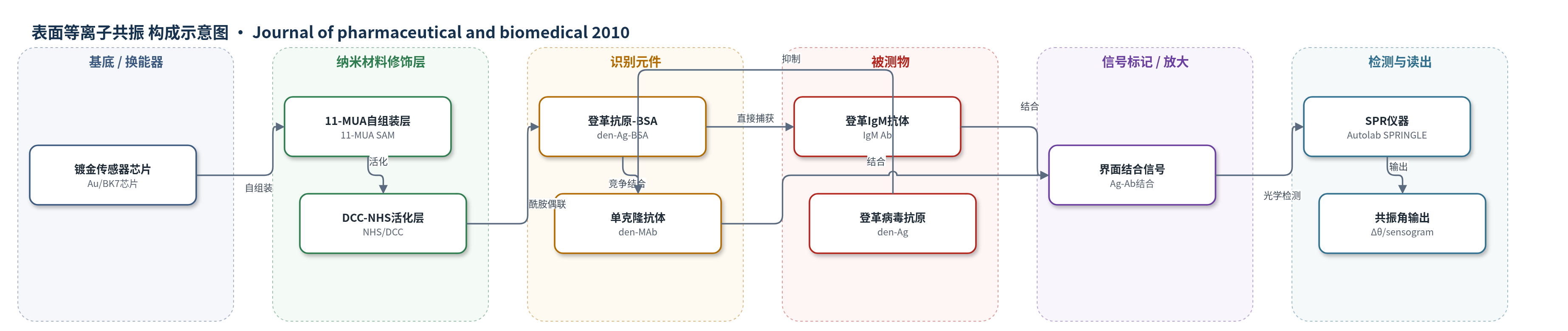
点击图片查看大图 · 依据论文自动绘制
传感器类型
表面等离子共振(SPR)生物传感器
检测对象
登革病毒特异性IgM抗体(dengue virus specific IgM antibodies, IgM Ab)、登革病毒抗原(dengue virus antigen, den-Ag);样品基质:人血清/血浆/脑脊液(serum/plasma/CSF)、蚊子头匀浆(mosquito head squash)
检测原理
该传感器采用无标记SPR免疫检测。金芯片上11-MUA自组装单分子层经DCC/NHS活化后,与登革抗原-BSA偶联物形成酰胺键,构成固定识别层。直接法中,样品血清中的登革病毒特异性IgM抗体与表面抗原结合,结合质量增加使界面局部折射率升高,SPR共振角发生正偏移;抗体浓度越高,共振角增加越大。竞争法中,游离登革病毒抗原先与单克隆抗体den-MAb孵育,再注入传感器,游离抗原占据抗体结合位点,抑制其与表面抗原-BSA结合,抗原浓度越高,共振角增加越小。仪器通过监测反射光强度极小值随时间变化获得传感图,实现实时定量。BSA偶联提高抗原固定稳定性,竞争抑制增强抗原检测能力。
检测灵敏度
线性范围: 10–100% of strong positive control serum;回归方程: y = 5.74 ± 0.14x + 25.00 ± 7.94 (n = 12, p < 0.0001, R = 0.9970);阳性判据: SPR angle shift of at least 50 m°
效应效果
该传感器对阴性血清无明显共振角升高,显示良好特异性。与MAC-ELISA比较,SPR灵敏度更高;ELISA阳性判据为吸光度>0.174 OD(2.1×阴性OD),SPR阳性判据为共振角偏移≥50 m°。50%阳性对照血清在直接法中产生305 m°净升高,1:100稀释的den-MAb与表面抗原-BSA结合产生241 m°升高。经胃蛋白酶再生后,传感器表面在约30个测量循环中保持稳定,免疫反应无显著变化。AFM显示固定层均匀、致密。作者认为该方法简单、经济、无标记、实时,可用于登革热临床诊断和蚊虫监测。
传感器的构成
- 基底/换能器:BK7玻璃镀金传感器芯片(Au sensor chip),提供SPR换能表面和硫醇自组装位点
- 自组装单分子层:11-巯基十一烷酸(11-MUA)SAM,在金表面形成有序羧基功能层
- 活化层:N-羟基丁二酰亚胺(NHS)与N,N'-二环己基碳二亚胺(DCC)原位活化11-MUA羧基,形成活性酯
- 识别元件:登革病毒抗原-牛血清白蛋白(dengue antigen–BSA)共价偶联,作为传感元件捕获IgM抗体或用于竞争抑制检测抗原
- 封闭剂:乙醇胺(EA)1 M水溶液(pH 8),封闭未反应活性酯,减少非特异结合
- 竞争识别元件:生物素化黄病毒交叉反应单克隆抗体(den-MAb),用于间接竞争抑制法检测登革病毒抗原
- 再生剂:胃蛋白酶(pepsin)甘氨酸-HCl缓冲液(摘要pH 2.2,实验pH 2),洗脱结合物并恢复传感表面
- 载液/清洗介质:磷酸盐缓冲液(PBS,pH 7.2),维持流动、清洗和免疫反应环境
中文摘要
表面等离子共振(SPR)是生物医学传感技术中有前景的工具。本研究建立了一种基于SPR的免疫传感器,用于登革病毒感染的无标记、实时血清学诊断,以登革病毒抗原作为传感元件。登革病毒抗原与牛血清白蛋白(BSA)偶联后,通过11-巯基十一烷酸(11-MUA)活化自组装单分子层(SAM)以酰胺键共价固定于金传感器芯片上,并用原子力显微镜(AFM)表征表面形貌。直接免疫法中,登革阳性血清内登革病毒特异性IgM抗体与固定抗原结合,引起共振角升高;间接竞争抑制免疫法则用于早期检测登革病毒抗原。结果与MAC-ELISA比较,显示SPR灵敏度更高。传感器表面可用甘氨酸-HCl缓冲液(pH 2.2)中的胃蛋白酶再生,并在重复免疫反应循环中保持高稳定性。该传感器简单、有效,基于天然抗原-抗体亲和力,为登革热和登革出血热的临床诊断生物传感器开发提供了良好前景。
英文摘要
Surface plasmon resonance (SPR) is a promising tool in sensor technology for biomedical applications. An SPR based immunosensor was established for label free and real time assay for the serological diagnosis of dengue virus infection employing the dengue virus antigen as the sensing element. The dengue virus antigen conjugated with bovine serum albumin is covalently immobilized on a gold sensor chip via activated self-assembled monolayer (SAM) of 11-mercaptoundecanoic acid, by amide coupling. Surface morphology of the biosensor was recorded using atomic force microscopy. Presence of dengue virus specific IgM antibodies in dengue positive sera was monitored by increase in resonance angle in direct immunoassay, whereas the principle of indirect competitive inhibition immunoassay was used to detect presence of dengue virus for early detection of the onset of dengue viral infection in clinical diagnostics. Results were compared with those obtained by MAC-ELISA. The regeneration was achieved by pepsin solution in glycin-HCl buffer (pH 2.2) and sensor surface displayed a high level of stability during repeated immunoreaction cycles. The proposed biosensor being simple, effective and based on utilization of natural antigen-antibody affinity, our study presents an encouraging scope for development of biosensors for diagnosis of dengue and dengue hemorrhagic fever (DHF) which continues to be a major health problem in the tropical and subtropical regions of world.