组成图示
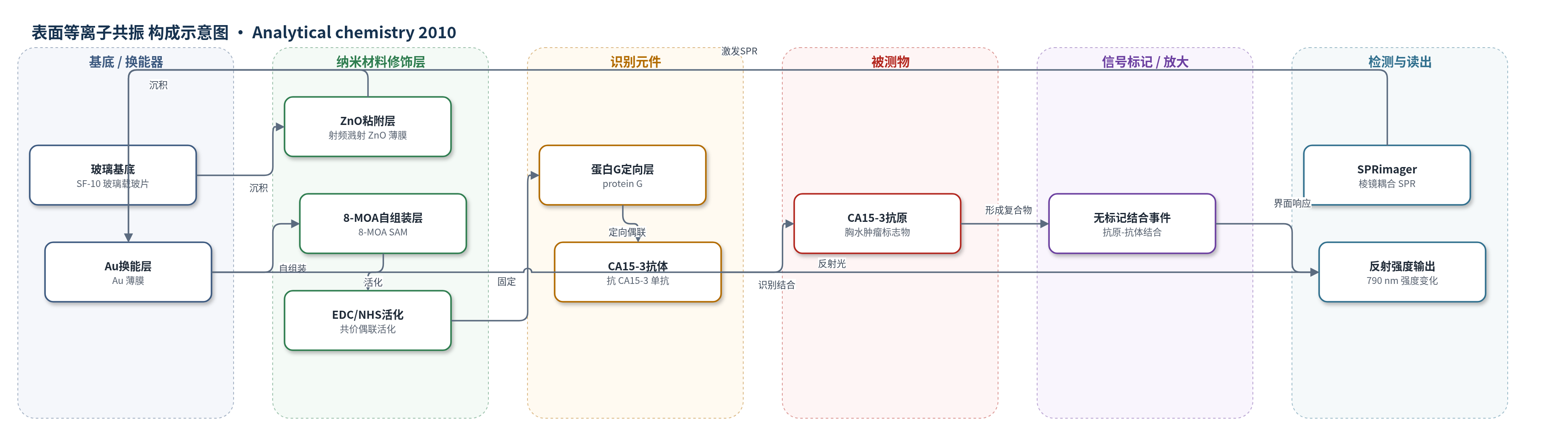
点击图片查看大图 · 依据论文自动绘制
传感器类型
表面等离子共振(SPR)生物传感器
检测对象
糖类抗原15-3(CA15-3,Carbohydrate Antigen 15-3);样品基质:乳腺癌患者胸水(pleural fluid)及 PBS 稀释标准液
检测原理
传感器以玻璃为基底,依次构建 ZnO 粘附层和 Au 换能层。Au 表面先形成 8-MOA 自组装单分子层,经 EDC/NHS 活化后,通过蛋白 G 将抗 CA15-3 单克隆抗体定向偶联,并用 BSA 封闭。当胸水样品中的 CA15-3 抗原流过传感表面时,抗原与抗体发生特异性结合,使 Au 表面附近的质量与折射率发生变化,从而改变表面等离子共振条件。SPRimager 在 790 nm 下实时监测反射光强度,结合量随抗原浓度增加而增加,信号在 40 U/mL 后趋于饱和。Au/ZnO 结构具有更窄的半峰宽和更大的角度偏移,因此相比 Au/Cr 可获得更强 SPR 响应。该方法为无标记检测,未使用额外信号放大策略。
检测灵敏度
LOD: 0.025 U/mL(信噪比 3:1);线性范围: 1–40 U/mL;R^2 = 0.991;全范围拟合 R^2 = 0.979
效应效果
与 Au/Cr 相比,Au/ZnO 在 40 和 5 U/mL 时 SPR 强度变化至少提高 2 倍,0.1 U/mL 时提高 3 倍,检出限由 0.1 降至 0.025 U/mL,约低 4 倍。AFM 粗糙度分别为 0.27 和 0.26 nm,差异小于 0.2 nm,排除粗糙度主导。实验三次重复,误差棒为标准偏差。胸水与标准样品在 40、20、5、1、0.025 U/mL 下线性相关,斜率 1.754,R^2=0.994,非特异结合和交叉反应干扰不明显。LOD 低于成像椭偏术(1 U/mL)和扫描电化学显微镜(2.5 U/mL),与 CE-EIA-ED(0.025 U/mL)相当,且比其 1 h 孵育更快,适合肿瘤标志物快速检测。
传感器的构成
- 基底:玻璃显微镜载玻片(SF-10,Schott Glass),作为支撑基底并承载薄膜结构
- 粘附层:氧化锌(ZnO)薄膜,通过射频溅射沉积,增强金膜与玻璃结合并改善光学性能
- 换能层:金(Au)薄膜,作为 SPR 换能层并激发表面等离子共振
- 自组装层:8-巯基辛酸(8-MOA)自组装单分子层(SAM),提供羧基用于后续共价偶联
- 活化层:EDC/NHS 活化体系,活化羧基以形成共价键
- 识别元件:蛋白 G(protein G)与抗 CA15-3 单克隆抗体,定向固定抗体并特异性识别抗原
- 封闭层:1% 牛血清白蛋白(BSA),封闭非特异性结合位点
中文摘要
本文报道了金/氧化锌(Au/ZnO)纳米复合薄膜用于增强表面等离子共振(SPR)检测肿瘤标志物的性能。以乳腺癌肿瘤标志物糖类抗原15-3(CA15-3)为模型分析物,在乳腺癌患者胸水样品中分析不同浓度(0.0125–160 U/mL)的强度响应,评估基于 Au/ZnO 薄膜的 SPR 生物传感器检测能力。结果显示,CA15-3 的线性范围为 1–40 U/mL,相关系数 R^2 = 0.991,在信噪比 3:1 条件下检出限达 0.025 U/mL。与抗体-抗原特异性结合引起的 SPR 强度偏移相比,Au/ZnO 层的强度变化至少比金/铬(Au/Cr)层提高 2 倍;Au/ZnO 层的检出限比广泛用作 SPR 传感界面的 Au/Cr 层低约 4 倍。结果表明,Au/ZnO 薄膜可显著提高该双分子相互作用的 SPR 信号产率,并表现出高灵敏度,可用于肿瘤标志物检测。
英文摘要
We report that gold/zinc oxide (Au/ZnO) nanocomposite films were effectively employed to enhance the performance of surface plasmon resonance (SPR) for the detection of tumor markers. Carbohydrate antigen 15.3 (CA15-3), a tumor marker for breast cancer, was chosen as a model analyte. We analyzed intensity response to the samples at various concentrations (0.0125 U/mL to 160 U/mL) in pleural fluid to evaluate the detection capability of the SPR biosensor based on Au/ZnO thin films. The linear range extended from 1 to 40 U/mL with a correlation coefficient of R(2) = 0.991 and a limit of detection reaching 0.025 U/mL at a signal-to-noise ratio of 3:1. Compared with the degree of the shift in SPR intensity induced by the specific binding event between antibody and antigen, the change of intensity on the Au/ZnO layers was increased by at least 2 fold over that on the gold/chromium (Au/Cr) layers. In addition, we determined that the Au/ZnO layers allowed for a detection limit 4 times lower than the Au/Cr layers, which are in widespread use as the sensing interfaces in current SPR-based detectors. In conclusion, the use of Au/ZnO films greatly enhanced the SPR signal yield for this bimolecular interaction and showed high sensitivity.