组成图示
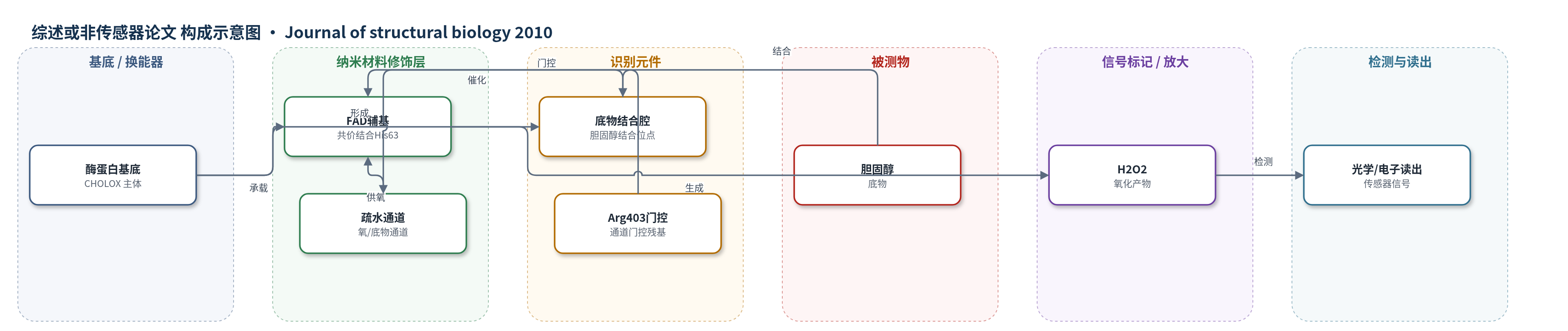
点击图片查看大图 · 依据论文自动绘制
传感器类型
综述或非传感器论文
检测对象
胆固醇(cholesterol);样品基质:临床样本、血清、食品(引言提及)
检测原理
本文未构建具体传感器,但所述胆固醇氧化酶的传感原理为:胆固醇进入酶的大底物腔,与活性中心结合;共价 FAD 辅基介导胆固醇氧化,生成 H2O2 及胆甾烯酮类产物。H2O2 的量与样品中胆固醇浓度成正比,可被光学或电子换能器读取。结构上,疏水通道将底物腔与蛋白表面连通,Arg403/Glu401 等残基形成门控,影响氧分子进入活性中心;CHOLOX 的较大空腔、较少表面电荷和表面残基替换有助于在有机溶剂、去垢剂及高温下维持构象与催化活性,从而支持稳定信号输出。
检测灵敏度
原文未报告传感器检出限、线性范围、灵敏度斜率或相关系数。
效应效果
本文未评价传感器选择性、抗干扰、重现性或实际样品回收率,也未与 ELISA/HPLC/qPCR 等检测方法直接对比。主要性能为酶稳定性:CHOLOX 在有机溶剂和去垢剂中保持活性,85 °C 孵育后仍保留约 80% 活性,显著优于 B. sterolicum 胆固醇氧化酶(BCO)约 50 °C 的稳定性和易被异丙醇、Triton X-405 失活的特性。结构比较显示 CHOLOX 整体空腔体积为 615.4 ų,BCO 为 564.2 ų;3.2 Å 截距下盐桥数为 19,BCO 为 23。作者认为表面残基替换和电荷分布优化是其稳定性的关键,提示可用于高稳定性胆固醇传感酶设计。
传感器的构成
- 识别元件:胆固醇氧化酶(CHOLOX,Chromobacterium sp. DS-1);催化胆固醇氧化,是胆固醇生物传感器中常用识别/催化元件
- 辅因子:FAD(黄素腺嘌呤二核苷酸);共价结合于 His63,参与氧化还原催化并生成 H2O2
- 结构通道:疏水通道与 Arg403/Glu401 门控残基;连接底物腔与蛋白表面,影响氧/底物可及性与溶剂稳定性
中文摘要
胆固醇氧化酶因广泛用于临床样本、血清和食品中胆固醇的生物传感器检测而具有重要商业价值。提高该酶对温度及不同溶剂条件的稳定性,对提升其应用可靠性与适用性至关重要。本文报道了来自 Chromobacterium sp. DS-1 的胆固醇氧化酶(CHOLOX)的晶体结构。与以往已表征的胆固醇氧化酶不同,该酶尽管来源于中温菌,仍能在有机溶剂和去垢剂存在下、85 °C 以上保持较高活性。借助另一已知三维结构的同源氧化酶,作者对其序列和结构进行了详细比较,以阐明其稳定化机制。与通常赋予嗜热蛋白稳定性的因素相反,CHOLOX 结构表现出更大的整体空腔体积、更少的带电残基以及更少的盐桥相互作用。此外,绝大多数残基替换位于或靠近蛋白溶剂暴露表面。作者据此提出,增强蛋白稳定性也可通过选择性改造蛋白外围区域实现,而不必重新设计整个蛋白核心。
英文摘要
Cholesterol oxidase is of significant commercial interest as it is widely used as a biosensor for the detection of cholesterol in clinical samples, blood serum and food. Increased stability of this enzyme with regards to temperature and different solvent conditions are of great importance to the reliability and versatility of its applications. We here report the crystal structure of the cholesterol oxidase of Chromobacterium sp. DS-1 (CHOLOX). In contrast to other previously characterized cholesterol oxidases, this enzyme retains high activity in organic solvents and detergents at temperatures above 85 degrees C despite its mesophilic origin. With the availability of one other homologous oxidase of known three-dimensional structure, a detailed comparison of its sequence and structure was performed to elucidate the mechanisms of stabilization. In contrast to factors that typically contribute to the stability of thermophilic proteins, the structure of CHOLOX exhibits a larger overall cavity volume, less charged residues and less salt bridge interactions. Moreover, the vast majority of residue substitutions were found on or near the protein's solvent exposed surface. We propose that the engineering of enhanced stability may also be accomplished through selective engineering of the protein periphery rather than by redesigning its entire core.