组成图示
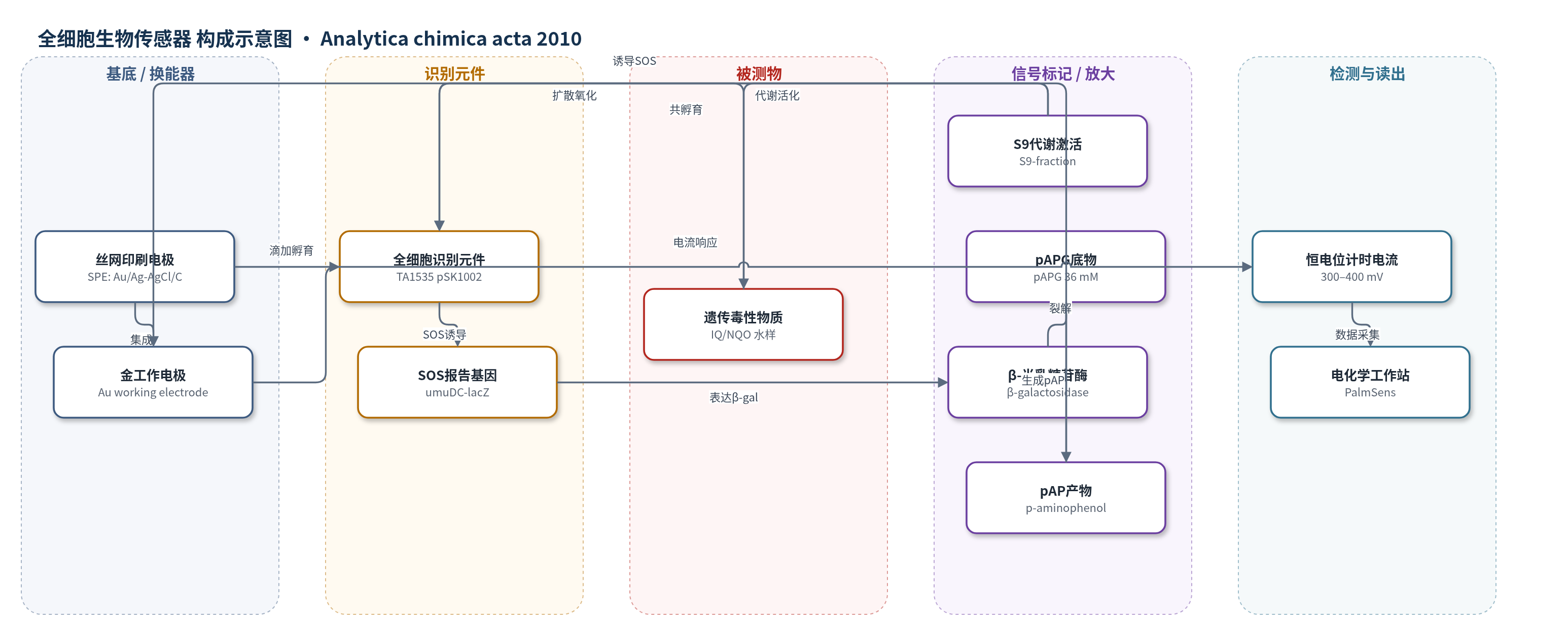
点击图片查看大图 · 依据论文自动绘制
传感器类型
全细胞生物传感器
检测对象
遗传毒性化合物(genotoxic compounds,标准品 IQ 2-amino-3-methylimidazo[4,5-f]quinoline、NQO 4-nitroquinoline-1-oxide);样品基质为水/废水/环境水样(文中以含 2% Me2SO 的双蒸水模拟)。
检测原理
遗传毒性物质进入沙门氏菌 TA1535 pSK1002 后造成 DNA 损伤,激活细菌 SOS 响应,使 umuDC-lacZ 融合基因表达 β-半乳糖苷酶;前遗传毒性物质可先经 S9 肝微粒体酶体系代谢活化。β-半乳糖苷酶裂解加入的底物 pAPG,生成对氨基苯酚 pAP。pAP 扩散至金工作电极,在 300–400 mV 恒电位下被氧化为对亚胺醌,产生计时电流。电流斜率 dI/dt 与 β-半乳糖苷酶活性及 SOS 诱导因子相关,因此随遗传毒性物质浓度增加而增大。该策略利用基因表达和酶催化实现信号放大,并通过选择 300–400 mV 电位窗口避免 S9 体系中电活性物质干扰。
检测灵敏度
LOD: 1.183(SOS-induction,400 mV);LOQ: 1.61(SOS-induction,400 mV);LOD: 1.39(SOS-induction,300 mV);LOQ: 2.3(SOS-induction,300 mV);斜率 a: 0.740(400 mV)、0.610(300 mV);R^2: 0.9997(400 mV)、0.9990(300 mV)
效应效果
该法与 ISO 比色法呈高相关:400 mV 时 r2=0.9997、斜率 0.740,300 mV 时 r2=0.9990、斜率 0.610。负对照标准偏差分别为 0.061(400 mV)、0.13(300 mV)和 0.051(比色法),400 mV 噪声与比色法相当,LOD/LOQ 为 1.183/1.61,满足 ISO 对低遗传毒性阈值(SOS 诱导因子<1.5)的质量要求;300 mV 的 LOQ 2.3 不满足。S9 代谢激活体系中的电活性物质不干扰,阴性对照菌株无 pAP 信号,显示特异性。未报告实际环境样品回收率,但作者认为其可微型化、与比色法互补,用于环境水样遗传毒性现场评估。
传感器的构成
- 换能器电极:丝网印刷电极(SPE),工作电极为金(Au),参比电极为 Ag/AgCl,对电极为碳石墨(carbon graphite),用于施加 300–400 mV 并采集计时电流。
- 识别元件:沙门氏菌 TA1535 pSK1002 全细胞(S. typhimurium TA1535 pSK1002),携带 pSK1002 质粒,含 SOS 响应 umuDC-lacZ 融合基因,受遗传毒性物质诱导表达 β-半乳糖苷酶(β-galactosidase)。
- 代谢激活系统:S9 肝微粒体酶组分(S9-fraction)及辅因子(NADP、葡萄糖-6-磷酸、KCl、MgCl2),用于将前遗传毒性物质生物活化。
- 信号底物:对氨基苯基-β-D-吡喃半乳糖苷(pAPG),被 β-galactosidase 裂解生成对氨基苯酚(pAP)。
- 电化学信号产物:对氨基苯酚(pAP)在 Au 工作电极上氧化为对亚胺醌(p-iminoquinone),产生随时间增加的电流。
- 反应介质:TGA 培养基(tryptone-glucose-HEPES)及氨苄西林(ampicillin),用于细菌复苏、培养与质粒选择。
中文摘要
电化学信号检测易于集成到生物传感器中,是光学检测方法的有吸引力替代方案。在环境化学与生态毒理学领域,基于全细胞生物传感器、可脱离实验室使用的遗传毒性化合物检测设备需求日益增加。由于环境中普遍存在需要生物活化的前遗传毒性化合物,将代谢激活系统整合到此类生物传感器中尤为重要。本研究评估了一种计时电流检测法,其中对氨基苯基-β-D-吡喃半乳糖苷(pAPG)作为基于细菌 SOS 响应的报告基因试验底物,并与按国际标准化组织(ISO)标准进行的水中遗传毒性测定系统进行比较。评估旨在分析电化学信号检测作为标准试验系统互补方法的潜力,从而评价电化学生物传感器用于环境样品遗传毒性评估的可用性。结果表明,即使在用于污染物外部生物活化的酶体系所产生的电活性物质存在下,对氨基苯酚的计时电流检测仍具有特异性;在优化条件下,电化学检测具有足够灵敏度,其检出限与相应 ISO 标准相当。
英文摘要
Electrochemical signal detection can be readily integrated in biosensors and is thus an attractive alternative to optical detection methods. In the field of environmental chemistry and ecotoxicology there is a growing demand for lab-independent devices based on whole cell biosensors for the detection of genotoxic compounds. Because of the broad occurrence of pre-genotoxic compounds that need to be bio-activated, the integration of a system for metabolic activation into such a biosensor is important. The present study evaluates a chrono-amperometric detection method in which para-aminophenyl beta-D-galactopyranoside is used as substrate for a reporter gene assay based on the bacterial SOS-response in comparison to a test system for the determination of genotoxicity in water that is standardized according to the International Organization for Standardization (ISO). The evaluation was done in order to analyze the potential of the electrochemical signal detection to be used as a complementary method for the standard test system and thus to evaluate the usability of electrochemical biosensors for the assessment of genotoxicity of environmental samples. In the present study it is shown that the chrono-amperometric detection of para-aminophenol is specific even in the presence of electro-active species generated by the enzymatic system used for the external bio-activation of contaminants. Under optimized conditions electrochemistry is sufficiently sensitive with a limit of detection that is comparable to the respective ISO-standard.