组成图示
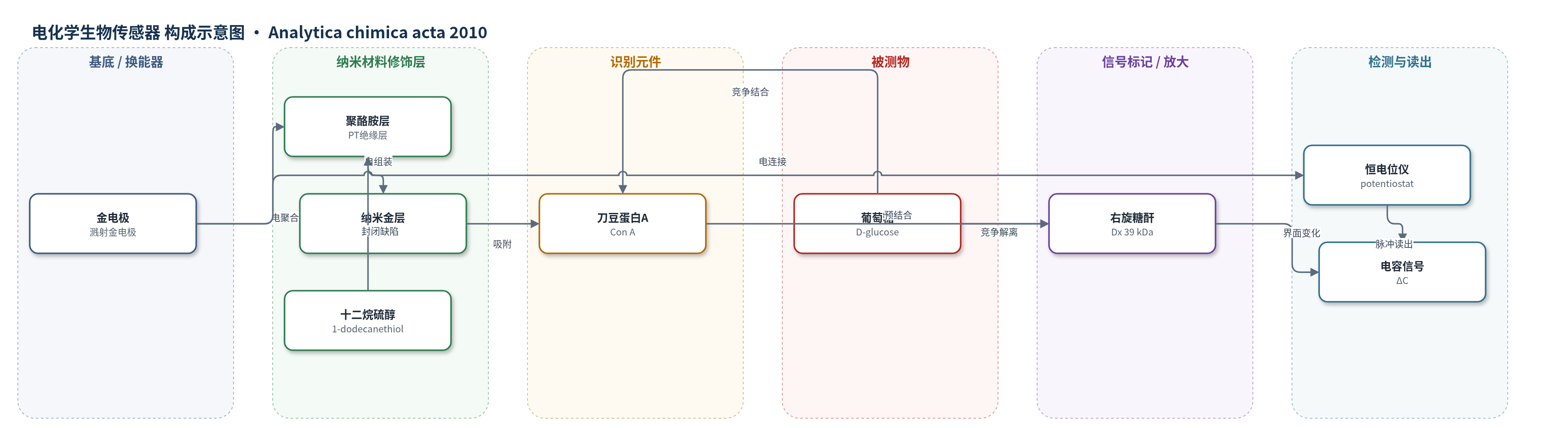
点击图片查看大图 · 依据论文自动绘制
传感器类型
电化学生物传感器
检测对象
葡萄糖(D-glucose);样品基质为含CaCl2、MgCl2、MnCl2的Tris-HCl缓冲液,文中面向细胞培养与微生物发酵等低葡萄糖体系。
检测原理
传感器以聚酪胺修饰金电极为电容换能器,纳米金上吸附刀豆蛋白A(Con A)。检测前注入39 kDa右旋糖酐(Dx)使其与Con A结合,增加电极表面绝缘/生物识别层厚度,使双电层电容下降。加入葡萄糖后,葡萄糖与Dx竞争结合Con A的糖配体位点,Dx从界面解离,绝缘层厚度减小,双电层位移,电容回升。通过恒电位仪施加+50 mV脉冲,记录电流瞬态并按RC模型计算电容,ΔC与葡萄糖浓度对数呈线性。该竞争模式将小分子葡萄糖结合转化为大分子解离引起的界面厚度变化,实现信号放大。
检测灵敏度
LOD: 1.0 × 10⁻⁶ M(0.18 μg mL−1,S/N = 3);线性范围: 1.0 × 10⁻⁶–1.0 × 10⁻² M(0.18 μg mL−1–1.8 mg mL−1);灵敏度斜率: 0.43 nF/log M(y = 0.43x + 3.16);R^2 = 0.985
效应效果
该传感器在测试葡萄糖浓度范围内RSD为1.5%–5.7%;10 mM葡萄糖重复测量10次RSD为7.5%,4个不同电极制备重现性RSD为7.9%。4 ℃ Tris-HCl缓冲液保存1天后保留约70%初始响应,第一周内持续下降;10次重复分析循环后灵敏度损失可忽略。选择性由Con A决定,D-果糖、D-甘露糖、D-麦芽糖、甲基-D-葡萄糖苷和甲基-D-甘露糖苷可部分竞争解离右旋糖酐并产生干扰,但在葡萄糖单独存在或生理条件下影响有限。响应时间约15 min,适合离线分析。作者认为该竞争电容策略可监测细胞培养与微生物发酵中的低浓度葡萄糖,并通过更换聚合物调节动态范围。
传感器的构成
- 基底/换能器电极:溅射金电极(sputtered gold electrode),作为工作电极与电容换能器。
- 绝缘修饰层:聚酪胺(polytyramine, PT)膜,电化学聚合形成,提供绝缘层与反应性氨基。
- 纳米材料修饰层:金纳米胶体/纳米金(nanogold colloids, AuNPs),固定于PT层上,增大表面积并负载Con A。
- 识别元件:刀豆蛋白A(concanavalin A, Con A),吸附于AuNPs表面,识别葡萄糖及葡萄糖聚合物。
- 封闭/缺陷填充层:1-十二烷硫醇(1-dodecanethiol),填充膜缺陷,形成高绝缘电容界面。
- 信号标记/竞争配体:右旋糖酐(dextran, Dx, MW 39 kDa),预先结合Con A,被葡萄糖竞争解离以产生电容变化。
中文摘要
本研究构建了一种高灵敏竞争性电容葡萄糖生物传感器。以金纳米颗粒作为固定刀豆蛋白A(Con A)的平台,金纳米颗粒通过聚酪胺(PT)修饰的金电极固定;聚酪胺层由电化学聚合预先形成。传感机制基于加入葡萄糖后,葡萄糖与预先结合在固定 Con A 糖配体结合位点上的葡萄糖聚合物或糖缀合物发生竞争性解离。为进一步提高响应,筛选了多种葡萄糖聚合物及用高碘酸盐法合成的糖缀合物,最终选择分子量39 kDa的右旋糖酐(dextran)用于竞争性葡萄糖检测。实验结果表明,在优化条件下,传感器对葡萄糖在1.0×10⁻⁶至1.0×10⁻² mol/L范围内呈线性响应,相当于0.18 μg/mL至1.8 mg/mL,检出限为1.0×10−6 mol/L。该传感器响应时间约15 min,经10次重复分析循环后灵敏度损失可忽略。
英文摘要
A highly sensitive competitive capacitive glucose biosensor was constructed based on gold nanoparticles, which were employed as a platform to immobilize concanavalin A (Con A). Gold nanoparticles were fixed on a gold electrode, on which a layer of polytyramine was preformed via electrochemical polymerization. The sensing mechanism is based on the competitive dissociation of a glucose polymer or a glycoconjugate from the glycoligand binding sites of immobilized Con A by the added glucose. To further improve the sensor response, several glucose polymers as well as a synthesized glycoconjugate using the periodate method, were screened. Consequently, dextran (MW 39 kDa) was selected and the feasibility of the proposed biosensor was evaluated for a competitive assay of glucose. Experimental results show that the biosensor responded linearly to glucose in the range from 1.0 x 10(-6) to 1.0 x 10(-2) M, corresponding to 0.18 microg mL(-1) to 1.8 mg mL(-1) of glucose with a detection limit of 1.0 x 10(-6) M under optimized conditions. The studied biosensor exhibited a response time of about 15 min and a neglectable loss in sensitivity after 10 repeated analytical cycles.