组成图示
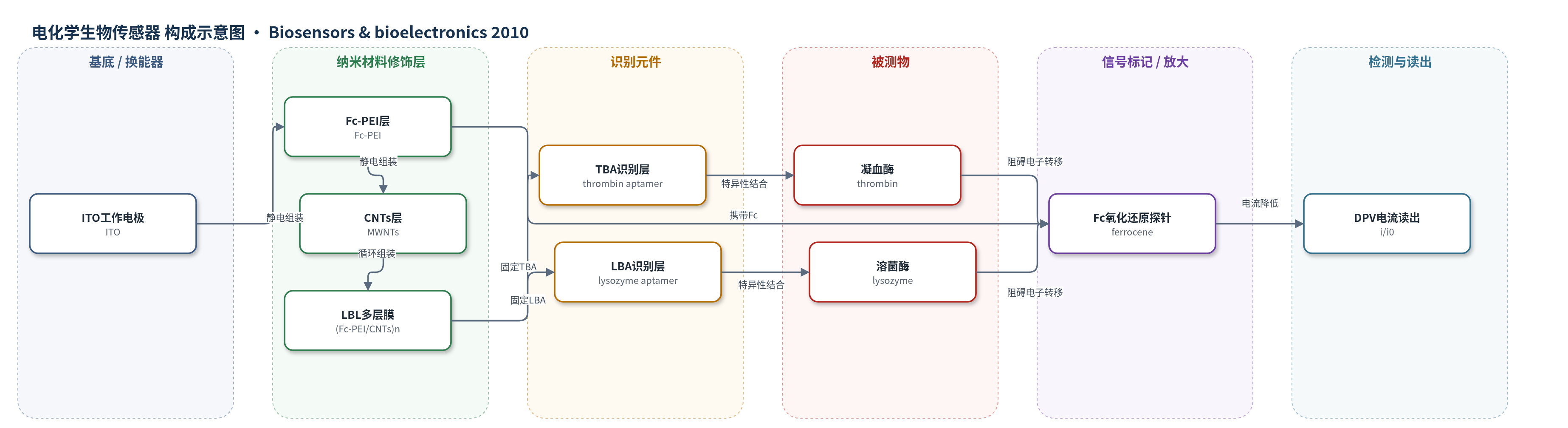
点击图片查看大图 · 依据论文自动绘制
传感器类型
电化学生物传感器
检测对象
凝血酶(thrombin)、溶菌酶(lysozyme);样品基质:Tris-HCl缓冲液(T-Buffer)及10%人血清(human serum)
检测原理
该传感器采用LBL技术在ITO电极上交替组装Fc-PEI与CNTs,形成(Fc-PEI/CNTs)n多层膜,并在最外层固定TBA或LBA。Fc作为电极表面氧化还原探针,CNTs促进电子转移,多层结构增加探针和适配体负载量以实现信号放大。目标蛋白与适配体特异性结合后,在电极界面形成大分子蛋白-适配体复合物,阻碍Fc向电极的电子转移,使DPV氧化峰电流降低。以i/i0对目标浓度取对数作图,信号随浓度升高而下降,从而实现无标记定量检测。
检测灵敏度
凝血酶: LOD: 0.14 ng ml−1;线性范围: 0.3–165 ng ml−1;R^2 = 0.9980。溶菌酶: LOD: 0.17 ng ml−1;线性范围: 0.2 ng ml−1–1.66 μg ml−1(两段线性)。
效应效果
传感器对50 μg/mL BSA及非目标蛋白无明显响应,选择性良好。稳定性方面,多层膜干燥暴露24 d后峰电流仅下降7.5%;传感界面4 ℃保存21 d后峰电流增加2.25%,仍可检测。重现性平均RSD为0.0178(凝血酶)和0.0176(溶菌酶)。70 ℃处理10 min可再生约73%,RSD=0.06。在10%人血清中凝血酶最低可检测浓度为5 ng/mL,较缓冲液灵敏度略低。作者认为该无标记LBL适配体传感器具有灵敏、稳定、通用和实际应用潜力。
传感器的构成
- 基底电极:ITO(indium tin oxide)负电荷工作电极,作为换能器与电子转移基底
- 聚电解质修饰层:Fc-PEI(ferrocene-appended poly(ethyleneimine))带正电,携带Fc氧化还原探针,提供DPV信号
- 纳米材料修饰层:CNTs/MWNTs(carbon nanotubes/multi-walled carbon nanotubes)带负电,促进电子转移并参与静电LBL组装
- 多层组装层:(Fc-PEI/CNTs)n 交替层,增加Fc探针与识别元件负载量,放大信号
- 识别元件:TBA(thrombin-binding aptamer)或LBA(lysozyme-binding aptamer)固定于最外层,特异性结合目标蛋白
- 封闭层:BSA(bovine serum albumin)封闭非特异性吸附位点,降低背景
- 信号标记物:Fc(ferrocene)共价连接于PEI,作为可逆氧化还原探针,其氧化峰电流随目标结合而降低
中文摘要
本文报道了两种基于层层自组装(LBL)活性聚电解质多层膜的无标记电化学适配体传感器,用于蛋白质的灵敏检测。传感器以带负电的ITO电极为基底,通过静电作用交替组装带二茂铁基团的聚乙烯亚胺(Fc-PEI)和多壁碳纳米管(CNTs/MWNTs),并在最外层固定凝血酶结合适配体(TBA)或溶菌酶结合适配体(LBA),再用BSA封闭。当目标蛋白存在时,适配体捕获目标蛋白并在电极界面形成蛋白-适配体复合物,阻碍Fc氧化还原探针的电子转移,使差分脉冲伏安法(DPV)氧化峰电流降低。凝血酶检测线性范围为0.3–165 ng/mL,检出限0.14 ng/mL;溶菌酶检测范围为0.2 ng/mL–1.66 μg/mL,检出限0.17 ng/mL。结果表明该LBL策略具有灵敏度、选择性、稳定性和通用性。
英文摘要
Herein, we report two simple label-free electrochemical aptasensors for protein detection using layer-by-layer (LBL) self-assembled multilayers with ferrocene-appended poly(ethyleneimine) (Fc-PEI), carbon nanotubes (CNTs) and aptamer. In one sensing strategy, the Fc-PEI, CNTs and DNA aptamer are LBL assembled on the electrode surface via electrostatic interaction. In the presence of target, the aptamer on the outermost layer of the LBL self-assembled multilayer would catch the target on the electrode interface, which makes a barrier for electrons and inhibits the electro-transfer, resulting in the decreased DPV signals of Fc-PEI. Using this strategy, a wide detection range (0.3-165 ng ml(-1)) for model target thrombin is obtained, with a low detection limit of 0.14 ng ml(-1). In the similar sensing strategy for detection of lysozyme, a wide detection range (0.2 ng ml(-1) to 1.66 microg ml(-1)) and a low detection limit (0.17 ng ml(-1)) are obtained. These results prove that the LBL sensing strategies developed possess sensitivity, selectivity, stability and generality.