组成图示
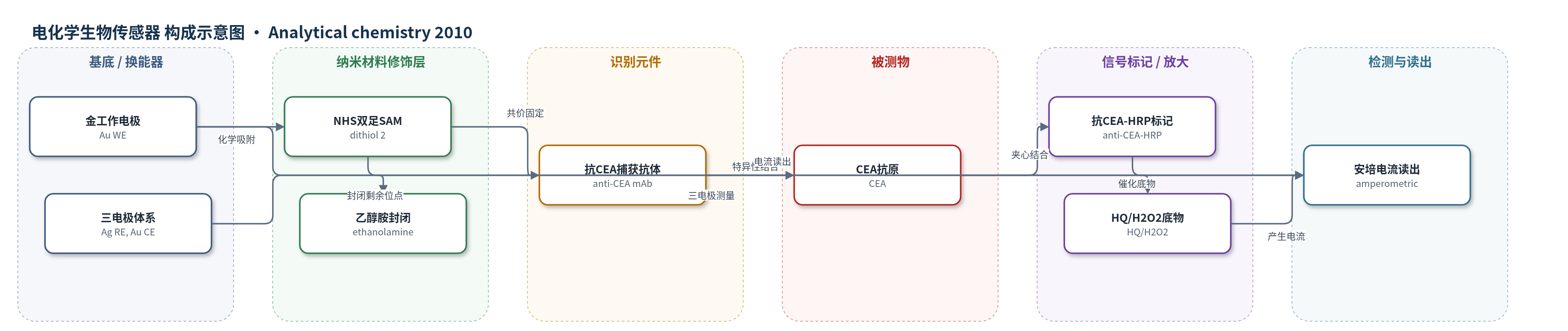
点击图片查看大图 · 依据论文自动绘制
传感器类型
电化学生物传感器
检测对象
癌胚抗原(carcinoembryonic antigen, CEA);样品基质:结肠癌患者血清
检测原理
金工作电极表面自组装NHS酯端基双足二硫醇SAM,通过硫醇与金的化学吸附形成有序界面,并保持电子渗透。抗CEA捕获抗体经NHS酯共价固定于SAM上,样品中的CEA与捕获抗体特异性结合。随后加入抗CEA-HRP标记抗体,形成夹心免疫复合物。HRP催化H2O2氧化对苯二酚(HQ)生成苯醌,苯醌在-0.2 V下被还原,产生与表面HRP量成正比的安培电流。CEA浓度越高,形成的夹心复合物和HRP越多,催化电流越大,从而在0–200 ng/mL范围内实现线性检测。该体系依靠酶催化放大信号,SAM和乙醇胺封闭降低非特异结合。
检测灵敏度
LOD: 0.2 ng/mL;线性范围: 0-200 ng/mL;灵敏度斜率: 3.8 nA · mL · ng-1
效应效果
该传感器在含10 mg/mL胎牛血清体系中仍可选择性检测CEA;SPR显示PSA、BSA及anti-PSA表面非特异结合较低。16电极阵列检测10 ng/mL CEA的RSD为7%。稳定性方面,anti-CEA-HRP在StabilGuard中4°C 222天保留>85%酶活,37°C 165天约60%,4°C半衰期2.1年;180天后检测10 ng/mL CEA电流下降<5%。涂层电极在StabilCoat中25°C 1个月保留>90%亲和力,37°C约70%。结肠癌患者血清检测与ELISA相关斜率为1.04,总检测时间<10 min,作者认为可用于即时检测和多联检测。
传感器的构成
- 基底/换能器电极:金(Au)工作电极阵列(16个,1×1 mm²),配合银(Ag)伪参比电极与金(Au)对电极,用于安培电流读出。
- 自组装单分子层:NHS酯端基双足二硫醇(dithiol 2)SAM,硫醇化学吸附于金,提供共价固定位点并保持电子渗透。
- 捕获识别元件:抗CEA单克隆抗体(anti-CEA mAb),通过NHS酯共价固定,特异性结合CEA。
- 封闭剂:乙醇胺(ethanolamine,1.0 M,pH 8.5),封闭残余NHS酯,降低非特异吸附。
- 信号标记物:抗CEA-HRP偶联抗体(anti-CEA-HRP conjugate),与CEA形成夹心复合物,HRP催化底物。
- 电子供体/底物:对苯二酚(HQ)与过氧化氢(H2O2)混合液,经HRP催化产生安培电流。
- 微流控封装:微流控芯片与点样装置,实现低体积样品和试剂输送。
中文摘要
检测提示癌症存在或复发的蛋白是早期诊断和治疗的重要工具。癌胚抗原(CEA)是临床诊断中广泛研究的肿瘤标志物。本文报道了一种用于检测CEA的安培免疫传感器,其基于将抗CEA单克隆抗体固定于新型双足二硫醇自组装单分子层(SAM)上,该SAM含有反应性N-羟基琥珀酰亚胺(NHS)酯端基。电流变化与CEA浓度在0–200 ng/mL范围内呈线性关系,灵敏度为3.8 nA·mL·ng−1,检出限为0.2 ng/mL,低于临床诊断常用阈值5 ng/mL。在不同储存条件下对标记抗体进行实时和加速稳定性研究,表明在StabilGuard等商品化稳定缓冲液中,偶联物的酶活性和抗体亲和力可长期保持,并利用Arrhenius方程预测稳定性趋势。所开发的免疫传感器与商品化ELISA试剂盒均成功用于结肠癌患者血清中CEA检测,两者结果具有良好相关性。后续工作将把该传感器整合到多种乳腺癌相关生物标志物多联检测平台中。
英文摘要
Detection of proteins that signal the presence or recurrence of cancer is a powerful therapeutic tool for effective early diagnosis and treatment. Carcinoembryonic antigen (CEA) has been extensively studied as a tumor marker in clinical diagnosis. We report on the development of an amperometric biosensor for the detection of CEA based on the immobilization of anti-CEA monoclonal antibody on a novel class of bipodal thiolated self-assembled monolayers containing reactive N-hydroxysuccinimide (NHS) ester end groups. The current variations showed a linear relationship with the concentration of CEA over the range of 0-200 ng/mL with a sensitivity of 3.8 nA x mL x ng(-1) and a detection limit of 0.2 ng/mL, which is well below the commonly accepted concentration threshold (5 ng/mL) used in clinical diagnosis. Real time and accelerated stability studies of the reporter antibody under various storage conditions demonstrated that the enzymatic activity and antibody affinity of the conjugate is retained for long periods of time in commercial stabilizing buffers such as StabilGuard Biomolecule Stabilizer, and a prediction of the stability trends was carried out using the kinetic and thermodynamic parameters obtained from the Arrhenius equation. The developed immunosensor as well as a commercially available enzyme-linked immunosorbent assay (ELISA) kit were successfully applied to the detection of CEA in serum samples obtained from colon cancer patients, and an excellent correlation of the levels of CEA measured was obtained. Ongoing work is looking at the incorporation of the developed biosensor into a platform for multiplexed simultaneous detection of several breast cancer related biomarkers.