组成图示
点击图片查看大图 · 依据论文自动绘制
传感器类型
其他(压电悬臂梁生物传感器)
检测对象
贾第鞭毛虫包囊(Giardia lamblia cysts);样品基质:缓冲液(PBS)、自来水、河水
检测原理
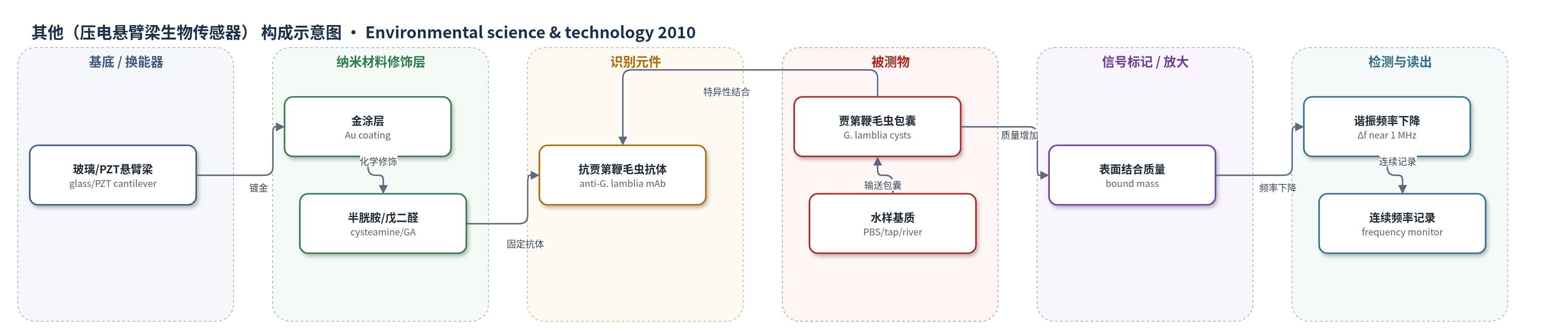
PEMC 由玻璃层和 PZT 压电层构成,工作在约 1 MHz 的高阶谐振模态。传感器表面先镀金,再经半胱胺和戊二醛修饰形成醛基,随后固定抗 G. lamblia 单克隆抗体。样品在流池中流动时,贾第鞭毛虫包囊与表面抗体特异性结合,使悬臂梁表面质量增加,导致谐振频率下降;仪器连续记录频率变化 Δf。响应随包囊浓度升高而增大,并与浓度呈对数线性关系(-Δf = A Log(C) + B)。提高流速可增强包囊向传感器表面的传质和抗原表位暴露,从而增大响应,实现无需预浓缩的直接检测。
检测灵敏度
LOD: 1-10 cysts/mL;线性范围: 10–12,500 cysts/mL;(-∆f) = 405.7 Log(C) - 572.5, R^2 = 0.99 (0.5 mL/min);(-∆f) = 435.4 Log(C) - 405.9, R^2 = 0.98 (0.8 mL/min);(-∆f) = 572.3 Log(C) - 573.4, R^2 = 0.92 (1.5 mL/min);(-∆f) = 1055.0 Log(C) - 1200.9, R^2 = 0.91 (2.4 mL/min)
效应效果
传感器选择性良好,未功能化对照响应接近噪声(500 包囊/mL 为 10±6 Hz;10,000 包囊/mL 在 PBS、自来水、河水中为 20±5、18±8、45±12 Hz)。ESEM 确认包囊附着。三种水基质中均可检测 10 包囊/mL,15 min 内显著响应;自来水响应比 PBS 低 4–20%,河水低 20–47%。10 个传感器重复性良好,R^2 为 0.99–0.91。5 mL/min 下 1 L 样品中 1 和 10 包囊/mL 响应为 1,950±318 Hz 和 3,800±895 Hz。相比需预浓缩的 EPA 1623、PCR 及灵敏度较低的 ELISA,该方法快速、无需预浓缩,适用于水源监测。
传感器的构成
- 基底/换能器:玻璃层(glass layer)与压电陶瓷层(PZT layer)组成压电激励毫米级悬臂梁(PEMC),提供质量变化引起的谐振频率响应
- 金属修饰层:金涂层(Au coating),为表面化学修饰提供基础
- 化学修饰层:半胱胺(cysteamine)与戊二醛(glutaraldehyde)依次孵育,在 Au 表面形成醛基用于固定抗体
- 识别元件:抗贾第鞭毛虫单克隆抗体(anti-G. lamblia monoclonal antibody, mAb),特异性结合包囊抗原
中文摘要
目前检测水源性寄生虫贾第鞭毛虫(Giardia lamblia)的方法繁琐且通常需要预浓缩。本文首次报道一种固定抗 G. lamblia 单克隆抗体的压电激励毫米级悬臂梁(PEMC)生物传感器,可在缓冲液、自来水和河水等多种水基质中,无需预浓缩即以 1–10 个包囊/mL 的检出限选择性、灵敏地检测 G. lamblia 包囊。PEMC 为谐振式器件,工作于接近 1 MHz 的高阶模态。将固定抗体的传感器置于流动系统中,暴露于 1–10,000 个包囊/mL 的样品;当包囊与传感器表面抗体结合时,悬臂梁谐振频率下降并被连续记录。检测后用环境扫描电镜对传感器表面进行阳性确认。较高样品流速(0.5–5.0 mL/min)可获得更高响应;在三种水基质中均可检测低至 10 个包囊/mL,并在 15 min 内获得显著响应。研究还证明在 5 mL/min 高流速下分析 1 L 样品中 1 个包囊/mL 的可行性。
英文摘要
The current method for detecting the waterborne parasite Giardia lamblia is tedious and requires a preconcentration step. We show for the first time a piezoelectric-excited millimeter-sized cantilever (PEMC) biosensor immobilized with a monoclonal antibody against G. lamblia that exhibits selective and sensitive detection of G. lamblia cysts in several water matrixes (buffer, tap, and river water) at a detection limit of 1-10 cysts/mL without a preconcentration step. The PEMC sensor is a resonance-based device that functions at a high-order mode near 1 MHz. The antibody-immobilized sensor was exposed to 1-10,000 G. lamblia cysts/mL samples in a flow arrangement. When the cysts bind to the antibody on the sensor, the resonant frequency of the cantilever sensor decreases and is recorded continuously. Positive confirmation of sensor detection responses was obtained by environmental scanning electron microscope of sensor surface after detection experiments. Higher sample flow rates (0.5-5.0 mL/min) gave higher sensor detection response. Detecting as few as 10 cysts per mL was achieved in all three water matrixes tested, and significant sensor response was obtained in 15 min. We also show the feasibility of analyzing at a low concentration of 1 cyst/mL in a one liter sample at a high flow rate of 5 mL/min.