组成图示
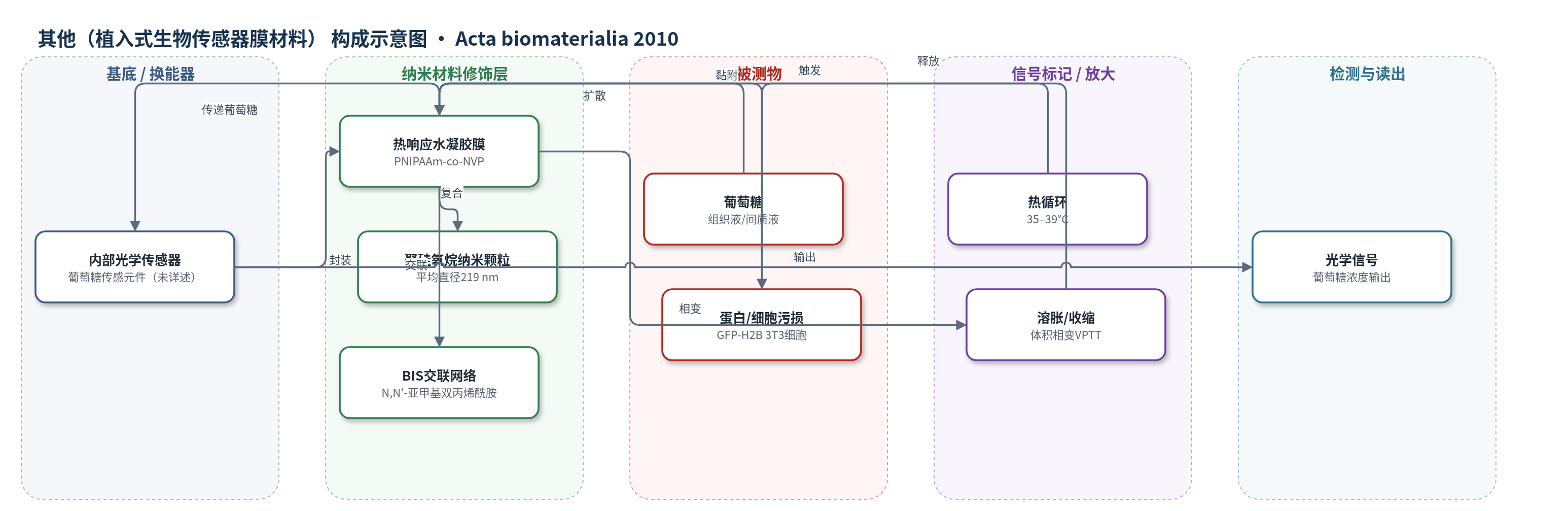
点击图片查看大图 · 依据论文自动绘制
传感器类型
其他(植入式生物传感器膜材料)
检测对象
葡萄糖(glucose);样品基质:皮下组织间质液(体外以 PBS 模拟)
检测原理
该膜本身不含识别元件,而是作为植入式光学葡萄糖传感器的封装膜。葡萄糖从皮下组织液扩散穿过处于溶胀状态的 PNIPAAm-co-NVP 水凝胶,到达内部光学传感元件,光学信号随葡萄糖浓度变化。由于引入 NVP 后 VPTT 略高于体温,35°C 时膜保持溶胀,维持较高葡萄糖扩散系数;当外部加热至 39°C 超过 VPTT 时,水凝胶发生体积相变而收缩,表面亲疏水性和机械刚度改变,使黏附的蛋白质和细胞脱落,实现自清洁。热循环后膜重新溶胀,恢复扩散通道,从而减少生物污损对扩散和光学信号传播的干扰。
检测灵敏度
原文未报告 LOD、线性范围、灵敏度斜率或相关系数。
效应效果
PBS 中含 NVP 水凝胶 VPTT 为 To 34.6±0.7°C、Tmax 37.4±1.5°C,高于无 NVP 的 30.4±1.8°C 和 31.7±1.7°C,使 35°C 保持溶胀。35°C 葡萄糖扩散系数 1.24×10^-6 cm²/s,高于无 NVP 的 0.193×10^-6 cm²/s;39°C 仍为 0.785×10^-6 cm²/s。35°C 拉伸模量 2.0±0.4 kPa,接近软组织;39°C 增至 8.5±1.1 kPa,UTS 由 89.2±27.9 增至 353.7±46.2 kPa。7 天细胞黏附实验显示热循环显著限制细胞附着,聚苯乙烯对照持续增加。未报告选择性、RSD、回收率及与 ELISA/HPLC/qPCR 对比。
传感器的构成
- 传感膜基质:PNIPAAm-co-NVP 水凝胶(NIPAAm 与 NVP 共聚物),提供热响应溶胀/收缩和葡萄糖扩散通道
- 交联网络:BIS(N,N'-亚甲基双丙烯酰胺),0.2 wt%,形成三维交联网络
- 纳米增强填料:聚硅氧烷胶体纳米颗粒(polysiloxane colloidal nanoparticles,平均直径 219 nm),1 wt% 固体,提高机械强度
- 光引发剂:Irgacure-2959,1 wt%,在 365 nm UV 下引发聚合
- 目标分析物:葡萄糖(glucose),经膜扩散至内部光学传感器(原文未描述传感器内部结构)
中文摘要
生物传感器植入后,蛋白质和细胞黏附及纤维包埋会限制分析物扩散并损害性能。本文开发了一种热响应纳米复合水凝胶膜,用作植入式生物传感器的自清洁膜,并展示其在光学葡萄糖传感器中的潜在应用。此前报道的由 N-异丙基丙烯酰胺(NIPAAm)与聚硅氧烷胶体纳米颗粒光聚合制备的热响应纳米复合水凝胶可通过热循环释放黏附细胞,但聚(N-异丙基丙烯酰胺)水凝胶的体积相变温度(VPTT)约为33–34°C,低于体温,体内会处于收缩状态,限制葡萄糖等分析物扩散。本研究引入 N-乙烯基吡咯烷酮(NVP)作为共聚单体,将 VPTT 提高至略高于体温,使水凝胶在体内保持溶胀状态。该膜由 NIPAAm、NVP 和聚硅氧烷胶体纳米颗粒水溶液光聚合制备,除具有高于体温的 VPTT 外,还表现出良好机械强度、葡萄糖扩散能力和热循环下体外细胞释放能力,因此可作为减少生物污损、延长植入式葡萄糖传感器及其他生物传感器寿命和效率的膜材料。
英文摘要
Following implantation of a biosensor, adhesion of proteins and cells and eventual fibrous encapsulation will limit analyte diffusion and impair sensor performance. A thermoresponsive nanocomposite hydrogel was developed as a self-cleaning biosensor membrane to minimize the effect of the host response and its utility for an optical glucose sensor, demonstrated here. It was previously reported that thermoresponsive nanocomposite hydrogels prepared from photopolymerization of an aqueous solution of N-isopropylacrylamide (NIPAAm) and polysiloxane colloidal nanoparticles released adhered cells with thermal cycling. However, poly(N-isopropylacrylamide) hydrogels exhibit a volume phase transition temperature (VPTT) of approximately 33-34 degrees C, which is below body temperature. Thus, the hydrogel would be in a collapsed state in vivo, which would ultimately limit diffusion of the target analyte (e.g., glucose) to the encapsulated sensor. In this study, the VPTT of the nanocomposite hydrogel was increased by introducing N-vinylpyrrolidone (NVP) as a comonomer, so that the hydrogel was in the swollen state in vivo. This thermoresponsive nanocomposite hydrogel was prepared by the photopolymerization of an aqueous solution of NIPAAm, NVP, and polysiloxane colloidal nanoparticles. In addition to a VPTT a few degrees above body temperature, the hydrogel also exhibited good mechanical strength, glucose diffusion, and in vitro cell release upon thermal cycling. Thus, this nanocomposite hydrogel may be useful as a biosensor membrane to minimize biofouling and extend the lifetime and efficiency of implantable glucose sensors and other biosensors.