组成图示
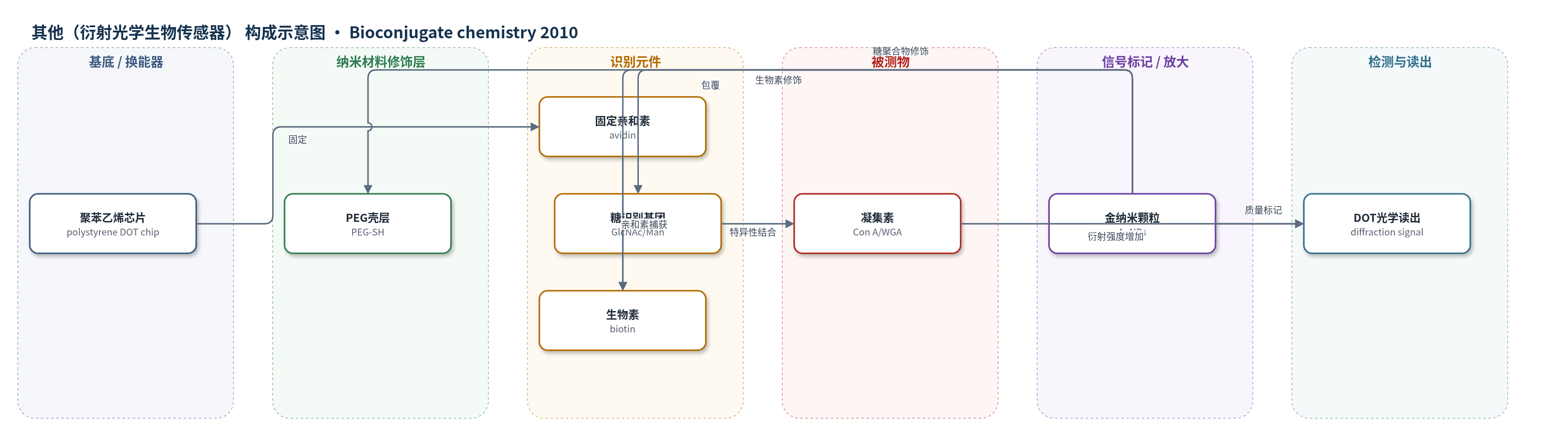
点击图片查看大图 · 依据论文自动绘制
传感器类型
其他(衍射光学生物传感器)
检测对象
凝集素:刀豆蛋白A(Concanavalin A, Con A)、小麦胚芽凝集素(wheat germ agglutinin, WGA);样品基质:PBS缓冲液/溶液
检测原理
DOT芯片表面固定亲和素(avidin),生物素化金糖纳米颗粒通过生物素-亲和素高亲和作用被捕获在衍射光栅表面。纳米颗粒表面由PEG-SH和糖聚合物组成,暴露多价GlcNAc或Man糖残基。当加入对应凝集素(WGA或Con A)时,糖残基与凝集素发生特异性结合,形成表面复合物。结合事件增加衍射光栅表面的质量/界面结构,改变衍射图案高度、衍射效率和衍射级强度;激光照射下由光二极管实时监测衍射强度变化,结合量增加时衍射强度相应增加。多价糖簇通过簇糖苷效应增强弱碳水化合物-蛋白相互作用,金纳米颗粒作为大尺寸标记提供信号放大。
检测灵敏度
原文未报告LOD、线性范围、灵敏度斜率或相关系数。
效应效果
实验以无生物素糖纳米颗粒为阴性对照,其不能固定在avidin芯片上,洗涤后信号恢复;生物素化纳米颗粒可稳定固定。GlcNAc修饰纳米颗粒与WGA结合产生高响应,而与Con A交叉实验几乎无响应;Man修饰纳米颗粒与Con A结合产生强响应,而与WGA交叉几乎无响应,非特异性结合低于10%。DLS显示粒径约4–6 nm,多分散性低于0.2,TEM显示球形均匀,溶液可稳定数周。作者认为该金糖纳米颗粒兼具稳定、生物相容和可识别表面,可用于碳水化合物-凝集素相互作用的实时无标记检测。
传感器的构成
- 基底/换能器:聚苯乙烯(polystyrene)衍射光栅芯片,内置棱镜,承载识别层并产生衍射信号
- 识别元件:固定于芯片表面的亲和素(avidin),通过生物素-亲和素作用捕获纳米颗粒
- 信号标记层:金纳米颗粒(AuNPs)核,由HAuCl4光化学还原形成,作为载体与光学/质量标记
- 修饰层:聚乙二醇硫醇(PEG-SH)与糖聚合物混合壳层,提供水稳定性、生物相容性和表面功能
- 识别元件:N-乙酰-α-D-氨基葡萄糖苷(GlcNAc)或α-D-甘露糖苷(Man)侧基,作为凝集素识别配体
- 连接元件:生物素(biotin)位于糖聚合物链端,用于与芯片avidin特异性偶联
- 信号读出:衍射光学技术(DOT)/dotLab系统,激光照射衍射光栅并由光二极管监测衍射强度变化
中文摘要
本文报道了通过可逆加成-断裂链转移(RAFT)聚合合成结构明确的生物素化糖聚合物,并将其与聚乙二醇(PEG)共同用于光化学原位制备金糖纳米颗粒。糖聚合物以N-乙酰-α-D-氨基葡萄糖苷(GlcNAc)或α-D-甘露糖苷(Man)为侧基,链端引入生物素。所得金纳米颗粒经动态光散射(DLS)和透射电镜(TEM)表征,具有均匀粒径和良好胶体稳定性。利用衍射光学技术(DOT)系统评估纳米颗粒表面生物素和糖残基的生物可利用性,结果表明生物素配体可被DOTLab生物传感器芯片上固定的亲和素(avidin)捕获。进一步实验显示,亲和素偶联的糖纳米颗粒能选择性固定凝集素:GlcNAc修饰的金纳米颗粒与小麦胚芽凝集素(WGA)发生特异性相互作用,而Man修饰的金纳米颗粒与刀豆蛋白A(Con A)发生特异性相互作用。该工作为碳水化合物-蛋白识别研究提供了稳定、生物相容的纳米平台。
英文摘要
Gold nanoparticles (NPs) functionalized with a mixed shell of well-defined biotinylated glycopolymers and polyethylene glycol (PEG) provide an effective platform for the biomolecular recognition of proteins both in solution and on surfaces. Well-defined biotinylated glycopolymers were first synthesized by the reversible addition-fragmentation chain transfer (RAFT) process. They contain two types of carbohydrate residues either N-acetyl β-D-glucosaminopyranoside (GlcNAc) or α-D-mannopyranoside (Man) as pendent groups. The biotinylated glycopolymers and polyethylene glycol were subsequently used in the in situ formation of gold glyconanoparticles via an easy photochemical process. The obtained biotinylated glyconanoparticles were characterized by dynamic light scattering (DLS) and transmission electron microscopy (TEM). The bioavailability of the biotin and specific carbohydrate residues at the periphery of the NPs were assessed using the diffraction optic technology (DOT) system. The studies showed the accessibility of the biotin ligands for conjugation to immobilized avidin on the DOTLab biosensor. Furthermore, these avidin conjugated glyconanoparticles were found to selectively immobilize lectins. The specificity of lectin binding was dependent on the type of carbohydrate residues. As such, N-acetyl β-D-glucosaminoside decorated gold nanoparticles were found to specifically interact with wheat germ agglutinin (WGA) lectin, whereas α-D-mannoside ones were found to specifically interact with Concanavalin A (Con A) lectin.