组成图示
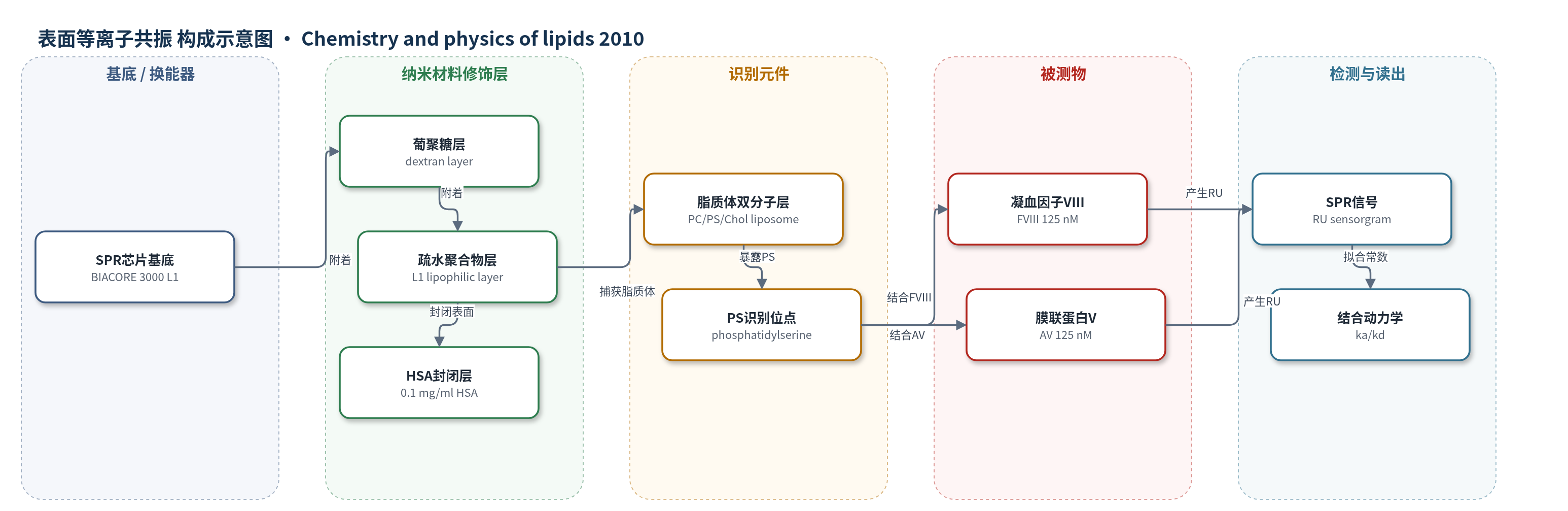
点击图片查看大图 · 依据论文自动绘制
传感器类型
表面等离子共振(SPR)生物传感器
检测对象
凝血因子VIII(factor VIII, FVIII)、膜联蛋白V(annexin V, AV);样品基质为含5 mM CaCl2的HBS缓冲液,检测界面为人工PC/PS/Chol脂质体膜
检测原理
该检测基于无标记SPR实时监测膜表面质量变化。首先将不同组成的PC/PS/Chol脂质体捕获在L1芯片疏水聚合物层上,形成人工磷脂双分子层;PS暴露于膜表面,作为FVIII和AV的识别位点。在含5 mM CaCl2的HBS缓冲液中注入125 nM FVIII或AV后,蛋白通过Ca2+依赖方式与PS结合,使界面质量/折射率增加,SPR共振信号以RU形式上升;解离阶段信号下降。结合量随PS含量、蛋白浓度和胆固醇组成变化:胆固醇可诱导PS富集微区,增强FVIII/AV结合,并降低AV解离速率。系统通过传感器图拟合得到结合与解离常数,从而定量反映膜蛋白结合亲和力与稳定性。
检测灵敏度
原文未报告LOD、线性范围、灵敏度斜率或相关系数。
效应效果
SPR固定化重复性良好,脂质体固定化水平约1500–2100 RU,NaOH处理后基线稳定。HSA非特异结合仅9–33 RU,抗非特异吸附较强。PS对结合起决定作用:无PS脂质体上AV归一化结合仅11和16,含PS表面为56–96;FVIII无PS表面为2.4和3.0,含PS表面为17–30,约低5–9倍。胆固醇提高结合水平并显著增强AV稳定性,AV解离速率常数从1.69×10^-3 s^-1降至3.24×10^-4 s^-1;FVIII稳定性变化不明显。相比流式细胞术和荧光法,该SPR脂质体体系可无标记、实时定量膜蛋白结合动力学。
传感器的构成
- 换能器基底:BIACORE 3000 SPR芯片(L1芯片),提供表面等离子共振检测界面
- 固定化层:L1芯片上的葡聚糖层(dextran layer)与疏水聚合物层(lipophilic polymer layer),用于捕获脂质体
- 识别膜层:PC/PS/Chol脂质体双分子层,PS作为FVIII/AV识别位点,胆固醇调节膜排列
- 封闭剂:0.1 mg/ml HSA,封闭未覆盖表面并抑制非特异结合
- 信号读出:SPR共振单位(RU)实时记录结合与解离
中文摘要
为研究胆固醇组成对凝血因子VIII(FVIII)和膜联蛋白V(AV)与膜结合的影响,作者构建了不同磷脂酰胆碱(PC)、磷脂酰丝氨酸(PS)和胆固醇组成的磷脂双分子层脂质体膜,并采用表面等离子共振(SPR)生物传感器系统测定其结合平衡常数与速率常数。结果表明,PS在AV结合中起主导作用,AV结合水平与脂质体中PS摩尔比例基本成正比。FVIII和AV对脂质体膜的结合水平均随胆固醇比例增加而升高,提示胆固醇可作为“磷脂排列”因子,诱导形成PS富集微区,从而增强蛋白结合。然而,当脂质体不含PS时,胆固醇不能发挥增强结合的作用,再次证明PS是结合的关键位点。胆固醇还显著提高AV结合的稳定性:AV解离速率常数从不含胆固醇时的1.7×10^-3 s^-1降至仅含10%胆固醇时的3.3×10^-4 s^-1,约降低5倍;而FVIII结合稳定性受胆固醇添加(最高50 mol%)影响较小。综上,该工作利用脂质体-SPR体系定量揭示了胆固醇对膜结合蛋白亲和力和稳定性的表观效应。
英文摘要
To investigate the effect of cholesterol composition on the binding of factor VIII (FVIII) and annexin V (AV) to membranes, liposomal membranes with phospholipid bilayers of various compositions of phosphatidylcholine (PC), phosphatidylserine (PS), and cholesterol were constructed. A surface plasmon resonance (SPR) biosensor system was employed to measure the equilibrium and rate constants of the bindings. As expected, PS was found to play a dominant role in the binding of AV; its binding level was directly proportional to the PS composition in a liposome. The binding levels of FVIII and AV to liposome increased with an increase in cholesterol composition in liposome. It seemed to suggest that cholesterol in liposome acts as a 'phospholipid arrangement' factor by inducing the formation of PS-rich microdomains. However, in the absence of PS (20% on a mole basis), cholesterol could not exert the binding enhancement effect, which again confirmed the critical role of PS in the bindings. Stability of the AV binding was significantly improved by the increase in cholesterol content; for AV, the dissociation rate constant was decreased approximately fivefold, from 1.7 x 10(-3)s(-1) in the absence of cholesterol to 3.3 x 10(-4)s(-1) in the presence of only 10% cholesterol. But, for FVIII the binding stability was not so much influenced by the cholesterol addition (up to 50% on a mole basis). In summary, by using liposomes on an SPR system, we were able to demonstrate quantitatively the apparent effects of cholesterol on the binding affinity and stability of the membrane-binding proteins.