组成图示
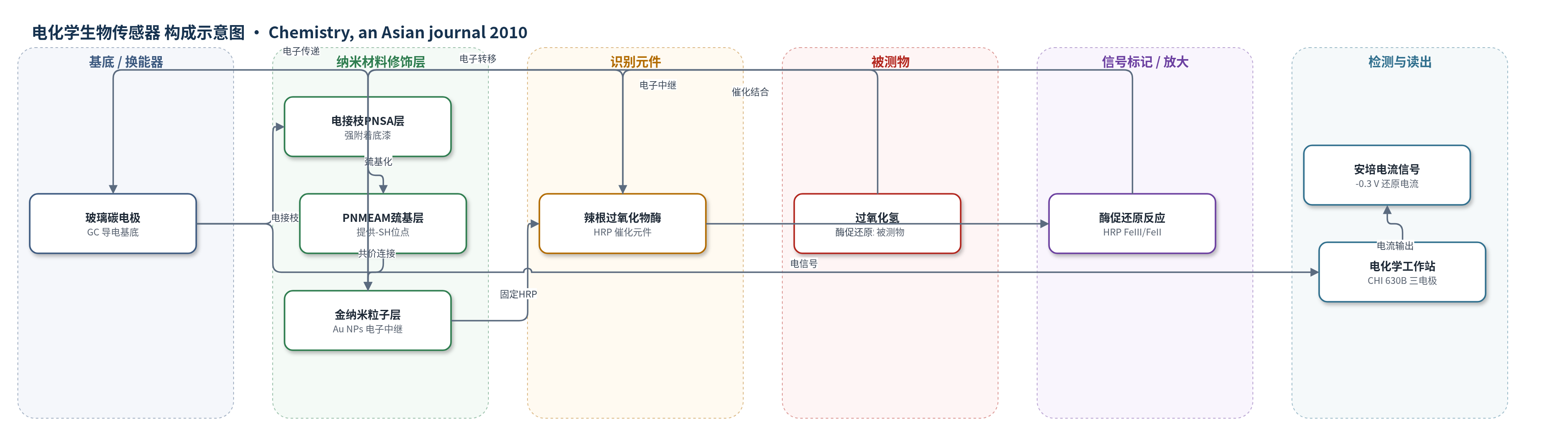
点击图片查看大图 · 依据论文自动绘制
传感器类型
电化学生物传感器
检测对象
过氧化氢(H2O2),样品基质为磷酸盐缓冲液(PBS, pH 7.0)
检测原理
HRP 固定于 Au/PNMEAM 复合膜中,其血红素活性中心 Fe(III)/Fe(II) 可在电极表面发生直接电子转移。加入 H2O2 后,HRP Fe(III) 与 H2O2 反应生成 Compound I 并再生 Fe(III),H2O2 被催化还原;在 -0.3 V 下,HRP Fe(III) 从电极获得电子再生,形成催化还原电流。Au NPs 作为纳米导线和电子中继,降低电子转移阻力,使酶活性中心与 GC 电极间电子传递加快。H2O2 浓度增加时,酶促反应速率提高,稳态还原电流增大,在 50–700 μM 范围内呈线性。该传感器无外加介质,信号直接来自酶的直接电化学与电催化过程。
检测灵敏度
LOD: 10 μM (S/N = 3);线性范围: 50–700 μM;灵敏度: 0.39 μA mM−1 cm−2;R^2 = 0.997
效应效果
该传感器在 -0.3 V 安培法下对 H2O2 响应迅速,达到稳态电流 95% 的时间小于 5 s;在 50–700 μM 范围内线性良好,相关系数 0.997,灵敏度 0.39 μA mM−1 cm−2,检出限 10 μM(S/N=3)。表观 Michaelis–Menten 常数 Kapp_m 为 0.48 mM,小于文献中 Au NPs/半胱胺修饰金电极,说明固定化 HRP 对 H2O2 具有更高亲和力和催化活性。连续 10 次测定 100 μM H2O2 的 RSD 约 2.7%;4 °C PBS 中保存 3 周后仍保留 89% 初始电流。论文未报告选择性、抗干扰或实际样品加标回收率,但作者认为该平台可用于无介质 H2O2 检测及其他氧化还原酶传感。
传感器的构成
- 基底电极:玻璃碳电极(GC),作为导电基底与电子换能器
- 电接枝聚合物层:聚(N-琥珀酰亚胺基丙烯酰胺)(PNSA),提供强附着底漆和后续反应位点
- 巯基化聚合物层:聚(N-巯基乙基丙烯酰胺)(PNMEAM),提供巯基(-SH)用于金纳米粒子共价连接
- 金纳米粒子层:金纳米粒子(Au NPs),共价连接于 PNMEAM,促进电子转移并固定酶
- 识别/催化元件:辣根过氧化物酶(HRP),催化过氧化氢还原并实现直接电子转移
中文摘要
本研究报道了将电接枝聚(N-巯基乙基丙烯酰胺)(PNMEAM)与金纳米粒子(Au NPs)相结合构建高性能生物传感器的方法。PNMEAM 通过电接枝沉积于玻璃碳电极表面,形成强附着底漆膜,为 Au NPs 和辣根过氧化物酶(HRP)的稳定固定提供基础。基于 HRP 固定于 Au/PNMEAM 复合膜中的生物传感器性能被系统考察。循环伏安结果显示一对可逆氧化还原峰,表明 Au NPs 可促进 HRP 活性中心与电极之间的直接电子转移。由于电接枝膜稳定且 Au NPs 生物相容,该传感器对过氧化氢(H2O2)还原表现出优异的电催化活性、快速响应和长期稳定性。结果表明,电接枝与 Au NPs 的组合为生物分子固定及氧化还原酶传感应用提供了有前景的平台。
英文摘要
In this study, we describe the use of the combination of eletrografting poly(N-mercaptoethyl acrylamide) and Au nanoparticles in the construction of high-performance biosensors. The poly(N-mercaptoethyl acrylamide) was electrografted onto the glassy carbon electrode surface, which provided a strongly adhering primer film for the stable attachment of Au nanoparticles and horseradish peroxidase (HRP) enzymes. The performances of the biosensors based on the HRP immobilized in the Au/poly(N-mercaptoethyl acrylamide) composite film were investigated. A couple of redox peaks were obtained, indicating that the Au nanoparticles could facilitate the direct-electron transfer between HRP and the underlying electrode. The biosensor showed an excellent electrocatalytic activity toward the reduction of hydrogen oxide and long-term stability, owing to the stable electrografted film and biocompatible Au nanoparticles. Our results demonstrate that the combination of electrografting and Au nanoparticles provides a promising platform for the immobilization of biomolecules and analysis of redox enzymes for their sensing applications.