组成图示
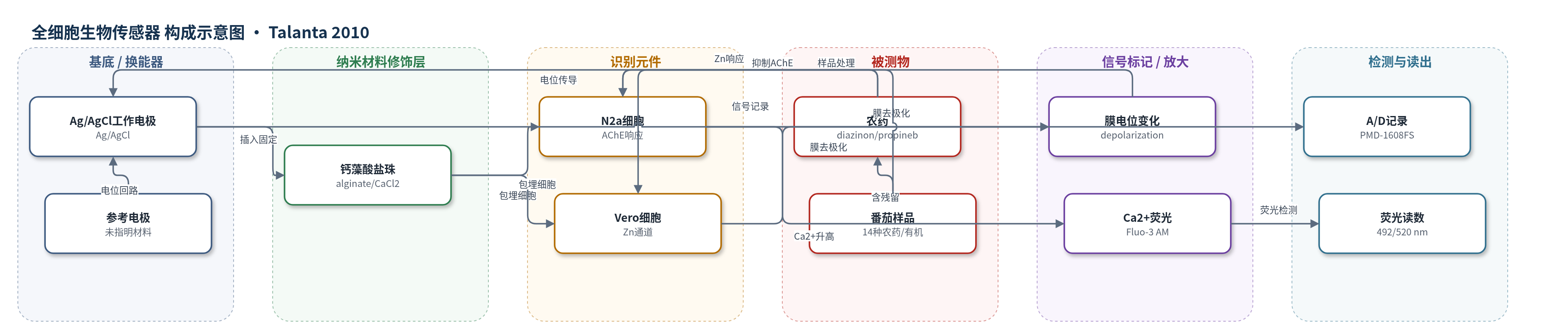
点击图片查看大图 · 依据论文自动绘制
传感器类型
全细胞生物传感器
检测对象
有机磷杀虫剂diazinon、二硫代氨基甲酸盐杀菌剂propineb(丙森锌);样品基质:标准水溶液/5%乙醇-水溶液、番茄样品(有机番茄及含14种农药的EU能力测试番茄样品)
检测原理
农药接触固定化细胞后,有机磷diazinon抑制细胞膜乙酰胆碱酯酶(AChE),使乙酰胆碱(ACh)积累并过度刺激胆碱能受体,导致N2a细胞膜去极化;propineb为含锌二硫代氨基甲酸盐,可作用于Vero细胞锌激活离子通道(ZAC)或影响ACh释放,引起膜电位变化。膜电位变化改变工作电极附近电解质分布,Ag/AgCl工作电极与参考电极将电位差转换为电信号,由A/D卡记录。在一定浓度范围内,电位变化随农药浓度线性增加。荧光Ca2+检测作为机制验证:农药诱导胞内Ca2+升高,Fluo-3 AM荧光增强。
检测灵敏度
最低检测浓度(LOD): 3 nM(原文:The lowest detected concentration was 3 nM);线性范围: Vero/propineb 0.03–0.33 μM, r2 = 0.9816, y = 7.788x −37.758;N2a/propineb 0–0.16 μM, r2 = 0.9527, y = 15.5x −68.386;N2a/diazinon 0–0.33 μM, r2 = 0.9046, y = 6.4788x −59.268;另原文称propineb在173 nM和3 nM间有满意响应。
效应效果
传感器在室温培养液中可保存至少3周且性能不损失;重复测量(图中n=15)误差棒为标准误,重现性高。13个番茄样品中无假阴性,能区分有机对照与含14种农药样品。回收率:diazinon 51.01%–92.81%,propineb 51.62%–121.93%。N2a对diazinon选择性更高,Vero对propineb更敏感,显示细胞类型差异可提高选择性。检测时间约180 s,作者认为可用于番茄农药残留快速定性及部分定量筛查。
传感器的构成
- 工作电极:纯银(Ag)电极,表面电化学镀Ag/AgCl层,直径0.75 mm,插入细胞珠,采集细胞膜电位变化
- 参考电极:原文未指明材料,与Ag/AgCl工作电极构成电位测量回路
- 细胞包埋基质:4% (w/v)海藻酸钠(sodium alginate)与0.8 M CaCl2交联形成约2 mm钙藻酸盐珠,固定细胞
- 生物识别元件:N2a小鼠神经母细胞瘤细胞或Vero非洲绿猴肾细胞,约5×10^4细胞/珠,作为农药响应元件
- 样品接触层:200 μl标准农药溶液或番茄样品提取物,使农药接触固定化细胞
- 信号读出装置:PMD-1608FS A/D卡与InstaCal软件,记录180 s平均电位变化
中文摘要
有机磷和二硫代氨基甲酸盐是农业生产中两类重要农药,其广泛和不合理使用使痕量水平可靠监测日益必要。本研究构建了一种基于生物电识别法(BERA)原理的快速、灵敏细胞生物传感器,通过测量固定化细胞膜电位变化来检测农药。细胞被包埋于海藻酸钠珠中,并直接用于不同农药稀释液和农业样品。所用农药为有机磷杀虫剂diazinon和二硫代氨基甲酸盐杀菌剂propineb。研究采用N2a神经母细胞瘤细胞和Vero细胞作为生物传感元件,以考察其对农药的差异响应并提高选择性。结果表明,该传感器可高重现性地对农药进行定性检测,并在一定浓度范围内实现定量检测,最低检测浓度为3 nM。此外,作者用Fluo-3荧光法检测N2a细胞胞质Ca2+积累,处理含14种农药的EU能力测试番茄样品与有机番茄样品,发现非有机样品使细胞内Ca2+浓度升高更明显。
英文摘要
Two of the most important categories of pesticides used in agricultural practice are organophosphates and dithiocarbamates. Their extensive and inappropriate use has rendered their reliable monitoring at trace levels more and more necessary. This study presents the construction of a rapid and sensitive cellular biosensor test based on the measurement of changes of the cell membrane potential of immobilized cells, according to the working principle of the Bioelectric Recognition Assay (BERA). The cells were immobilized by entrapment in a sodium alginate bead and directly applied in different pesticide dilutions and agricultural samples. The pesticides used were the organophosphate insecticide diazinon and the dithiocarbamate fungicide propineb. Two different cell types, N2a (neuroblastoma) and Vero (fibroblast) were used as the biosensory elements in order to investigate their differential response against the pesticides. In this way, we hoped to increase the selectivity of the assay. Based on the observed patterns of response, we demonstrate that the sensor can be used for the qualitative and, in some concentrations, quantitative detection of the pesticides with a high degree of reproducibility. The lowest detected concentration was 3nM. Finally, for the investigation of the effects of different pesticides on the accumulation of cytosolic Ca(2+), we conducted a fluorescent assay on N2a cells treated with tomato sample extracts, which were replicates of the E.U. proficiency test sample. The tomato samples were either organically grown or contained 14 different pesticides. The experimental results showed a higher increase of the intracellular Ca(2+) concentration in cells treated with non-organic samples compared to the cells treated with organic samples.