组成图示
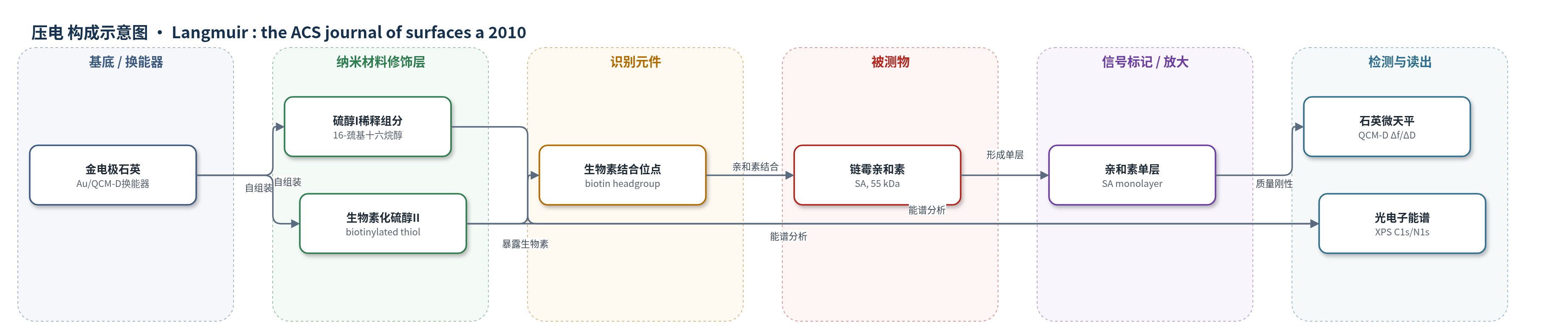
点击图片查看大图 · 依据论文自动绘制
传感器类型
压电(QCM)生物传感器
检测对象
链霉亲和素(Streptavidin, SA);样品基质:TBS缓冲液(pH 7.4)
检测原理
金表面先形成由硫醇I和生物素化硫醇II组成的二元SAM,生物素头基从疏水烷基链背景中伸出。将链霉亲和素(SA)加入TBS缓冲液后,SA通过四个生物素结合口袋与表面生物素发生高亲和识别(Ka≈10^13 M^-1)。结合事件使界面质量增加,并因SA分子间侧向接触形成部分二维晶格而刚性化。QCM-D监测剪切振荡石英晶体的频率偏移Δf和耗散因子ΔD:质量增加使Δf负向增大,刚性化使ΔD降低或趋于稳定。Sauerbrey方程将Δf换算为SA质量,Voight模型用于校核粘弹性。SAM中生物素化硫醇II比例越高,SA结合量越大;比例过高则空间位阻降低结合,比例过低则位点不足,信号下降。
检测灵敏度
原文未报告LOD、线性范围、灵敏度斜率或相关系数。
效应效果
实验重复至少三次独立制备(N=3),Sauerbrey与Voight计算质量一致,表明SA层可近似为刚性质量层。单一硫醇I SAM上SA结合可忽略,说明结合主要来自SA-生物素特异性相互作用。氯仿体系中,溶液比例nI/nII≈1000即可达到最大SA结合质量约400 ng cm−2,相当于SA单层;乙醇体系中需nI/nII≈50才接近完整单层,nI/nII=1000时仅约151 ng cm−2。XPS证实SAM中生物素化硫醇II比例决定SA结合量,且氯仿显著提高生物素化硫醇II的表面富集。作者认为该结果可用于控制生物芯片/传感器表面的SA固定密度。
传感器的构成
- 基底/换能器:AT切石英晶体金电极(QSX 301-Standard Gold)或玻璃-铬-金,提供压电换能与金表面
- 自组装修饰层:二元硫醇SAM,由16-巯基-1-十六烷醇(thiol I)和生物素化硫醇II组成,形成有序单分子层
- 识别元件:thiol II 末端生物素(biotin),通过SA-biotin高亲和力结合链霉亲和素
- 结合蛋白/被测物:链霉亲和素(SA,约55 kDa),结合后形成SA单层或二维晶格
- 测量介质:TBS缓冲液(pH 7.4),维持蛋白结合环境并冲洗非特异结合
- 读出/表征:QCM-D(Q-Sense E1)监测Δf/ΔD;XPS(AXIS-ULTRA)分析SAM组成
中文摘要
许多生物传感器应用基于链霉亲和素(SA)与部分生物素化自组装硫醇单分子层(SAM)的结合。本研究在金表面制备由16-巯基-1-十六烷醇(硫醇I)和N-(8-生物素基-3,6-二氧杂辛酰胺基)-16-巯基十六酰胺(硫醇II)组成的二元SAM,采用氯仿或乙醇为溶剂,并以不同组分比例孵育24 h。随后利用SA-生物素强相互作用将SA固定于SAM表面,并用QCM-D(监测耗散因子的石英晶体微天平)监测结合过程。结果表明,在所选孵育条件下,Sauerbrey方程可用于计算固定SA层的质量。氯仿体系中,溶液中生物素化组分II的极低比例(nI/nII≈1000)即可形成使SA结合量最大(约400 ng cm−2,相当于SA单层)的SAM;乙醇体系中形成完整SA层需要显著更高的生物素化组分II比例(nI/nII≈50)。XPS数据表明,SAM中生物素化硫醇II的比例决定表面结合SA的量。SAM中的硫醇比例不仅取决于孵育溶液中的组分比例,还受溶剂强烈影响;与乙醇相比,氯仿显著提高SAM中生物素化硫醇II的比例。
英文摘要
Many biosensor applications are based on streptavidin (SA) binding to partially biotinylated self-assembled thiol monolayers (SAMs). In our study, binary SAMs on gold were prepared from solutions containing 16-mercapto-1-hexadecanol (thiol I) and N-(8-biotinyl-3,6-dioxa-octanamidyl)-16-mercaptohexadecanamide (thiol II) in varying component ratios. Either chloroform or ethanol was used as solvent. After 24 h thiol incubation, SA was immobilized on the resulting SAMs using the strong SA-biotin interaction. The SA binding process was monitored by QCM-D (quartz crystal microbalance monitoring dissipation factor). It is shown that the Sauerbrey equation is valid to calculate the mass quantities of the immobilized SA layers. Under the chosen incubation conditions, marginal fractions of the biotinylated component II in chloroform ((n(I)/n(II))(solution) approximately = 1000) lead to SAMs which ensure a maximal SA binding quantity of m(Sauerbrey SA) approximately = 400 ng x cm(-2), being equivalent to a SA single-layer arrangement on the SAM surface. In case of incubations from ethanolic solutions, a complete SA layer formation needs significantly higher amounts of the biotinylated component II during SAM preparation ((n(I)/n(II))(solution) approximately = 50). X-ray photoelectron spectroscopy data show that the fraction of biotinylated thiol II in the SAM determines the amount of surface-bound SA. The SAM thiol ratio ((n(I)/n(II))(SAM)) not only depends on the corresponding component ratio in the incubation solution, but is also strongly influenced by the solvent. Using chloroform as solvent during SAM preparation significantly increased the fraction of biotinylated thiol II in the SAMs compared to ethanol.