组成图示
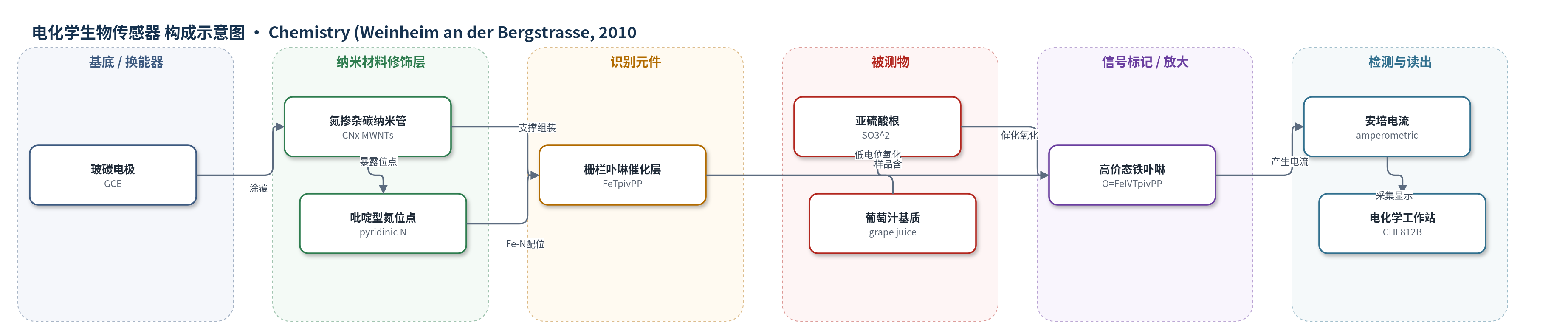
点击图片查看大图 · 依据论文自动绘制
传感器类型
电化学生物传感器
检测对象
亚硫酸根离子(sulfite ions, SO3^2-);样品基质:磷酸盐缓冲液(PBS)、葡萄汁/饮料
检测原理
FeTpivPP通过中心铁与CNx MWNTs中吡啶型氮的Fe–N配位非共价组装在碳纳米管表面,CNx MWNTs提供导电通道和缺陷位点,促进卟啉与玻碳电极间的直接电子转移。在+0.47 V附近低电位下,FeIII卟啉发生一电子一质子氧化生成高价态O=FeIVTpivPP。该活性物种通过氧原子转移机制催化氧化SO3^2-为SO4^2-,自身还原再生为HO-FeIIITpivPP,形成循环催化。随着亚硫酸根浓度升高,催化氧化产生的电子转移速率增大,安培电流线性增加,从而实现低过电位、宽线性范围的电化学检测。
检测灵敏度
LOD: 3.5×10^-7 mol L^-1 (S/N=3:1);线性范围: 8.0×10^-7–4.9×10^-3 mol L^-1
效应效果
响应3 s内达稳态,线性范围宽于碳离子液体电极(6×10^-6–1×10^-3 mol L^-1)和纳米铜-salen膜电极(4×10^-6–6.9×10^-5 mol L^-1),检出限低于4×10^-6和1.2×10^-6 mol L^-1。五个电极斜率RSD为4.3%;8和800 mmol L^-1重复RSD为4.7%和4.0%。50次循环伏安后响应保持98.2%,室温保存4周保持95.3%。+0.47 V下1000倍阴离子、有机酸和糖类无干扰,抗坏血酸低于3倍可耐受。葡萄汁测得5.3±0.2 mmol L^-1,接近碘量法5.0 mmol L^-1,加标回收率105.2±2.8%和97.1±2.5%。
传感器的构成
- 基底/换能器电极:玻碳电极(GCE),提供电子转导与安培信号采集
- 纳米材料修饰层:氮掺杂多壁碳纳米管(CNx MWNTs),提供导电通道、缺陷位点和吡啶型氮配位位点
- 识别/催化元件:溴化[铁(III) 5,10,15,20-四(α,α,α,α-2-异丁酰胺苯基)卟啉](FeTpivPP),通过Fe–N配位非共价组装于CNx MWNTs,形成高价态铁(IV)–卟啉催化氧化亚硫酸根
- 电子供体/配位位点:CNx MWNTs中的吡啶型氮原子,作为电子供体与FeTpivPP中心铁配位
中文摘要
本文首次将水不溶性栅栏卟啉通过Fe–N配位非共价组装到氮掺杂多壁碳纳米管(CNx MWNTs)上,构建用于高效催化与生物传感的新型纳米复合材料。采用扫描电镜、拉曼光谱、X射线光电子能谱、紫外-可见吸收光谱和电化学阻抗谱对该复合材料进行表征。在中性水溶液中,利用低电位电化学方法使卟啉发生直接电子转移,CNx MWNTs的存在促使高价态铁(IV)–卟啉单元直接生成,从而对亚硫酸根离子氧化表现出优异催化活性。以食品与饮料工业中广泛使用的亚硫酸根离子为模型,提出一种高灵敏度安培生物传感器。该传感器线性范围达四个数量级,为8.0×10^-7至4.9×10^-3 mol L^-1,检出限为3.5×10^-7 mol L^-1。该平台分析性能良好,可成功用于饮料中亚硫酸根离子的测定。卟啉在氮掺杂碳纳米管上的直接非共价组装为设计用于生物传感和光伏器件的新型生物功能材料提供了简便途径。
英文摘要
A water-insoluble picket-fence porphyrin was first assembled on nitrogen-doped multiwalled carbon nanotubes (CN(x) MWNTs) through Fe--N coordination for highly efficient catalysis and biosensing. Scanning electron micrographs, Raman spectra, X-ray photoelectron spectra, UV/Vis absorption spectra, and electrochemical impedance spectra were employed to characterize this novel nanocomposite. By using electrochemical methods on the porphyrin at low potential in neutral aqueous solution, the presence of CN(x) MWNTs led to the direct formation of a high-valent iron(IV)-porphyrin unit, which produced excellent catalytic activity toward the oxidation of sulfite ions. By using sulfite ions, a widely used versatile additive and preservative in the food and beverage industries, as a model, a highly sensitive amperometric biosensor was proposed. The biosensor showed a linear range of four orders of magnitude from 8.0x10(-7) to 4.9x10(-3) mol L(-1) and a detection limit of 3.5x10(-7) mol L(-1) due to the highly efficient catalysis of the nanocomposite. The designed platform and method had good analytical performance and could be successfully applied in the determination of sulfite ions in beverages. The direct noncovalent assembly of porphyrin on CN(x) MWNTs provided a facile way to design novel biofunctional materials for biosensing and photovoltaic devices.