组成图示
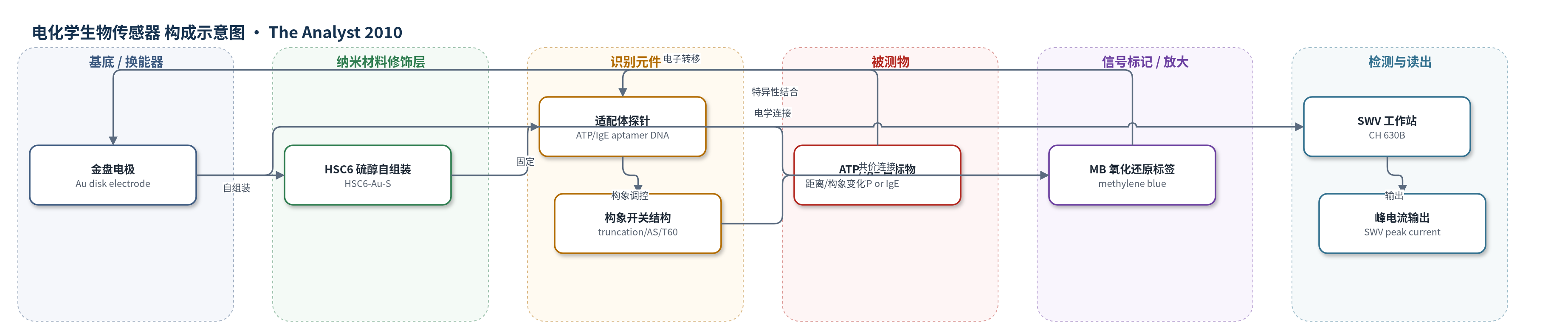
点击图片查看大图 · 依据论文自动绘制
传感器类型
电化学生物传感器
检测对象
腺苷三磷酸(ATP)、人免疫球蛋白 E(IgE);样品基质:ATP 在 1.0 M NaCl/0.1 M Tris 缓冲液(pH 7.0),IgE 在 20 mM Tris/100 mM NaCl/5 mM MgCl2 缓冲液(pH 7.5);文中亦称可用于全血、血清、食品等复杂基质。
检测原理
传感器由金电极表面硫醇固定的适配体探针和 3′ 端甲硫基蓝(MB)氧化还原标签组成。目标物结合适配体后,诱导探针发生构象变化:去稳定化序列由无规卷曲折叠为天然结合构象,反义序列由双链转为天然构象,假三明治结构使两个结构域结合。构象变化改变 MB 与金电极之间的距离、取向或柔性,从而改变 MB 与电极间的电子转移效率。采用方波伏安法(SWV)读取 MB 氧化还原峰电流,目标浓度升高时峰电流按 signal-on 或 signal-off 变化,信号增益定义为相对峰电流变化。该过程无需外源标记、洗涤或酶放大。
检测灵敏度
原文未报告 LOD、线性范围、灵敏度斜率或 R^2。ATP 传感器动态范围约 5 个数量级,覆盖 0.1–3 mM,最高测试 250 mM;IgE 传感器在 200 nM 饱和,表观亲和力 18 ± 3 nM。
效应效果
ATP 传感器中,全长适配体信号增益 130%,去稳定化序列最高 190 ± 45%,反义序列最佳 146 ± 22%,假三明治结构信号差且传感器间变异大;对 GTP 无特异响应。IgE 传感器中,全长和柔性连接子结构无显著信号,去稳定化点突变结构在 200 nM IgE 下增益 22 ± 6%,表观亲和力 18 ± 3 nM,对 IgG 无特异响应;反义和假三明治结构无有效信号或呈非特异结合。误差棒为至少 3 个独立制备传感器的标准差。作者认为适配体构象重构是优化无试剂自报告 E-AB 传感器灵敏度的关键,适用于复杂样品和即时检测。
传感器的构成
- 换能器电极:金盘电极(Au disk electrode),经金刚石/氧化铝抛光和电化学清洗,提供电子交换界面。
- 自组装固定层:适配体 5′ 端 HSC6 硫醇连接子,通过 Au–S 键将 DNA 探针固定于金表面。
- 识别元件:ATP 或 IgE 适配体 DNA,特异性结合目标分子并发生结合诱导构象变化。
- 构象调控序列:反义 DNA 序列或 60T 多胸腺嘧啶连接子,形成双链/假三明治结构以改变构象平衡。
- 信号标记物:甲硫基蓝(methylene blue, MB),共价连接于适配体 3′ 端,作为氧化还原电子供体。
- 封闭/钝化层:6-巯基-1-己醇(6-mercapto-1-hexanol, MCH)自组装封闭金表面;IgE 体系另用 casein 和 Tween-20 缓冲液钝化。
- 检测介质:ATP 或 IgE 溶液,目标物与表面适配体结合后改变 MB 电子转移效率。
中文摘要
电化学适配体(E-AB)传感器将适配体-配体识别与电化学读出相结合,可在无需外源试剂和洗涤步骤的情况下直接检测全血、食品和土壤提取物等复杂样品中的目标物。该类传感器依赖电极固定探针适配体在目标结合后发生构象变化,从而改变共价连接的氧化还原标签与电极之间的电子交换效率。然而,传统适配体筛选通常不选择构象开关结构,因此需要重新工程化适配体以支持结合诱导的构象转换。本文以腺苷三磷酸(ATP)和人免疫球蛋白 E(IgE)适配体为代表,系统比较了截短/点突变去稳定化、反义序列和长非结构连接子“假三明治”等重构策略。结果表明,多种适配体结构均可支持 E-AB 信号,但信号增益差异超过两个数量级(ATP 传感器约 10% 至 200%),最优构象开关几何结构依赖于具体适配体序列。
英文摘要
Electrochemical aptamer-based (E-AB) sensors have emerged as a promising and versatile new biosensor platform. Combining the generality and specificity of aptamer-ligand interactions with the selectivity and convenience of electrochemical readouts, this approach affords the detection of a wide variety of targets directly in complex, contaminant-ridden samples, such as whole blood, foodstuffs and crude soil extracts, without the need for exogenous reagents or washing steps. Signaling in this class of sensors is predicated on target-induced changes in the conformation of an electrode-bound probe aptamer that, in turn, changes the efficiency with which a covalently attached redox tag exchanges electrons with the interrogating electrode. Aptamer selection strategies, however, typically do not select for the conformation-switching architectures, and as such several approaches have been reported to date by which aptamers can be re-engineered such that they undergo the binding-induced switching required to support efficient E-AB signaling. Here, we systematically compare the merits of these re-engineering approaches using representative aptamers specific to the small molecule adenosine triphosphate and the protein human immunoglobulin E. We find that, while many aptamer architectures support E-AB signaling, the observed signal gain (relative change in signal upon target binding) varies by more than two orders of magnitude across the various constructs we have investigated (e.g., ranging from -10% to 200% for our ATP sensors). Optimization of the switching architecture is thus an important element in achieving maximum E-AB signal gain and we find that this optimal geometry is specific to the aptamer sequence upon which the sensor is built.