组成图示
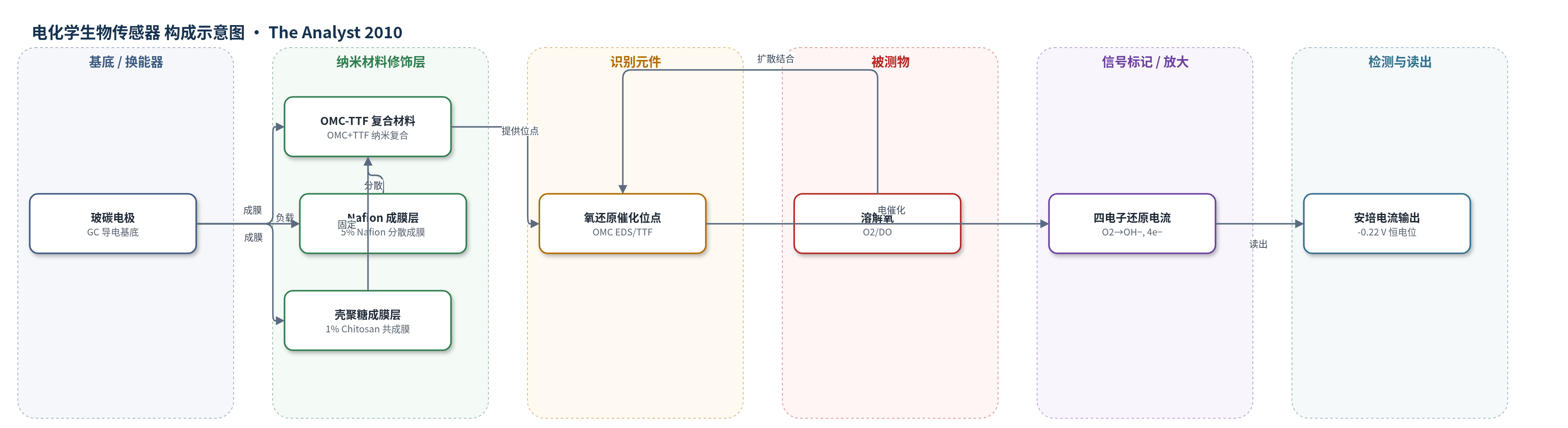
点击图片查看大图 · 依据论文自动绘制
传感器类型
电化学生物传感器
检测对象
溶解氧(dissolved oxygen, DO/O2);样品基质:磷酸盐缓冲液(PBS)/水溶液
检测原理
OMC-TTF 修饰电极中,有序介孔碳(OMC)具有有序介孔、高比表面积和较多边缘平面缺陷位点(EDS),四硫富瓦烯(TTF)作为电子供体嵌入 OMC 孔道表面,形成主客体协同杂化结构,降低异相电子转移阻力。检测时,溶解氧(O2)从 PBS 溶液扩散至修饰电极表面,在 -0.22 V 恒电位下发生电催化还原。RDE 与 Koutecky–Levich 分析表明 OMC-TTF 上氧还原转移电子数约为 4,即 O2 直接经四电子途径还原为 OH−,而 OMC 电极主要为两步两电子过程。随着 O2 浓度升高,扩散通量增大,阴极电流线性增大,从而通过安培电流定量溶解氧。
检测灵敏度
LOD: 0.39 μM(S/N = 3);线性范围: 0.07–193 μM;灵敏度: 0.03 μA μM−1;R^2 = 0.995
效应效果
该传感器在 -0.22 V 下对溶解氧响应迅速,达到稳态 98% 仅需数秒。80 μM 抗坏血酸和 26 μM 尿酸不干扰响应,且施加电位较正,可避免其他可电还原化合物干扰。10 个电极对 50 μM 氧的响应 RSD 为 5.1%;4 ℃ 保存 1 个月后安培电流基本不变,连续搅拌 400 s 电流仅下降约 6%。其线性范围宽于 VB12 基(15–45 μM)、ABTS/漆酶(0.06–4 μM)和 GNP/MWNTs-FeTMAPP(0.52–180 μM)等报道体系,检出限低于近期报道。作者认为 OMC-TTF 可用于溶解氧检测,并有望拓展到其他生物分子电化学传感。
传感器的构成
- 基底/换能器电极:玻碳电极(GC),提供导电基底与电子转移界面
- 纳米材料修饰层:有序介孔碳-四硫富瓦烯复合材料(OMC-TTF),OMC 提供高比表面积和边缘平面缺陷位点(EDS),TTF 作为电子供体促进异相电子转移
- 成膜/分散介质:Nafion 溶液(5% wt),分散 OMC-TTF 并辅助成膜
- 成膜/限域介质:壳聚糖(Chitosan,1%),与 Nafion 共同形成修饰膜并辅助固定 OMC-TTF
- 识别/催化元件:无独立生物识别元件,溶解氧(O2)直接在 OMC-TTF 表面发生四电子电催化还原
中文摘要
本文合成了一种新型有序介孔碳-四硫富瓦烯(OMC-TTF)复合材料。该材料基于主客体化学,利用有序介孔碳(OMC)纳米结构基质与四硫富瓦烯(TTF)优良电子供体性质之间的协同作用,使 OMC 的部分特性得到改善,尤其是与电催化活性密切相关的边缘平面缺陷位点密度增加,并能促进异相电子转移。作者首次利用 OMC-TTF 研究溶解氧的电催化还原。结果表明,OMC-TTF 修饰电极上氧还原通过直接四电子途径进行,而 OMC 电极上过程并非直接四电子途径。基于 OMC-TTF 构建了安培型溶解氧生物传感器,其对溶解氧响应良好,具有较宽线性范围和很低检出限;抗坏血酸和尿酸干扰被抑制,且施加电位足够正,可避免其他可电还原化合物的干扰。结果表明 OMC-TTF 在溶解氧检测中具有应用潜力,其特性也为研究其他生物分子电化学行为提供新途径。
英文摘要
A novel ordered mesoporous carbon-tetrathiafulvalene composite is synthesized. It is based on host-guest chemistry which utilizes synergic interactions between a nanostructured matrix of ordered mesoporous carbon (OMC) and the excellent electron donor properties of tetrathiafulvalene (TTF). It has been found that some interesting properties of OMC are improved. Especially the density of the edge plane-like defective sites, important groups responsible for the electrocatalytic activity towards some molecules, is increased on OMC-TTF composite. Moreover, this new material can be used to facilitate the heterogeneous electron transfer process. OMC-TTF was used, for the first time, to investigate the electrocatalytic reduction of oxygen. The results show that the electrocatalytic behavior of OMC-TTF is attributed to the unique physico-chemical properties of OMC and TTF. At the OMC-TTF modified electrode, the reduction proceeds by the direct four-electron pathway whereas at the OMC electrode the process is not direct. In order to show that the ability of OMC-TTF to promote the electron transfer can allow the application of this composite in many domains, an amperometric oxygen biosensor has been constructed based on OMC-TTF. It exhibits good response to dissolved oxygen with a large linear range and a very low detection limit. The interferences of ascorbic acid and uric acid are suppressed and the applied potential is positive enough to avoid perturbations of other electrochemically reducible compounds. The results above suggest that OMC-TTF has potential applications in the detection of dissolved oxygen and interesting properties of this composite may open up a new approach to study the electrochemical behavior of other biomolecules.