组成图示
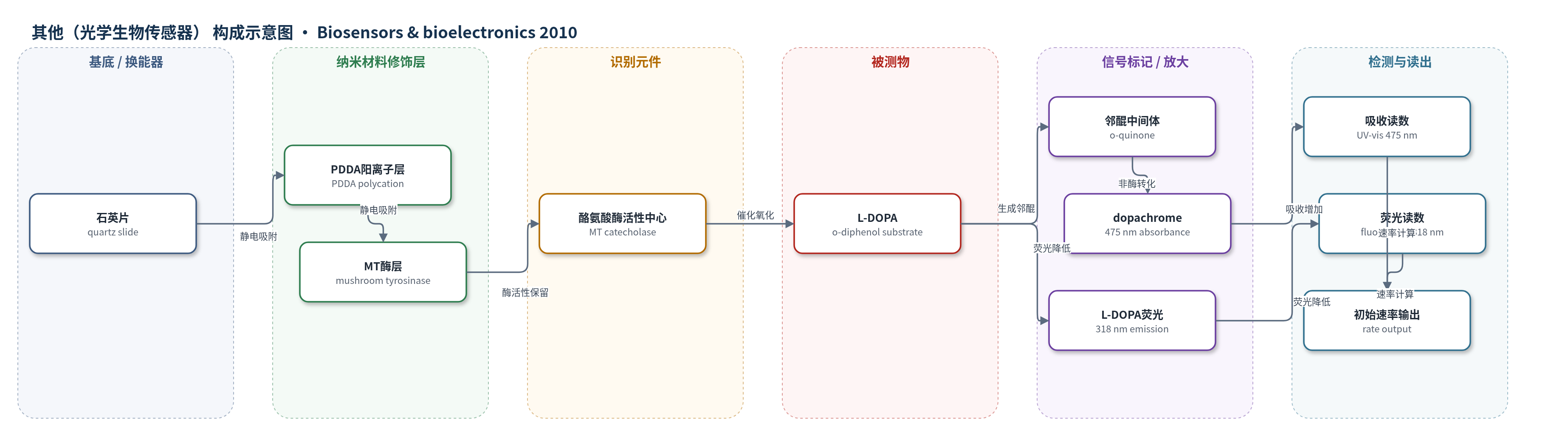
点击图片查看大图 · 依据论文自动绘制
传感器类型
其他(光学生物传感器)
检测对象
L-3,4-二羟基苯丙氨酸(L-DOPA,模型底物)、多巴胺(dopamine)、儿茶酚(catechol)、咖啡酸(caffeic acid);样品基质:20 mM Na-phosphate buffer(pH 7.0)
检测原理
该传感器以石英片上PDDA-MT聚电解质多层膜为识别与催化界面。L-DOPA等邻二酚进入反应介质后,被固定化蘑菇酪氨酸酶催化氧化为邻醌;L-DOPA进一步经非酶反应生成dopachrome,产生475 nm特征吸收,同时L-DOPA自身荧光在318 nm处因底物消耗而降低。检测在反应最初2 min内测量吸收增加或荧光降低的初始速率,以避免黑色素聚合物污染并保证膜可重复使用。在底物浓度远低于Km时,初始速率与底物浓度近似线性,比例常数约为Vmax/Km;通过改变MT层数可改变酶负载和Vmax,从而调节灵敏度。荧光法因背景低而获得更低检出限。
检测灵敏度
LOD: 23 μM(吸收法);线性响应: 至350 μM;灵敏度斜率: 0.184 Abs min^-1 mM^-1。LOD: 3 μM(20层荧光法);线性响应: 至25 μM。LOD: 4 μM(10层荧光法);线性响应: 至35 μM。
效应效果
该传感器无需MBTH等外源试剂,同一石英支撑PEM可分别用于吸收和荧光检测,并可通过缓冲液洗涤重复使用。重复性方面,同一多层膜在2 mM L-DOPA下连续10次测定的RSD为2%。稳定性方面,多层膜在4 ℃缓冲液中保存至少1个月,完成至少40次测定仍结果一致;每周监测2个月,前6周酶活性变化在4%以内,之后活性下降。选择性方面,作者预期可用于多巴胺、儿茶酚、咖啡酸等邻二酚,但未报告抗干扰或实际样品回收率。与现有方法相比,吸收法LOD 23 μM接近文献中29 μM的安培流动注射法,但高于1 μM的另一种酪氨酸酶安培法;作者认为其适合缺乏电化学条件的实验室,并可按层数调节性能。
传感器的构成
- 基底/换能器:石英片(quartz slide, Hellma),经piranha溶液氧化清洁形成负电荷表面,作为光学透明支撑并允许透射/反射检测。
- 聚电解质多层膜:PDDA(poly(dimethyldiallylammonium chloride))与MT(mushroom tyrosinase)通过LbL静电吸附交替沉积,形成有序透明多层膜。
- 识别/催化元件:蘑菇酪氨酸酶(MT, EC 1.14.18.1),催化邻二酚氧化生成邻醌和dopachrome。
- 信号产物:dopachrome(L-DOPA氧化产物,475 nm吸收)和L-DOPA荧光(285 nm激发、318 nm发射)作为内源光学信号。
- 反应介质:20 mM Na-phosphate buffer(pH 7.0),维持酶活性与反应条件。
- 读出装置:紫外-可见分光光度计(Agilent 8453、PerkinElmer Lambda-40)和荧光光度计(Varian Cary Eclipse),测量吸收或荧光初始速率。
中文摘要
酚类衍生物在医学、食品和环境样品中的测定对健康监测与污染监控具有重要意义。酪氨酸酶生物传感器因选择性、低成本和快速筛查等优势而受到关注,其中酶的有效固定是关键。本文采用层状自组装(layer-by-layer, LbL)方法,将蘑菇酪氨酸酶(mushroom tyrosinase, MT)与聚阳离子聚二甲基二烯丙基氯化铵(PDDA)交替沉积在光学透明石英片上,制备聚电解质多层膜(PEM)。紫外-可见光谱表明该组装可实现高酶负载,且固定后的MT保留儿茶酚酶活性,其动力学参数可通过分光光度法测定。该传感器用于光学检测邻二酚模型底物L-3,4-二羟基苯丙氨酸(L-DOPA),无需外源试剂,并表现出良好的重复性和时间稳定性。吸收法检测的检出限为23 μM,线性响应至350 μM;荧光法检测的检出限为3 μM,线性范围在数十微摩尔区间,具体取决于MT层数。通过改变固定酶层数可调节传感器灵敏度。
英文摘要
Determination of phenolic derivatives is very important in medical, food and environmental samples because of their relevant significance in health care and pollution monitoring. Tyrosinase-based biosensors are promising tools for this purpose because of several advantages with respect to currently used detection methods. A key aspect in the development of a biosensor is the effective immobilization of the enzyme. In this work, ordered tyrosinase films on an optical transparent support were immobilized by a "layer-by-layer" (LbL) assembly, alternating the enzyme with the polycation polymer poly(dimethyldiallylammonium chloride). As confirmed by UV-vis spectroscopy, the LbL deposition allowed a high loading of enzyme. The immobilized tyrosinase functionality was proven and its kinetic parameters were spectrophotometrically determined. The prepared biosensor was used to optically detect the o-diphenolic compound l-3,4-dihydroxyphenyl-alanine (L-DOPA) and exhibited good repeatability and time stability. The sensing properties of the system were studied by means of both absorption and fluorescence spectroscopy. The bioassay based on the absorbance measurements gave a LOD of 23 microM and a linear response up to 350 microM. The bioassay based on the fluorescence measurements gave a LOD of 3 microM and a linear response in the range of tens of micromolar (the exact value depends on the number of mushroom tyrosinase layers). Biosensor sensitivity could be modulated varying the number of the immobilized enzyme layers.