组成图示
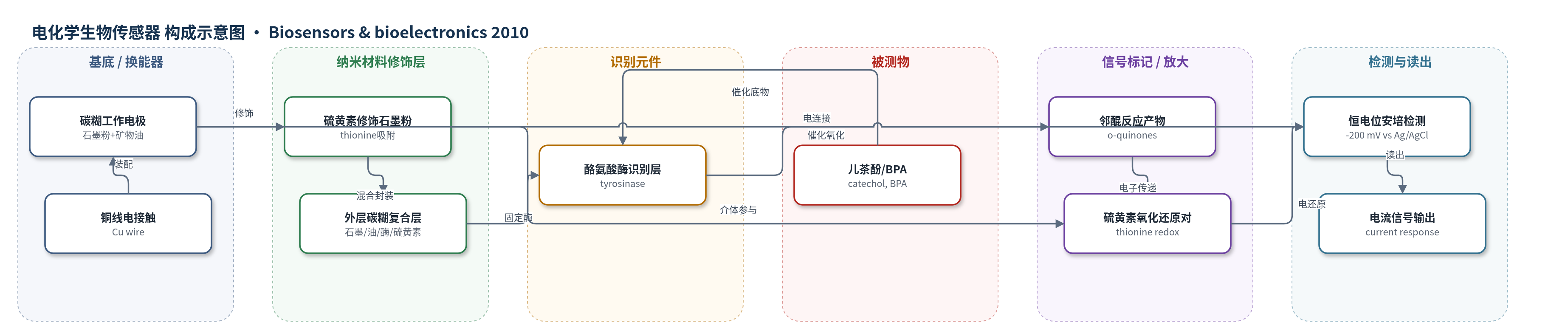
点击图片查看大图 · 依据论文自动绘制
传感器类型
电化学生物传感器
检测对象
儿茶酚(catechol)、双酚A(BPA);样品基质为磷酸盐缓冲液(0.1 M sodium phosphate, pH 6.5, 含0.1 M KCl)及受BPA污染的水样/水溶液
检测原理
该传感器以碳糊电极为换能器,外层碳糊中固定酪氨酸酶并吸附硫黄素。检测时,儿茶酚或BPA扩散进入碳糊层,被酪氨酸酶催化羟基化和氧化,生成邻醌类反应产物。酶反应产生的氧化性产物/中间物使硫黄素转化为氧化态(thionineox),硫黄素作为电化学介体在电极/溶液界面传递电子。在-200 mV(vs Ag/AgCl)恒电位下,thionineox在电极表面被还原,产生与底物浓度成正比的稳态安培电流。硫黄素介导降低了电子传递阻力,矿物油疏水相有利于BPA富集,从而提高灵敏度;电流随儿茶酚或BPA浓度增加而增大。
检测灵敏度
LOD: 0.15 μM(儿茶酚、BPA,1 mM thionine与thionine-free电极);线性范围: 儿茶酚 0.15–75 μM,BPA 0.15–45 μM;灵敏度: 儿茶酚 S = 139.6 ± 1.1 nA/μM(1 mM thionine)、S = 104.4 ± 0.5 nA/μM(thionine-free),BPA S = 85.4 ± 1.5 nA/μM(1 mM thionine)、S = 51.1 ± 0.6 nA/μM(thionine-free)
效应效果
该传感器电极间重现性约7%,电极内重复性不超过2%(n=5),等量注入响应差异在3%以内,比例注入响应差异在4%以内;儿茶酚平均响应时间约100 s,BPA约200 s。碳糊电极可稳定工作约1个月,当对5 μM儿茶酚响应下降7%时弃用。与文献相比,其灵敏度和检出限更优:儿茶酚灵敏度高于114、70.2和26.23 nA/μM;BPA灵敏度高于20.91和0.4 nA/μM,且检出限低于Dempsey等报道的23 μM。在BPA污染水生物降解验证中,传感器电流下降29%对应浓度下降25%,校准曲线推算值与HPLC测定值非常接近。文中未报告选择性、抗干扰和加标回收率。
传感器的构成
- 工作电极基底:聚四氟乙烯管(Teflon tube)与铜线(Cu wire),提供电极主体和电接触
- 内层碳糊:石墨粉(graphite powder)与矿物油(mineral oil)按60:40(w/w)混合,作为导电支撑层
- 硫黄素修饰石墨粉:硫黄素(thionine)吸附于石墨粉表面,作为电化学介体
- 外层碳糊:硫黄素/石墨粉、矿物油与酪氨酸酶按50:40:10(w/w)混合,形成复合传感层
- 识别元件:蘑菇酪氨酸酶(tyrosinase, E.C. 1.14.18.1),催化儿茶酚/BPA氧化
- 信号介体:硫黄素(thionine)氧化还原对,在-200 mV下传递电子并产生安培电流
中文摘要
本文报道了一种用于儿茶酚和双酚A(BPA)检测的硫黄素修饰碳糊电极。通过吸附硫黄素作为电化学介体修饰石墨粉,并在加入酪氨酸酶前测定了修饰碳糊电极(CPE)的电化学响应,随后加入酪氨酸酶组装生物传感器。在确定最佳工作条件后,电极间重现性约为7%,所得传感器灵敏度提高:儿茶酚为139.6±1.1 nA/μM,BPA为85.4±1.5 nA/μM;高于无硫黄素传感器的104.4±0.5 nA/μM(儿茶酚)和51.1±0.6 nA/μM(BPA),且两种电极对两种分析物的检出限均为0.15 μM。与文献报道相比,该传感器具有更高灵敏度和更低检出限。此外,通过跟踪受BPA污染水的生物降解过程,比较生物传感器校准曲线推算的BPA浓度变化与HPLC测定结果,验证了硫黄素-酪氨酸酶CPE的实际功能。
英文摘要
A thionine-modified carbon paste electrode for catechol and Bisphenol A (BPA) detection is presented. Graphite powder was modified by adsorbing thionine as electrochemical mediator. The electrochemical response of the modified carbon paste electrode (CPE) was determined before electrode modification with tyrosinase. Then, tyrosinase was added in order to assemble a biosensor. Once established the best operative conditions, an interelectrode reproducibility around 7% was obtained and the resulting biosensor showed improved sensitivities and (S=139.6+/-1.1 nA/microM for catechol and S=85.4+/-1.5 nA/microM for BPA) in comparison with the biosensor constructed without thionine (S=104.4+/-0.5 nA/microM for catechol and S=51.1+/-0.6 nA/microM for BPA) and low detection limits (0.15 microM for both the electrodes and analytes). Also the comparison with the results reported in the literature showed higher sensitivity and lower detection limit for our biosensor. Moreover the functioning of the thionine-tyrosinase CPE was validated following a biodegradation process of water polluted by BPA and comparing the time changes of BPA concentration inferred by the biosensor calibration curve and those determined by means of HPLC measurements.