组成图示
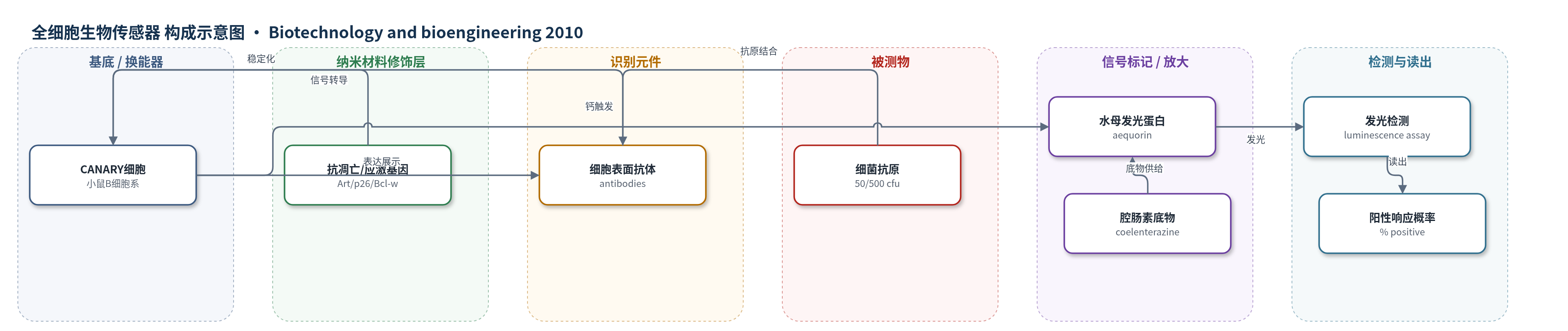
点击图片查看大图 · 依据论文自动绘制
传感器类型
全细胞生物传感器
检测对象
细菌抗原(bacterial antigen,50/500 cfu);样品基质:检测介质(assay medium),应用指向食品/植物病原筛查
检测原理
CANARY 细胞表面表达可识别特定细菌、病毒或毒素的抗体。当样品中的抗原与细胞表面抗体结合时,触发 B 细胞信号转导,引起胞内钙离子浓度变化。细胞内过表达的水母发光蛋白 aequorin 在钙离子结合后,与腔肠素 coelenterazine 发生氧化反应并释放光信号。抗原浓度越高,发生阳性响应的细胞比例或发光概率越高,因此可通过发光检测判断病原存在。该传感器不依赖外部电极或纳米材料,而以全细胞作为识别与换能单元;文中未使用 HCR、RCA 或酶催化沉积等体外放大策略,信号放大主要依赖细胞信号转导和 aequorin 钙依赖发光。
检测灵敏度
未报告LOD、线性范围、灵敏度斜率或R^2;文中以50 cfu和500 cfu抗原的阳性响应概率表征检测活性。
效应效果
未修改 CANARY 细胞室温2天、4℃2周仍完全功能(检测50 cfu阳性率≥50%)。过表达 Artemia franciscana 基因和 GADD45b 将室温活性储存延长3.5倍;抗凋亡蛋白将4℃储存延长2–3倍。4℃6周时,对照几乎无完整膜,Bcl-XL/Mcl-1为3–5%,Bcl-w/Bcl2为15–17%;4周时对照50 cfu检测概率25%,转染细胞约100%;6周时Bcl-w/Bcl2检测50 cfu>70%、500 cfu>95%。室温1周时对照对50 cfu无响应,GADD45b/artemin/p26为45–70%,Art/p26/Bcl-w为90%,2周为45%。未报告RSD、回收率或与ELISA/HPLC/qPCR对比。
传感器的构成
- 细胞换能器:CANARY 小鼠B细胞系(murine B-cell line),作为识别与信号转导单元
- 识别元件:细胞表面抗体(antibodies),识别特定细菌、病毒和毒素
- 报告蛋白:水母发光蛋白(aequorin),在钙信号触发下产生发光
- 发光底物:腔肠素(coelenterazine),作为 aequorin 发光反应底物
- 遗传稳定化元件:artemin、p26、GADD45b、Bcl-w、Bcl2、Mcl-1、Bcl-XL 过表达,抑制凋亡/氧化应激
- 储存介质:assay medium(CO2-independent medium、10% FBS、streptomycin、penicillin、amphotericin B),维持细胞活性
- 预处理剂:2% DMSO,诱导细胞进入可存储状态
中文摘要
哺乳动物细胞在医学、工业和诊断中具有独特价值,但其非冷冻长期储存能力有限,难以在延长时间内保持稳定性和响应性。为延长哺乳动物生物传感器细胞系在室温和冷藏温度下的活性寿命,作者过表达报道可抗凋亡、应激或氧化损伤的基因。结果显示,过表达极端生物 Artemia franciscana 的基因以及 GADD45b,可将完全活性细胞的室温储存时间延长3.5倍;过表达多种抗凋亡蛋白可将4℃储存时间延长2至3倍。此类提高哺乳动物细胞技术稳定性的方法,可在无超低温冷冻或液氮条件下,促进细胞基工具在以往仅因储存限制而不实用的场景中的广泛使用。
英文摘要
The unique properties of mammalian cells make them valuable for a variety of applications in medicine, industry, and diagnostics. However, the utility of such cells is restricted due to the difficulty in storing them non-frozen for an extended time and still maintaining their stability and responsiveness. In order to extend the active life span of a mammalian biosensor cell line at room and refrigerated temperatures, we have over expressed genes that are reported to provide protection from apoptosis, stress, or oxidation. We demonstrated that over expression of genes from the extremophile, Artemia franciscana, as well as GADD45beta, extends room-temperature storage of fully active cells 3.5-fold, while over production of several anti-apoptotic proteins extended 4 degrees C storage 2- to 3-fold. Methodologies like these that improve the stability of mammalian-cell-based technologies in the absence of freezers may enable widespread use of these tools in applications that have been considered impractical based solely on limited storage characteristics.