组成图示
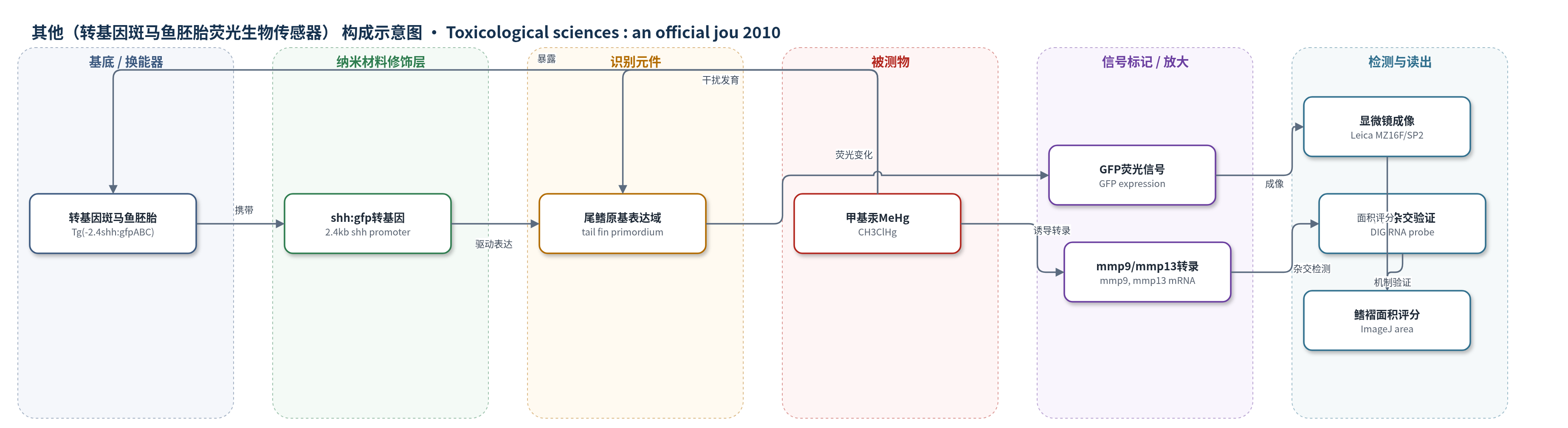
点击图片查看大图 · 依据论文自动绘制
传感器类型
其他(转基因斑马鱼胚胎荧光生物传感器)
检测对象
甲基汞(methyl mercury, MeHg);样品基质:斑马鱼胚胎培养基(模拟环境水样)
检测原理
MeHg 在 12–48 hpf 敏感窗口进入斑马鱼胚胎,干扰尾鳍原基形成与鳍褶发育。Tg(-2.4shh:gfpABC#15) 中 shh 启动子/增强子驱动的 GFP 表达域位于尾鳍原基;MeHg 暴露使该 GFP 表达域缩小(type I)或完全丢失(type II),从而将发育扰动转换为可量化的荧光信号变化。信号经显微镜成像和 ImageJ 面积/强度评分读出。机制上,MeHg 在 24 hpf 即诱导 mmp9 和 mmp13 等组织重塑蛋白酶转录,MMP 抑制剂 GM6001 或 MMP-9/MMP-13 Inhibitor II 可部分恢复鳍褶面积,提示蛋白酶介导的组织重塑参与毒性。
检测灵敏度
原文未报告 LOD、线性范围、R^2;有效浓度:6 μg/L(10% 胚胎 GFP 域缩小)、20 μg/L(>80% type I)、30 μg/L(全部缺陷且 >50% type II)、60 μg/L(>80% 完全丢失;86% 完全丢失);暴露窗口:12–48 hpf,6 h 暴露足够;鳍褶面积:100 μg/L MeHg 使后鳍褶面积减少约 2 倍,GM6001 或 MMP-9/MMP-13 Inhibitor II 分别增加 18% 和 25%。
效应效果
该转基因荧光读出对 MeHg 具有较高选择性:20 mg/L PbCl2、79 mg/L As2O3 和 15 mg/L CdCl2 均未引起尾鳍原基色素间隙消失或鳍褶缺陷,mmp9/mmp13 异位表达也主要见于 MeHg 处理。重复性方面,GFP 缺陷频率实验为五组独立实验,ANOVA/Dunnett p<0.01;鳍褶面积分析基于 86–92 次测量、四次独立实验,MMP 抑制剂效应 p<0.05。与文献中 27 μg/L 的 luciferase 报告胚胎和 266 μg/L 的细胞系相比,shh:gfp 胚胎在 6 μg/L 即可响应,且比 RT-PCR/原位杂交更敏感。作者认为其可用于活体、高通量、自动化图像采集的化学品毒性筛查。
传感器的构成
- 生物基底:Tg(-2.4shh:gfpABC#15) 转基因斑马鱼胚胎,作为活体报告与换能系统。
- 识别/响应元件:2.4 kb shh 启动子及 shh 内含子 1/2 的 ar-A、ar-B、ar-C 增强子元件,驱动 gfp 在尾鳍原基表达并响应 MeHg 诱导的发育扰动。
- 信号标记物:绿色荧光蛋白(GFP),其表达域缩小或丢失作为 MeHg 暴露的荧光读出。
- 暴露介质:胚胎培养基(Instant Ocean,pH 6.73,含 Ca、K、Mg、Na、S 等)中甲基汞氯化物(CH3ClHg)工作液,浓度 6–120 μg/L。
- 验证探针:DIG 标记反义 RNA 探针(mmp9、mmp13 等),经 T7/Sp6/T3 转录,用 anti-Dig POD、anti-DNP-HRP 及 tyramide signal amplification(TSA)/Cyanine 3/Cyanine 5 检测。
- 读出设备:Leica MZ16F 立体显微镜、Leica DM5000B 复合显微镜、Leica SP2 共聚焦显微镜,配合 ImageJ 分析鳍褶面积与 GFP 表达域。
- 机制验证试剂:GM6001、MMP-9/MMP-13 Inhibitor II、p53 morpholino、acridine orange(AO)和 caspase3 抗体,用于评估 MMP 活性、凋亡与缺陷关系。
中文摘要
本研究旨在表征模型环境毒物甲基汞(MeHg)在斑马鱼胚胎中的作用机制。作者将野生型和荧光报告转基因斑马鱼胚胎暴露于 MeHg,确定其有效浓度与暴露窗口,并通过原位杂交系统评估基因表达变化。结果显示,MeHg 损害鳍褶和尾鳍原基发育;在 6 μg/L MeHg 时即可观察到转基因表达改变,使 shh:gfp 品系成为对 MeHg 暴露最敏感的生物传感器。基质金属蛋白酶 mmp9 和 mmp13 以及另外八个基因在胚胎尾部被诱导表达。数据提示,MeHg 至少部分通过激活组织重塑蛋白酶 Mmp9 和 Mmp13 损害尾部发育。
英文摘要
The objective of this study was to characterize the mechanisms of action of the model environmental toxicant methyl mercury (MeHg) in the zebrafish embryo. Zebrafish embryos were exposed to MeHg, and the effective concentration and window of exposure were determined in wild-type and fluorescent reporter transgenic zebrafish embryos. Genes were systematically assessed for altered expression in response to MeHg by in situ hybridization. MeHg impairs development of the fin fold and the tail fin primordium. Alterations in transgene expression were noted at 6 microg/l MeHg, making this shh:gfp line the most sensitive biosensor of MeHg exposure. The matrix metalloproteases mmp9 and mmp13 and eight other genes are induced in the embryonic tail in response to MeHg. Our data suggest that MeHg impairs tail development at least partially by activation of the tissue remodeling proteases Mmp9 and Mmp13.