组成图示
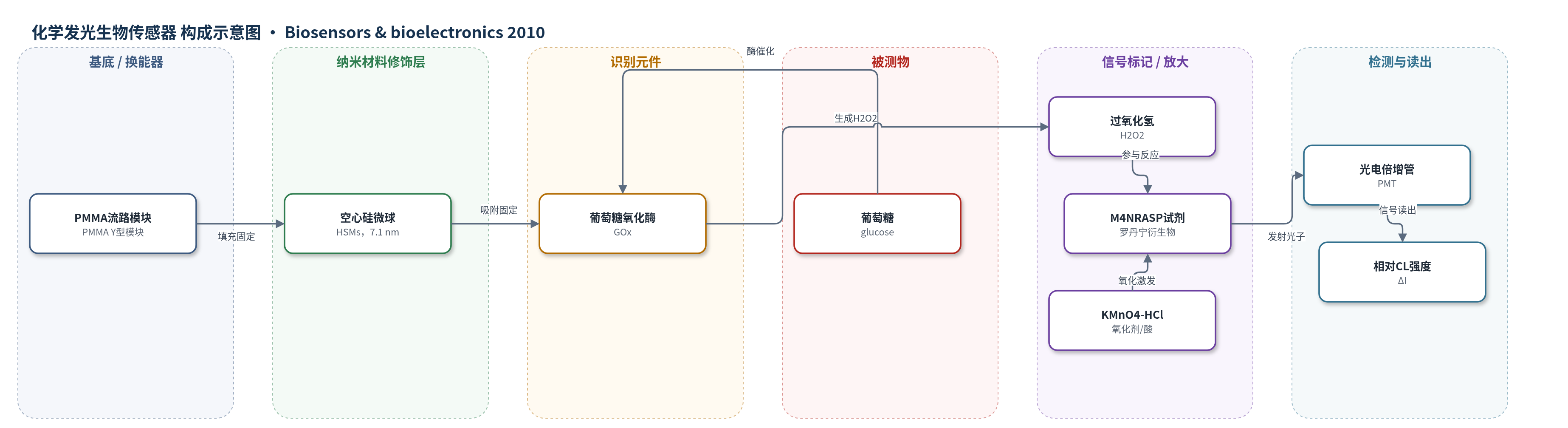
点击图片查看大图 · 依据论文自动绘制
传感器类型
化学发光生物传感器
检测对象
葡萄糖(glucose);样品基质为人血清(稀释50倍)及葡萄糖-PBS标准溶液
检测原理
葡萄糖在固定于空心硅微球(HSMs)内的葡萄糖氧化酶(GOx)催化下与氧气反应,生成葡萄糖酸和过氧化氢(H2O2)。H2O2 随葡萄糖浓度增加而增加,随后进入酸性高锰酸钾(KMnO4–HCl)体系,氧化罗丹宁衍生物 M4NRASP 使其进入激发态;激发态 M4NRASP 退激发射光子,由光电倍增管(PMT)检测化学发光强度。系统以相对发光强度 ΔI(样品信号 I 减去空白 I0)定量葡萄糖,因此 CL 信号与葡萄糖浓度正相关。HSMs 的多孔壳层和中空结构提高 GOx 固定量、稳定性和底物亲和力,使传感器具有宽线性范围和低检出限。
检测灵敏度
LOD: 8.0 × 10⁻⁷ mol L−1;线性范围: 7.72 × 10⁻⁶–2.54 × 10⁻² mol L−1;线性方程: ΔI = 1553.97 + 3593.62c(c: ×10−4 mol L−1);r = 0.9994
效应效果
该传感器选择性良好:K+、Na+、Mg2+、Cl−、Ca2+、Zn2+、多种氨基酸及乳酸耐受倍数≥1000,Fe3+、色氨酸、赖氨酸、亮氨酸≥500,组氨酸、精氨酸、抗坏血酸≥100,生理水平抗坏血酸干扰可接受。11 次重复 RSD<2.7%;400 次连续测量 RSD<5%,600 次后信号下降约 30%,4 ℃空气保存 6 周保留约 90% 初始信号。4 份人血清稀释 50 倍后检测,加标 2.00×10⁻³ mol/L,回收率 97.4%–104.1%,加标 RSD 1.1%–2.0%,与 YSI 2300 分析仪结果一致。
传感器的构成
- 检测模块:聚甲基丙烯酸甲酯(PMMA)Y型流路模块,承载 HSMs-GOx 并实现 CL 试剂同步注入
- 固定载体:空心硅微球(HSMs,mesoporous hollow silica microspheres,样品 B 孔径 7.1 nm、比表面积 882 m2 g−1),提供多孔壳层与中空内部用于酶固定
- 识别元件:葡萄糖氧化酶(GOx),吸附固定于 HSMs 中,催化葡萄糖氧化生成 H2O2
- 信号标记物:罗丹宁衍生物 M4NRASP(3-p-nitrylphenyl-5-(4′-methyl-2′-sulfonophenylazo)rhodanine),作为化学发光试剂
- 氧化/酸性试剂:高锰酸钾(KMnO4)与盐酸(HCl),与 M4NRASP 和 H2O2 构成 CL 体系
- 载体液:磷酸盐缓冲液(PBS,pH 7.4)或稀释人血清,输送样品并保护 GOx
- 读出装置:光电倍增管(PMT)/IFFM-D 流注入化学发光分析仪,检测相对 CL 强度 ΔI
- 固定床密封:玻璃棉(glass wool)堵塞 Branch-A 两端,固定 HSMs-GOx 床层
中文摘要
本研究利用具有中空内部和纳米孔壳层的空心硅微球(HSMs)固定酶,构建了一种新型化学发光生物传感器。系统研究了不同孔径 HSMs 中酶的固定行为,结果表明 HSMs 的孔径和比表面积对其固定性能具有重要影响。与传统固定方法相比,该方法不仅可提供可调且均一的孔道体系和受限微空间,还具有更大的酶固定容量和更高的吸附速率。作者采用罗丹宁衍生物–高锰酸钾–盐酸–过氧化氢(M4NRASP–KMnO4–HCl–H2O2)化学发光体系替代传统鲁米诺–辣根过氧化物酶–过氧化氢体系,以实现高灵敏度、操作简便并拓宽化学发光生物传感器的适用 pH 范围。以葡萄糖氧化酶为模型酶,该传感器对葡萄糖的线性范围为 7.72×10⁻⁶–2.54×10⁻² mol/L(r=0.9994),检出限为 8.0×10⁻⁷ mol/L,葡萄糖氧化酶的米氏常数为 0.3 mmol/L。将该方法应用于 4 份不同人血清样品中葡萄糖的检测,结果准确、令人满意。
英文摘要
In this work, hollow silica microspheres (HSMs), which have hollow interiors and nanoporous shells, were used in the immobilization of enzyme to establish a novel chemiluminescence biosensor. The immobilization behavior of enzyme in HSMs with different pore sizes has been studied. The results revealed that the pore size and the surface area of HSMs play important roles in their immobilization performance. Compared with traditional methods, this immobilization method not only provides tunable and consistent pore system and restricted microspaces for enzyme immobilization, but also exhibits a larger immobilization capacity and a higher adsorption rate. A rhodanine derivative-KMnO4-HCl-H2O2 was used to replace traditional chemiluminescence system (luminol-horseradish peroxidase-H2O2) to reach the purpose of high sensitivity, simple operation and pH expansion for chemiluminescence biosensor. The linear range of this novel method is 7.72 x 10(-6) to 2.54 x 10(-2) mol L(-1) (r=0.9994). The detection limit is 8.0 x 10(-7) mol L(-1). The Michaelis-Menten constant of glucose oxidase was 0.3 mmol L(-1). With glucose oxidase as a test enzyme, the proposed method gave an accurate and satisfactory result once applied to the determination of glucose in four different human serum samples.