组成图示
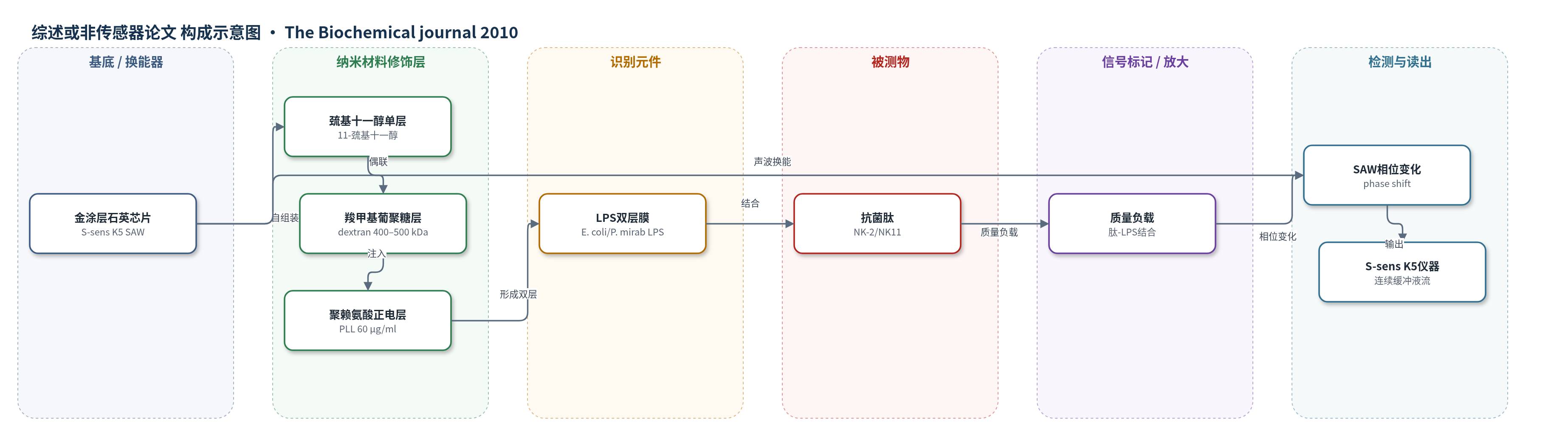
点击图片查看大图 · 依据论文自动绘制
传感器类型
综述或非传感器论文
检测对象
抗菌肽NK-2、NK11(NBD-NK-2用于完整细菌结合分析);样品基质:Hepes缓冲液(20 mM,pH 7.0,含/不含150 mM NaCl),结合对象为E. coli WBB01或P. mirabilis R45的LPS双层膜。
检测原理
在SAW换能器表面依次构建11-巯基十一醇自组装单层、羧甲基葡聚糖层和PLL正电层,再注入LPS聚集体形成固体支撑LPS双层膜。当含有抗菌肽NK-2或NK11的缓冲液流过表面时,带正电的肽通过静电作用结合到带负电的LPS头部基团,并进一步插入LPS双层膜。肽结合与插入使换能器表面质量负载增加,导致表面声波相位发生可逆或不可逆变化;相位变化近似与结合质量成正比,因此可实时反映肽-LPS结合量。脱附阶段相位回落程度反映结合亲和力。由于LPS结构决定肽结合量,不同菌株LPS上的相位响应差异可用于区分抗菌肽活性。
检测灵敏度
原文未报告LOD、线性范围、灵敏度斜率或相关系数。
效应效果
SAW显示100 μM NK-2使E. coli WBB01 LPS双层膜归一化相位最大增加84%,P. mirabilis R45为44%;NK11仅14%和18%,且NK-2脱附慢。FACS显示NBD-NK-2结合E. coli相对值为1.0,P. mirabilis为0.36±0.14。低盐下NK-2对E. coli WBB01的MIC/MBC为4/8 μg/ml,对P. mirabilis R45为8/32 μg/ml;生理盐下对P. mirabilis为64/>128 μg/ml。TEM/AFM、SYTOX Green、FRET和平面双层膜实验证实NK-2引起膜损伤、通透化、LPS插入及瞬态孔,稳定孔电导可达24 nS。作者认为LPS结合步骤决定差异活性。
传感器的构成
- 换能器基底:金涂层石英SAW芯片(S-sens K5 Biosensor Quartz Chips),提供表面声波换能与质量敏感界面。
- 自组装单层:11-巯基-1-十一醇(11-mercapto-1-undecanol)在金表面形成SAM,提供偶联位点。
- 聚合物垫层:葡聚糖(dextran,平均分子量400–500 kDa)经环氧氯丙烷偶联到SAM,形成支撑基质。
- 羧化层:溴乙酸(bromoacetic acid)羧化葡聚糖,形成带负电的羧甲基葡聚糖层。
- 正电固定层:聚-L-赖氨酸(PLL,60 μg/ml)形成正电荷层,促进LPS双层膜组装。
- LPS双层膜:E. coli WBB01或P. mirabilis R45的LPS聚集体(100 μM,180 μl两次注入)形成固体支撑LPS双层膜。
- 被测物:抗菌肽NK-2或NK11(100 μM注入),与LPS结合并产生质量负载变化。
- 信号读出:SAW相位变化(phase shift),近似反映表面质量负载,并归一化到LPS双层膜形成相位。
中文摘要
磷脂酰甘油常被用作模拟细菌胞质膜的模型,但仅凭该简单体系难以充分解释新型NK-2衍生抗菌肽的抗菌活性。由于含脂多糖(LPS)的外膜是革兰氏阴性菌的第一道屏障,本研究考察了NK-2及其缩短变体与活体大肠杆菌WBB01、奇异变形杆菌R45,以及由上述菌株分离LPS构建的模型膜的相互作用。两种LPS的净电荷与电荷分布差异曾被认为导致细菌对不同抗菌肽敏感性不同。透射电镜和原子力显微镜显示,NK-2介导的杀菌作用伴随外膜和内膜结构改变、大肠杆菌胞质释放以及奇异变形杆菌内形成独特纤维状结构,提示存在新的胞内靶点。NK-2可结合并插入LPS双层膜,最终在平面脂质双层膜中诱导瞬态异质损伤。然而,NK-2对两种菌株的鉴别活性并不依赖于膜插入和损伤形成,因为两者对两种LPS均无明显差异;活性差异来源于LPS结合步骤,这由NK-2与完整细菌结合以及表面声波生物传感器上固体支撑LPS双层膜结合实验证实。
英文摘要
Phosphatidylglycerol is a widely used mimetic to study the effects of AMPs (antimicrobial peptides) on the bacterial cytoplasmic membrane. However, the antibacterial activities of novel NK-2-derived AMPs could not be sufficiently explained by using this simple model system. Since the LPS (lipopolysaccharide)-containing outer membrane is the first barrier of Gram-negative bacteria, in the present study we investigated interactions of NK-2 and a shortened variant with viable Escherichia coli WBB01 and Proteus mirabilis R45, and with model membranes composed of LPS isolated from these two strains. Differences in net charge and charge distribution of the two LPS have been proposed to be responsible for the differential sensitivity of the respective bacteria to other AMPs. As imaged by TEM (transmission electron microscopy) and AFM (atomic force microscopy), NK-2-mediated killing of these bacteria was corroborated by structural alterations of the outer and inner membranes, the release of E. coli cytoplasma, and the formation of unique fibrous structures inside P. mirabilis, suggesting distinct and novel intracellular targets. NK-2 bound to and intercalated into LPS bilayers, and eventually induced the formation of transient heterogeneous lesions in planar lipid bilayers. However, the discriminative activity of NK-2 against the two bacterial strains was independent of membrane intercalation and lesion formation, which both were indistinguishable for the two LPS. Instead, differences in activity originated from the LPS-binding step, which could be demonstrated by NK-2 attachment to intact bacteria, and to solid-supported LPS bilayers on a surface acoustic wave biosensor.