组成图示
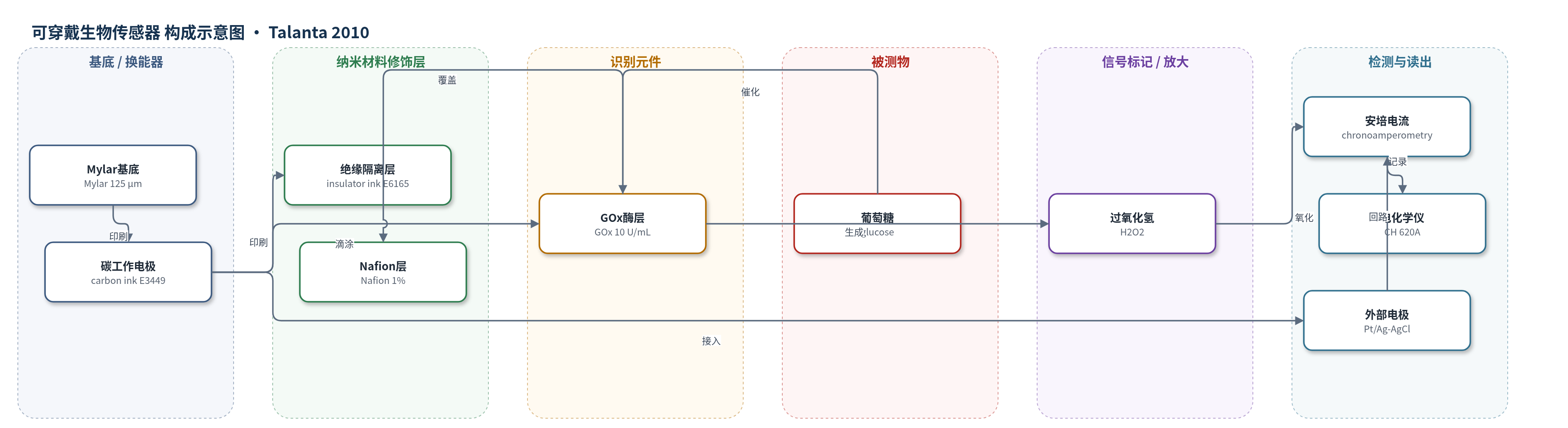
点击图片查看大图 · 依据论文自动绘制
传感器类型
可穿戴生物传感器
检测对象
葡萄糖(glucose);样品基质:0.1 M磷酸缓冲液(pH 7.0)
检测原理
葡萄糖扩散进入 Nafion®/GOx 修饰的碳丝网印刷电极,GOx 催化葡萄糖氧化并生成过氧化氢(H2O2)。在固定电位下,H2O2 于碳工作电极发生电化学氧化,产生与葡萄糖浓度相关的法拉第电流,采用恒电位计时安培法在 60 s 后采样。弯曲机械应力并未显著改变裸碳电极的表观面积或电子传递(亚铁氰化物循环伏安信号基本不变),也未明显改变 Nafion 膜通透性(H2O2 和邻苯二酚信号不变),但会改变 GOx 酶层形态或表面取向,提高底物可及性和生物催化效率,因此葡萄糖安培信号增强,且高浓度下更明显。
检测灵敏度
校准范围: 2–10 mM 和 2–80 mM;弯曲后灵敏度增强: 2.18-fold(2–10 mM)、>3.24-fold(>30 mM);Km,app: 5.6 mM(弯曲前)、9.4 mM(弯曲后)
效应效果
柔性 Nafion/GOx/碳 SPE 在 45°、90°、135° 和 180° 弯曲后均未失效,电阻由 175 Ω 增至约 220–230 Ω,延长弯曲至 10 或 20 min 影响很小。90° 弯曲 5 min 使 4 mM 葡萄糖电流增加 42%,180° 弯曲使电流增加 125%;重复弯曲后 180° 信号略降,90° 基本不变。背景电流几乎不受弯曲影响,H2O2、邻苯二酚和亚铁氰化物信号基本不变,表明弯曲主要改变生物催化活性并可能提高选择性。SEM 显示 Nafion 层形态无显著变化。作者认为该柔性酶/聚合物 SPE 有望用于糖尿病等可穿戴葡萄糖监测,但样品输送到活性表面仍是关键挑战。
传感器的构成
- 柔性基底:Mylar聚酯薄膜(125 μm,DuPont),提供可弯曲支撑。
- 碳工作电极:碳基墨水(E3449,Ercon)丝网印刷,约75 μm厚,作为换能器电极。
- 绝缘层:绝缘墨水(E6165,Ercon)印刷,限定工作电极面积10.5 mm2并隔离电路。
- 生物催化识别层:葡萄糖氧化酶(GOx,EC 1.1.3.4,Aspergillus niger)10 U/mL磷酸缓冲液滴涂2 μL,催化葡萄糖氧化。
- 聚合物修饰层:Nafion® 1%(95%乙醇稀释)滴涂2 μL,提供离子选择性、生物相容性并固定酶层。
- 外部电化学池:铂丝对电极、Ag/AgCl参比电极和塑料环氧环微型池,用于恒电位安培检测。
中文摘要
本文考察了柔性 Nafion®/葡萄糖氧化酶(GOx)/碳丝网印刷电极(SPE)葡萄糖生物传感器在弯曲诱导机械应力下的性能变化。结果表明,此类柔性酶/聚合物 SPE 在经历严重弯曲(包括 180° 对折)后仍能正常工作,并且弯曲后安培检测葡萄糖的灵敏度显著增强。该增强仅出现在葡萄糖底物的安培检测中,而在涂覆或裸 SPE 上测量过氧化氢、邻苯二酚或亚铁氰化物时未观察到。结合其他实验数据,弯曲效应主要与生物催化活性变化有关,而非电极面积、电子传递或聚合物膜通透性变化。灵敏度增强在高葡萄糖浓度下更明显,反映弯曲改变了生物催化反应。文章还考察了弯曲角度、时间和重复次数对性能的影响。数据表明柔性酶/聚合物 SPE 可耐受严重机械应力,有望用于可穿戴葡萄糖生物传感器,但样品向传感活性表面的输送仍是连续健康监测的主要挑战。
英文摘要
The influence of the bending-induced mechanical stress of flexible Nafion/GOx/carbon screen-printed electrodes (SPEs) upon the performance of such glucose biosensors has been examined. Surprisingly, such flexible enzyme/polymer-SPEs operate well following a severe bending-induced mechanical stress (including a 180 degrees pinch), and actually display a substantial sensitivity enhancement following their mechanical bending. The bending-induced sensitivity enhancement is observed only for the amperometric detection of the glucose substrate but not for measurements of hydrogen peroxide, catechol or ferrocyanide at coated or bare SPEs. These (and additional) data indicate that the bending effect is associated primarily with changes in the biocatalytic activity. Such sensitivity enhancement is more pronounced at elevated glucose levels, reflecting the bending-induced changes in the biocatalytic reaction. Factors affecting the bending-induced changes in the performance are examined. While our data clearly indicate that flexible enzyme/polymer-SPEs can tolerate a severe mechanical stress and hold promise as wearable glucose biosensors, delivering the sample to the active sensor surface remains the major challenge for such continuous health monitoring.