组成图示
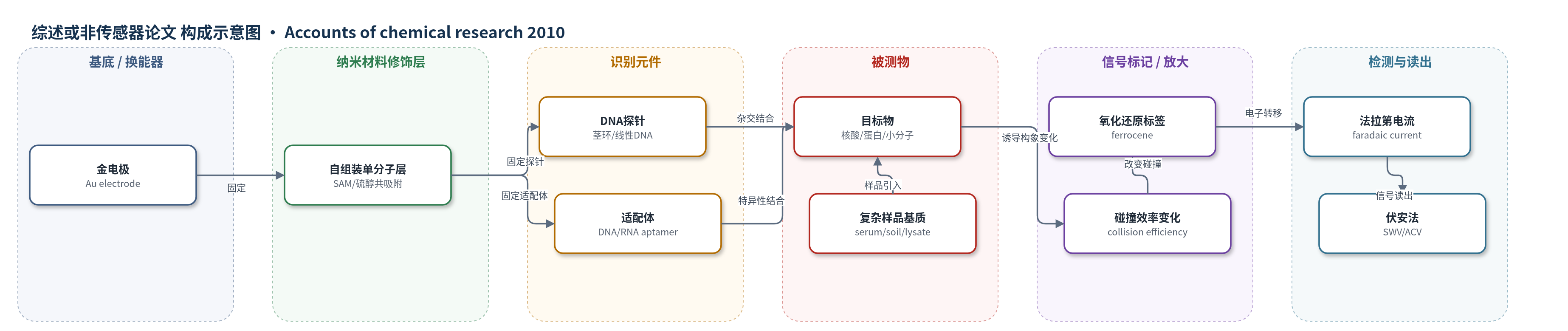
点击图片查看大图 · 依据论文自动绘制
传感器类型
综述或非传感器论文
检测对象
DNA序列(DNA sequences)、凝血酶(thrombin)、可卡因(cocaine)、钾离子(K+)、血小板衍生生长因子(PDGF)、碳纳米管(CNTs)、汞(II)(Hg(II))、茶碱(theophylline)、ATP、铅(II)(Pb(II))、DNA结合蛋白(DNA-binding proteins)、TNT/抗TNT抗体;样品基质:缓冲液、血液血清、全血、细胞裂解液、土壤提取物、食品、唾液、尿液
检测原理
传感器将氧化还原标记的 DNA 或适配体探针通过硫醇自组装固定于金电极。无目标时,探针保持茎环、假结或单链构象,使二茂铁等氧化还原标签与电极保持特定距离,产生基线法拉第电流。目标结合后,发生杂交、链置换、假结解开或适配体折叠,改变探针柔性和氧化还原标签与电极的碰撞频率。依据碰撞效率模型,结合态电子转移效率下降或上升,导致电流降低或升高;信号-on 架构通过链置换或假结释放使背景接近零,获得更高增益。电化学伏安法读出电流变化,信号随目标浓度增加而单调变化。探针密度拥挤可增强结合态电子转移抑制,提高灵敏度。
检测灵敏度
LOD: sub-nanomolar;LOD: ∼200 pM;LOD: sub-picomolar;LOD: 20 nM;LOD: 3 nM;LOD: 500 pM;LOD: 50 pM;LOD: 100 nM;LOD: 2 nM;LOD: parts per billion;LOD: parts-per-trillion
效应效果
该平台响应迅速,平衡半衰期可小于 1 至 30 min,简单水洗即可再生,信号回收率超过 99%。在 50000 倍过量基因组 DNA 存在下仍保持序列特异性响应,并可直接用于血液血清、全血、唾液、尿液、食品、土壤悬浮液和细胞裂解液等复杂样品。可卡因传感器可在未稀释流动血清中实时检测。信号-on 架构分别获得 600%、700% 和约 300% 的电流增益。传感器可制备在微米尺度电极上并集成阵列。原文未报告 RSD、加标回收率或与 ELISA、HPLC、qPCR 的直接对比。作者认为其适合芯片化病原体检测、蛋白质组学、代谢组学和药物发现。
传感器的构成
- 基底/换能器电极:金电极(Au electrode),提供电子转移界面并用于电化学检测
- 自组装单分子层(SAM):硫醇端 DNA 探针与 6/11 碳硫醇共吸附物,形成有序界面并固定探针
- 识别元件:茎环/线性/假结 DNA 探针或 DNA/RNA 适配体(aptamer),结合目标后改变构象与柔性
- 氧化还原信号标记:二茂铁(ferrocene, FC),产生法拉第电流
- 小分子受体支架:双链 DNA 支架连接生物素(biotin)或地高辛(digoxigenin),用于蛋白-小分子相互作用检测
- 三硫醇锚定基团:增强探针与金电极的化学吸附稳定性,提高传感器寿命
中文摘要
生物分子识别具有高亲和力和高特异性,但多数生物分子在结合目标后不产生易于测量的信号,这限制了无试剂、实时生物传感器的发展。本文综述了基于结合诱导电极固定 DNA 探针“折叠”的电化学生物传感器。该类传感器将氧化还原标记的 DNA 或适配体探针特异性固定于金电极表面,目标结合后诱导探针发生构象变化或柔性改变,从而改变氧化还原标签与电极之间的碰撞效率,产生可检测的法拉第电流变化。该平台已推广至核酸、蛋白和小分子目标,响应时间为秒至分钟,检测范围覆盖亚皮摩尔至微摩尔浓度,且无需试剂、可重复使用超过 99%。由于信号来源于结合特异性物理变化而非简单吸附,传感器可在血液血清、全血、细胞裂解液、土壤提取物和食品等复杂样品中直接检测,并支持实时监测未稀释流动血清中的小分子。作者认为其适合芯片化病原体检测、蛋白质组学、代谢组学和药物发现应用。
英文摘要
Biomolecular recognition is versatile, specific, and high affinity, qualities that have motivated decades of research aimed at adapting biomolecules into a general platform for molecular sensing. Despite significant effort, however, so-called "biosensors" have almost entirely failed to achieve their potential as reagentless, real-time analytical devices; the only quantitative, reagentless biosensor to achieve commercial success so far is the home glucose monitor, employed by millions of diabetics. The fundamental stumbling block that has precluded more widespread success of biosensors is the failure of most biomolecules to produce an easily measured signal upon target binding. Antibodies, for example, do not change their shape or dynamics when they bind their recognition partners, nor do they emit light or electrons upon binding. It has thus proven difficult to transduce biomolecular binding events into a measurable output signal, particularly one that is not readily spoofed by the binding of any of the many potentially interfering species in typical biological samples. Analytical approaches based on biomolecular recognition are therefore mostly cumbersome, multistep processes relying on analyte separation and isolation (such as Western blots, ELISA, and other immunochemical methods); these techniques have proven enormously useful, but are limited almost exclusively to laboratory settings. In this Account, we describe how we have refined a potentially general solution to the problem of signal detection in biosensors, one that is based on the binding-induced "folding" of electrode-bound DNA probes. That is, we have developed a broad new class of biosensors that employ electrochemistry to monitor binding-induced changes in the rigidity of a redox-tagged probe DNA that has been site-specifically attached to an interrogating electrode. These folding-based sensors, which have been generalized to a wide range of specific protein, nucleic acid, and small-molecule targets, are rapid (responding in seconds to minutes), sensitive (detecting sub-picomolar to micromolar concentrations), and reagentless. They are also greater than 99% reusable, are supported on micrometer-scale electrodes, and are readily fabricated into densely packed sensor arrays. Finally, and critically, their signaling is linked to a binding-specific change in the physics of the probe DNA, and not simply to adsorption of the target onto the sensor head. Accordingly, they are selective enough to be employed directly in blood, crude soil extracts, cell lysates, and other grossly contaminated clinical and environmental samples. Indeed, we have recently demonstrated the ability to quantitatively monitor a specific small molecule in real-time directly in microliters of flowing, unmodified blood serum. Because of their sensitivity, substantial background suppression, and operational convenience, these folding-based biosensors appear potentially well suited for electronic, on-chip applications in pathogen detection, proteomics, metabolomics, and drug discovery.