组成图示
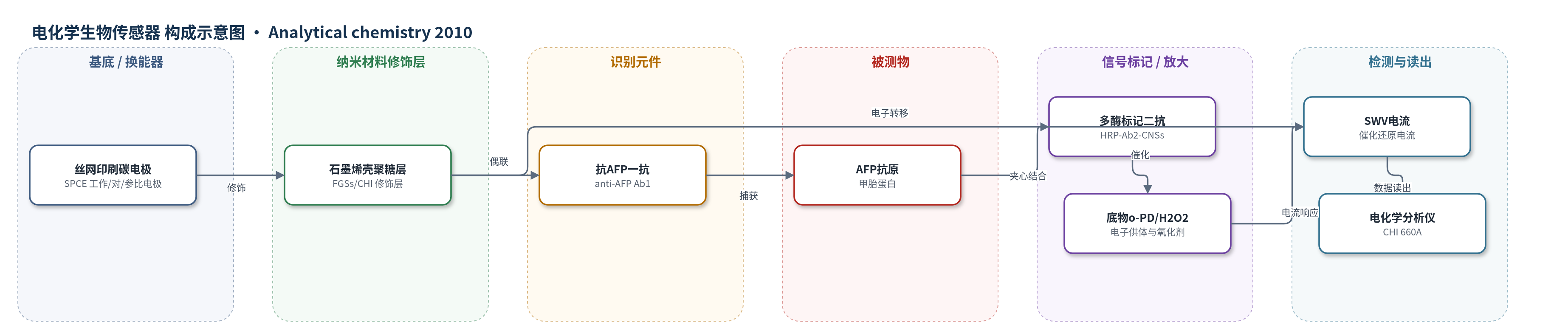
点击图片查看大图 · 依据论文自动绘制
传感器类型
电化学生物传感器
检测对象
AFP(甲胎蛋白,alpha-fetoprotein,AFP);样品基质:PBS 标准溶液与人血清加标样品
检测原理
该传感器基于夹心免疫反应与酶催化电化学检测。抗 AFP 一抗(Ab1)固定在石墨烯-壳聚糖修饰的丝网印刷碳电极上,捕获样品中的 AFP;随后 HRP-Ab2-CNSs 与 AFP 结合,将大量辣根过氧化物酶(HRP)引入电极界面。石墨烯片提供高比表面积以固定更多 Ab1,并加速电子转移;均一多孔碳纳米球(CNSs)作为载体负载多个 HRP-Ab2,使每个免疫结合事件携带多酶信号,实现双重放大。检测时加入邻苯二胺(o-PD)和过氧化氢(H2O2),HRP 催化 o-PD 与 H2O2 反应,产生可电化学检测的催化还原电流。AFP 浓度越高,界面 HRP 越多,SWV 电流越大。
检测灵敏度
LOD: 0.02 ng mL-1;线性范围: 0.05–6 ng mL-1;灵敏度斜率: 3.167 µA/(ng mL-1);线性方程: ip(µA) = 3.167c + 0.7367
效应效果
该传感器对 AFP 选择性良好:在 2 ng/mL AFP 中加入 CEA、CA125 和 PSA 时电流无明显变化。血清加标回收率为 97.1%–104.6%,与 ELISA 回收率 97.4%–103.8% 相比相对偏差低于 3.0%。批内 CV 为 3.5%(0.1 ng/mL)和 5.9%(2.0 ng/mL),批间 CV 为 4.3% 和 5.5%。HRP-Ab2-CNSs 分散液至少稳定 3 周。与未使用石墨烯和 CNSs 的传感器相比信号提高约 7 倍,检出限与 SiO2 纳米颗粒标记法(0.01 ng/mL)相当,优于羧基树脂微球法(1 ng/mL),适合癌症标志物筛查和即时诊断。
传感器的构成
- 基底/换能器电极:一次性丝网印刷碳电极(SPCE),含工作碳电极、碳对电极和 Ag/AgCl 参比电极,用于电化学检测
- 纳米材料修饰层:功能化石墨烯片(FGSs)与壳聚糖(CHI)复合修饰工作碳电极,形成 GS-CHI/SPCE,增大比表面积并促进电子转移
- 识别元件:抗 AFP 小鼠单克隆一抗(Ab1)通过 EDC/NHS 偶联到石墨烯/壳聚糖表面,用于捕获 AFP
- 封闭剂:3% 牛血清白蛋白(BSA)/PBS 封闭非特异性结合位点
- 信号标记物:辣根过氧化物酶标记抗 AFP 二抗(HRP-Ab2)负载于碳纳米球(CNSs)形成 HRP-Ab2-CNSs,用于夹心识别并催化底物
- 电子供体/底物:邻苯二胺(o-PD)和过氧化氢(H2O2),在 HRP 催化下产生可电化学检测的还原电流
中文摘要
本文报道了一种用于灵敏检测癌症生物标志物甲胎蛋白(AFP)的电化学免疫传感器。该传感器以功能化石墨烯片(FGSs)为传感平台,并利用负载辣根过氧化物酶标记二抗(HRP-Ab2)的碳纳米球(CNSs)作为信号标记物。其高灵敏度来自双重信号放大策略:一方面,水热法合成的 CNSs 粒径均一、分布窄,可在每个纳米球上负载多个 HRP-Ab2,通过夹心免疫反应将多酶生物偶联物引入电极表面,使每个识别事件产生多个催化信号;另一方面,功能化石墨烯片增大了电极比表面积,可固定大量抗 AFP 一抗(Ab1),从而提高抗原捕获量并加速电子转移。与未使用石墨烯修饰和 CNSs 标记的免疫传感器相比,该传感器检测信号提高约 7 倍。方法对 AFP 的检出限为 0.02 ng/mL,线性范围为 0.05–6 ng/mL,有望用于癌症生物标志物临床筛查和即时诊断。
英文摘要
A novel electrochemical immunosensor for sensitive detection of cancer biomarker alpha-fetoprotein (AFP) is described that uses a graphene sheet sensor platform and functionalized carbon nanospheres (CNSs) labeled with horseradish peroxidase-secondary antibodies (HRP-Ab2). Greatly enhanced sensitivity for the cancer biomarker is based on a dual signal amplification strategy: first, the synthesized CNSs yielded a homogeneous and narrow size distribution, which allowed several binding events of HRP-Ab2 on each nanosphere. Enhanced sensitivity was achieved by introducing the multibioconjugates of HRP-Ab2-CNSs onto the electrode surface through "sandwich" immunoreactions. Second, functionalized graphene sheets used for the biosensor platform increased the surface area to capture a large amount of primary antibodies (Ab1), thus amplifying the detection response. On the basis of the dual signal amplification strategy of graphene sheets and the multienzyme labeling, the developed immunosensor showed a 7-fold increase in detection signal compared to the immunosensor without graphene modification and CNSs labeling. The proposed method could respond to 0.02 ng mL(-1) AFP with a linear calibration range from 0.05 to 6 ng mL(-1). This amplification strategy is a promising platform for clinical screening of cancer biomarkers and point-of-care diagnostics.