组成图示
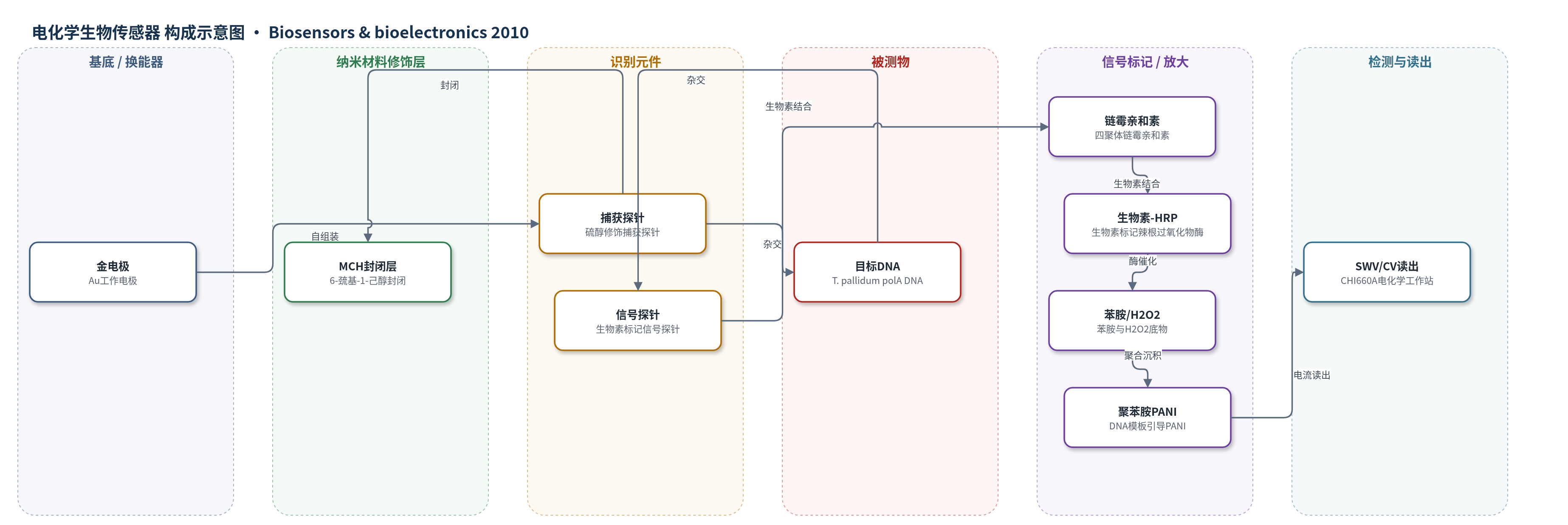
点击图片查看大图 · 依据论文自动绘制
传感器类型
电化学生物传感器
检测对象
梅毒螺旋体 polA 基因片段 DNA(T. pallidum polA gene fragment DNA / syphilis DNA),样品基质:基因组 DNA 的 PCR 扩增产物、合成互补 DNA
检测原理
金电极表面自组装硫醇捕获探针,与梅毒螺旋体 polA 基因片段目标 DNA 杂交;随后生物素标记信号探针与目标 DNA 另一端杂交,形成夹心结构。链霉亲和素结合信号探针上的生物素,生物素标记 HRP 再结合链霉亲和素,使多个 HRP 富集于电极表面。在 pH 4.3 的 HAc-NaAc 缓冲液中,HRP 催化 H2O2 氧化苯胺,杂交 DNA 骨架的磷酸基团提供局部酸性环境和模板,引导苯胺以头-尾方式聚合为导电聚苯胺(PANI)。目标 DNA 越多,沉积的 PANI 越多,其氧化还原峰电流越大,从而通过 SWV/CV 实现定量检测。
检测灵敏度
LOD: 0.5 pM (S/N = 3);线性范围: 1.0 pM–1.0 nM;线性方程: Ip (nA) = 12.9 + 0.97 C (pM);相关系数: 0.998
效应效果
该传感器对非互补 DNA 无 PANI 氧化还原峰,PCR 空白不产生干扰,表明选择性良好。PANI 形成后经充分洗涤和电位循环无明显变化,显示一定稳定性;对 PCR 扩增 polA 产物进行三次重复测量,结果可重现。实际样品中,将 T. pallidum 基因组 DNA 经 PCR 扩增后稀释检测,峰电流随 PCR 产物浓度增加而增大,并与 Southern blot 杂交结果一致。其检出限 0.5 pM 低于文献报道的 HIV 特异性 DNA 金纳米棒光散射法(80 pM)和自组装单分子层电化学法(0.3 nM),作者认为该平台可用于新发传染病中特异性 DNA 的可靠、灵敏、选择性诊断。
传感器的构成
- 基底/换能器:金电极(Au),工作电极,经抛光和清洗后用于电化学检测。
- 识别元件:硫醇修饰捕获探针(capture probe,5′-SH-(CH2)6-TGGTGTGGTCGCGTTTGATTG-3′),自组装于 Au 表面,特异性杂交目标 polA DNA。
- 封闭剂:6-巯基-1-己醇(MCH),封闭未修饰金表面,降低非特异性吸附。
- 识别元件:生物素标记信号探针(biotinylated signal probe,5′-CTCTTCATACCGAGTCAACTCA-Biotin-3′),与目标 DNA 杂交形成夹心结构。
- 信号标记物:链霉亲和素(streptavidin),结合信号探针 3′ 端生物素,提供多价结合位点。
- 信号标记物:生物素标记辣根过氧化物酶(biotin-HRP),通过生物素-链霉亲和素结合固定,催化苯胺聚合。
- 信号放大层:聚苯胺(PANI),在杂交 DNA 模板引导下由 HRP 催化 H2O2 氧化苯胺沉积,形成电活性导电聚合物。
- 反应底物/电子供体:H2O2 与苯胺(aniline),HRP 催化氧化苯胺生成 PANI 的原料。
中文摘要
本文提出一种基于酶催化聚苯胺(PANI)目标引导形成的超灵敏电化学生物传感器,用于检测梅毒螺旋体(Treponema pallidum)特异性 polA 基因片段 DNA。该检测依赖 DNA 杂交和生物素-链霉亲和素相互作用:生物素标记辣根过氧化物酶(HRP)与链霉亲和素修饰的杂交体结合后,以杂交 DNA 为模板形成头-尾结构的 PANI。PANI 的电流响应与目标 DNA 浓度在 1.0 pM 至 1.0 nM 范围内呈线性关系,相关系数为 0.998;在信噪比为 3 时检出限为 0.5 pM。DNA 杂交、生物素-链霉亲和素强结合能力和高效聚合的协同作用,为构建简单、高灵敏、高选择性的生物传感器提供了通用平台,可用于 T. pallidum 特异性 polA 基因片段的检测,并有望用于疾病诊断。
英文摘要
An ultrasensitive assay for electrical biosensing of syphilis DNA was proposed by using target-guided formation of polyaniline (PANI) based on an enzymatically catalyzed method. The sensitive biodetection relies on the DNA hybridization and biotin-streptavidin interaction. After coupling of biotinylated catalase with streptavidin-modified hybrids, a head-to-tail structure of PANI templated by hybridized DNA was formed. The current response of PANI was linearly related to target DNA concentration between 1.0 pM and 1.0 nM with a correlation coefficient of 0.998. The detection limit was determined to be 0.5 pM with the signal-to-noise ratio of 3. The synergistic performances of DNA hybridization, strong biotin-streptavidin binding ability, and highly efficient polymerization provide a general platform for simple, highly sensitive and selective biosensor for the detection of the specific polA gene fragment of T. pallidum. It is expected that the proposed biosensor holds great promise for diagnosing disease in practice.