组成图示
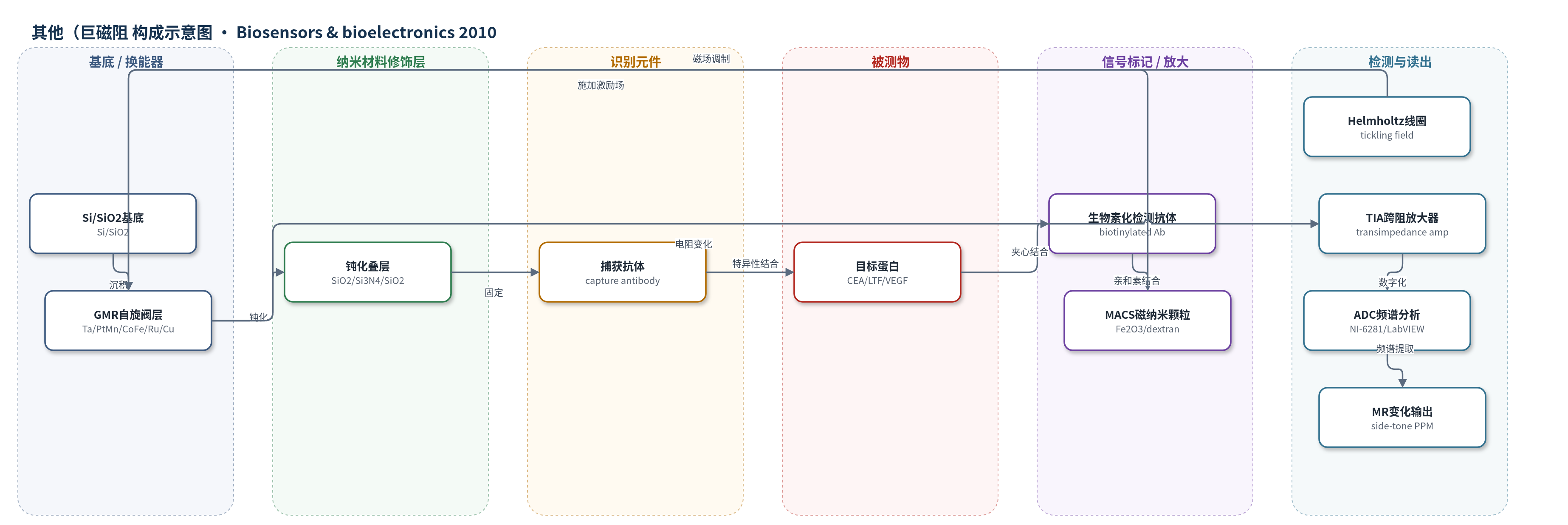
点击图片查看大图 · 依据论文自动绘制
传感器类型
其他(巨磁阻(GMR)磁生物传感器)
检测对象
癌胚抗原(CEA)、乳铁蛋白(LTF)、血管内皮生长因子(VEGF);样品基质:0.1% BSA/生理盐水、小鼠血清加标样品、反应井蛋白样品
检测原理
捕获抗体固定在 GMR 自旋阀表面,目标蛋白结合后,生物素化检测抗体形成夹心复合物;链霉亲和素功能化的超顺磁 Fe2O3 磁纳米颗粒(MNP)通过链霉亲和素–生物素结合附着。MNP 的杂散磁场改变自旋阀局部磁场,使电阻发生巨磁阻变化。系统采用双调制:Helmholtz 线圈以 ff 施加 tickling field,激励电压以 fc 调制,使磁阻分量出现在 fc±ff 边音中,避开 1/f 噪声。TIA 将电流变化转为电压,复制路径抑制载波,ADC 与 LabVIEW 做 FFT 提取边音幅值。边音 MR 变化与表面结合 MNP 数量及蛋白浓度成正比,无需酶放大。
检测灵敏度
LOD: 5 fM;线性范围: 对数–对数线性至 5 fM(原文未给出上限)
效应效果
系统对两个盲加标小鼠血清样品进行定量检测:样品 A 测得 66 fM,实际 75 fM,偏差 12%;样品 B 测得 6.9 fM,实际 7.5 fM,偏差 8%;同一样品 ELISA 无信号,说明灵敏度低于 ELISA 检出限。多路复用实验中,CEA、LTF 和 VEGF 以不同浓度在同一 20–50 µL 反应井内被同时监测,环氧涂层与 BSA 阴性对照基本无信号,显示低电子噪声和非特异结合可忽略。各重复传感器信号一致,体现芯片内重现性。64 传感器阵列全扫描小于 4 s,表 1 给出 0.06 s/传感器,FOM 为 4.4×10^-11。作者认为该平台适用于癌症诊断和辐射分诊中的生物标志物检测。
传感器的构成
- 基底/换能器:Si/SiO2 基底,承载自旋阀 GMR 传感条并作为机械支撑。
- GMR 自旋阀层:Ta/seed/PtMn/CoFe/Ru/CoFe/Cu/CoFe/Cu/Ta 多层膜,利用巨磁阻效应将磁场变化转换为电阻变化。
- 钝化层:SiO2/Si3N4/SiO2 叠层,隔离传感器与生物化学溶液。
- 封装/反应腔:84 引脚陶瓷封装、开放反应井或微流控腔,容纳样品并实现引线键合。
- 识别元件:捕获抗体(capture antibody)共价固定于传感器表面,特异性结合目标蛋白。
- 检测标记:生物素化检测抗体(biotinylated detection antibody),与目标蛋白形成夹心复合物。
- 信号标记:MACS 磁纳米颗粒(MNP,13 nm Fe2O3 嵌入 50 nm 葡聚糖壳,链霉亲和素 streptavidin 功能化),通过链霉亲和素–生物素结合提供磁信号。
- 激励/读出:外部 Helmholtz 线圈施加调制磁场,TIA 跨阻放大器与 NI-6281 ADC/LabVIEW 读取电阻变化。
中文摘要
巨磁阻(GMR)生物传感器正成为高灵敏度、可定量生物分子检测的重要平台。然而,要与现有光学蛋白微阵列技术竞争,必须在保持小阵列(1–8个传感器)高灵敏度和快速读出特性的同时,增加传感器数量。本文提出一种可扩展至64个独立可寻址传感器的电路架构,并能在4 s内完成整个阵列扫描。该系统同时采用时域复用和频域复用,以实现高速读出。为实现这一目标,作者提出一种不使用经典惠斯通电桥测量传感器微小电阻变化的新电路架构,而是围绕跨阻放大器(TIA)进行设计。文中详细分析了该架构的噪声、失真和潜在误差来源,并给出了包含磁标签、传感器和接口电子的全局优化策略。为验证灵敏度,作者对两个盲加样、浓度未知样品进行了定量检测,其浓度低于酶联免疫吸附试验(ELISA)的检出限。最后,通过同时实时监测功能化三种不同蛋白的传感器在不同浓度下的响应,展示了系统的多路复用能力和重现性。
英文摘要
Giant magnetoresistive biosensors are becoming more prevalent for sensitive, quantifiable biomolecular detection. However, in order for magnetic biosensing to become competitive with current optical protein microarray technology, there is a need to increase the number of sensors while maintaining the high sensitivity and fast readout time characteristic of smaller arrays (1-8 sensors). In this paper, we present a circuit architecture scalable for larger sensor arrays (64 individually addressable sensors) while maintaining a high readout rate (scanning the entire array in less than 4s). The system utilizes both time domain multiplexing and frequency domain multiplexing in order to achieve this scan rate. For the implementation, we propose a new circuit architecture that does not use a classical Wheatstone bridge to measure the small change in resistance of the sensor. Instead, an architecture designed around a transimpedance amplifier is employed. A detailed analysis of this architecture including the noise, distortion, and potential sources of errors is presented, followed by a global optimization strategy for the entire system comprising the magnetic tags, sensors, and interface electronics. To demonstrate the sensitivity, quantifiable detection of two blindly spiked samples of unknown concentrations has been performed at concentrations below the limit of detection for the enzyme-linked immunosorbent assay. Lastly, the multiplexing capability and reproducibility of the system was demonstrated by simultaneously monitoring sensors functionalized with three unique proteins at different concentrations in real-time.