组成图示
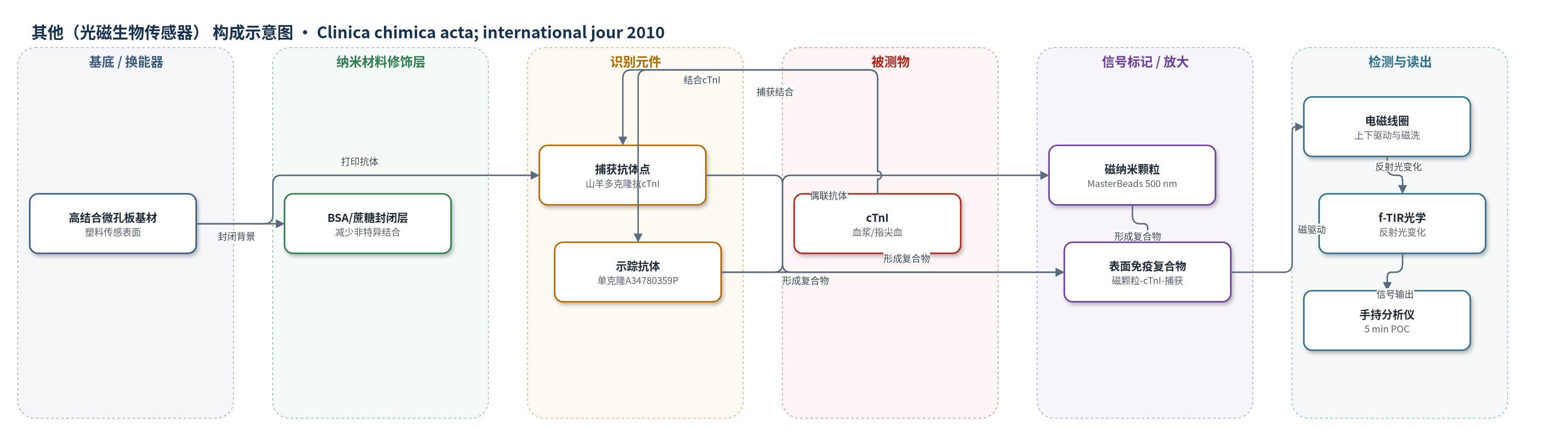
点击图片查看大图 · 依据论文自动绘制
传感器类型
其他(光磁生物传感器)
检测对象
心肌肌钙蛋白I(cardiac troponin I, cTnI);样品基质:血浆、EDTA全血/指尖血
检测原理
该传感器采用一步法夹心免疫分析。卡盒中预干燥的羧基超顺磁纳米颗粒偶联示踪抗体,加入样本后迅速再分散并与cTnI结合。上下电磁线圈施加交替磁场,将磁颗粒驱动至传感表面,使其与预印捕获抗体结合;随后施加反向磁场洗去未结合和弱结合颗粒。检测基于受激全内反射(f-TIR):光在传感表面形成倏逝场,表面附近磁颗粒散射/吸收光,使反射光强度下降。cTnI浓度越高,表面结合的磁颗粒越多,反射光下降越大,信号与浓度呈线性关系。磁场精确控制孵育与分离,避免流动和孵育时间差异,提高线性与灵敏度。
检测灵敏度
LOD: 0.03 ng/mL(1 pM);线性范围: 0.03–6.5 ng/mL;斜率: 37±4;截距: 0.22±0.01;R^2 = 0.98;扩展测量范围: 100 ng/mL
效应效果
该原型在血浆中5 min完成检测,25 μL全血经滤膜分离约1 μL血浆即可分析。13 ng/mL cTnI时信噪比>70,信空白比>100;0.5 ng/mL血浆批内不精密度为14%。通过150 μg/mL与9.4 μg/mL两个捕获抗体斑点,动态范围扩展约10倍至100 ng/mL,且130 ng/mL内未出现高剂量钩状效应。干试剂4 ℃保存14周性能稳定,25–40 ℃可工作,40 ℃以上空白略增。全血加标实验显示滤膜对cTnI有一定吸附,回收率偏低,作者正优化滤膜封闭。平台可成像>30个斑点,支持多路检测,适合急诊、救护车和居家等即时诊断场景。
传感器的构成
- 基底/传感表面:高结合微孔板基材(high binding microtiter plate substrate)注塑塑料底部,承载捕获抗体点
- 识别元件(捕获抗体):山羊多克隆抗cTnI抗体(Hytest),150 mg/L PBS喷墨打印于传感表面,形成免疫捕获点
- 封闭层:10 g/L BSA、100 g/L蔗糖PBS封闭背景,减少非特异结合
- 纳米材料修饰/信号标记:羧基超顺磁纳米颗粒 MasterBeads 500 nm(Ademtech),作为磁标签
- 识别元件(示踪抗体):单克隆抗体 A34780359P(BiosPacific)偶联到磁颗粒,捕获cTnI
- 干试剂/分散介质:50 g/L蔗糖、50 g/L BSA的PBS干燥缓冲液,保持颗粒干燥并快速再分散
- 样品处理层:Pall血分离滤膜(全血时),从指尖血分离血浆
- 换能/驱动与读出:上下电磁线圈(铜线圈绕2.5 mm钴铁合金芯)与f-TIR光学,控制磁颗粒并读取反射光变化
中文摘要
本文报道了一种基于光磁技术的便携式即时检测原型装置,用于在指尖血样本中快速、灵敏地检测心肌肌钙蛋白I(cTnI),检测周转时间约5分钟。检测在一次性塑料卡盒中完成,卡盒内置干试剂和超顺磁纳米颗粒。采用一步法夹心免疫分析,通过置于卡盒上下的电磁体精确控制反应过程:磁颗粒先与样本中的cTnI结合,再被驱动至传感表面与捕获抗体结合,随后用磁场洗去未结合及弱结合颗粒。500 nm磁颗粒标签通过受激全内反射(f-TIR)光学技术检测。血浆校准结果显示检出限为0.03 ng/mL cTnI;0.03–6.5 ng/mL范围内线性回归斜率为37±4,R²=0.98。通过同时成像第二个低抗体浓度斑点,测量范围可显著扩展至100 ng/mL。作者认为该技术兼具高分析性能与易用性,适合高要求的即时诊断应用。
英文摘要
BACKGROUND: We present a prototype handheld device based on a newly developed optomagnetic technology for the sensitive detection of cardiac troponin I (cTnI) in a finger-prick blood sample with a turnaround time of 5 min.
METHODS: The test was completed in a compact plastic disposable with on-board dry reagents and superparamagnetic nanoparticles. In our one-step assay, all reaction processes were precisely controlled using electromagnets positioned above and below the disposable. Nanoparticle labels (500 nm) bound to the sensor surface via a sandwich immunoassay were detected using the optical technique of frustrated total internal reflection.
RESULTS: A calibration function measured in plasma demonstrates a limit of detection (mean of blank plus 3-fold the standard deviation) of 0.03 ng/mL cTnI. A linear regression analysis of the region 0.03-6.5 ng/mL yields a slope of 37+/-4, and a linear correlation coefficient of R2=0.98. The measuring range could be extended substantially to 100 ng/mL by simultaneously imaging a second spot with a lower antibody concentration.
CONCLUSIONS: The combination of magnetic particles and their fine actuation with electromagnets permits the rapid and sensitive detection of cTnI. Because of the potential high analytical performance and ease-of-use of the test, it is well suited for demanding point-of-care diagnostic applications.