组成图示
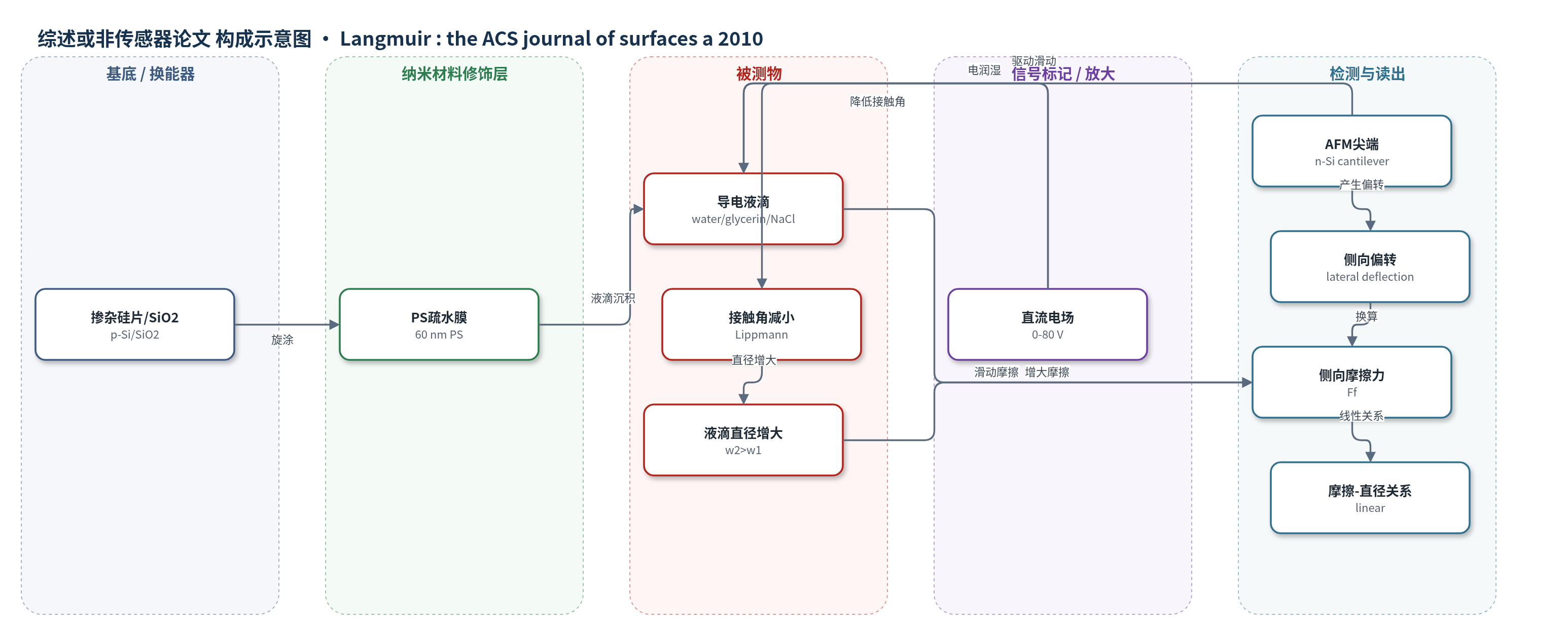
点击图片查看大图 · 依据论文自动绘制
传感器类型
综述或非传感器论文
检测对象
液滴滑动侧向摩擦力(lateral friction force);样品基质:聚苯乙烯(PS)疏水表面上的水/甘油/NaCl导电液滴
检测原理
AFM悬臂梁尖端横向推动聚苯乙烯表面上的导电液滴,液滴前缘和后缘分别形成前进接触角与后退接触角,接触角滞后使液滴前后毛细力不平衡,产生滑动阻力。侧向摩擦力近似与液滴宽度或直径成正比,因此不同直径液滴的滑动力呈线性关系。施加直流电场后,电润湿效应降低液-固界面张力,Lippmann方程描述接触角随电位平方减小;接触角减小使液滴铺展,直径增大,从而增加滑动所需侧向摩擦力。AFM悬臂梁侧向偏转信号经校准换算为力,信号随液滴直径和施加电位升高而增大。
检测灵敏度
原文未报告LOD、线性范围、灵敏度斜率或相关系数。
效应效果
该文未报告选择性、抗干扰、稳定性、重现性、实际样品加标回收率或与ELISA/HPLC/qPCR等方法的对比。实验定量测量了不同直径液滴的滑动力:无电场时侧向摩擦力随液滴直径线性增加;施加20 V后,各液滴的侧向摩擦力均明显增大,且仍随直径增加;对约16.5 μm液滴施加0–80 V时,摩擦力随电位升高而增大。作者认为滑动力测量可定量评估液滴滑动能力,对微纳流控液滴操控、边界滑移研究和相关生物传感器应用具有参考价值,并指出可通过电场或绝缘层厚度调节滑动力。
传感器的构成
- 基底/换能器电极材料:p型硼掺杂硅片(1–20 Ω cm)与300 nm热氧化SiO2,提供导电基底和绝缘层。
- 表面修饰层:约60 nm聚苯乙烯(PS)旋涂疏水膜,作为液滴滑动表面。
- 识别元件:无(非生物识别层,仅液滴-固体界面)。
- 信号标记物:无。
- 封闭剂:无。
- 电子供体:无。
- 换能/读出:AFM n型硅悬臂梁(标称3 N/m,尖端半径<10 nm)与侧向偏转信号,用于测量液滴滑动侧向摩擦力。
中文摘要
液滴滑动是微纳流控及生物传感器应用中流体输运与操控的重要方式,也可用于评估疏水/超疏水表面的边界滑移程度。本研究利用原子力显微镜(AFM)在热氧化硅片上旋涂聚苯乙烯(PS)疏水表面,系统研究了有无电场条件下微液滴的滑动行为。实验采用不同直径的导电液滴,由AFM悬臂梁尖端横向推动并定量测量滑动力(侧向摩擦力)。结果表明,侧向摩擦力随液滴直径增大而线性增加,可用液滴滑动模型解释。施加电场后,电润湿效应使液滴接触角减小,同时液滴直径增大,导致侧向摩擦力增加。进一步对约16.5 μm液滴施加0–80 V直流电位,发现侧向摩擦力随电位升高而增大。该工作为微纳尺度液滴操控和滑动力定量测量提供了实验依据。
英文摘要
Liquid droplet sliding is an approach for the transportation and manipulation of fluids in micro/nanofluidics related biosensor applications. Liquid droplet sliding is also instructive to evaluate the degree of boundary slip. In this study, liquid microdroplet sliding is studied with and without the presence of an electric field using atomic force microscopy on a polystyrene surface spin coated on a doped silicon wafer with a silicon oxide coating. Droplets with different diameters are slid with an atomic force microscope tip, and the sliding forces or lateral friction forces are quantitatively measured. Experimental results show that lateral friction force linearly increases with increasing droplet diameters, which can be explained by a droplet sliding model. When the electric field is applied, in addition to the decreased contact angle, diameters of the liquid droplets will increase. As a result, the electric field increases lateral friction force. To further investigate the impact of applied potential on lateral friction force, voltages from 0 to 80 V are applied to a droplet. Lateral friction force is found to increase with applied potential.