组成图示
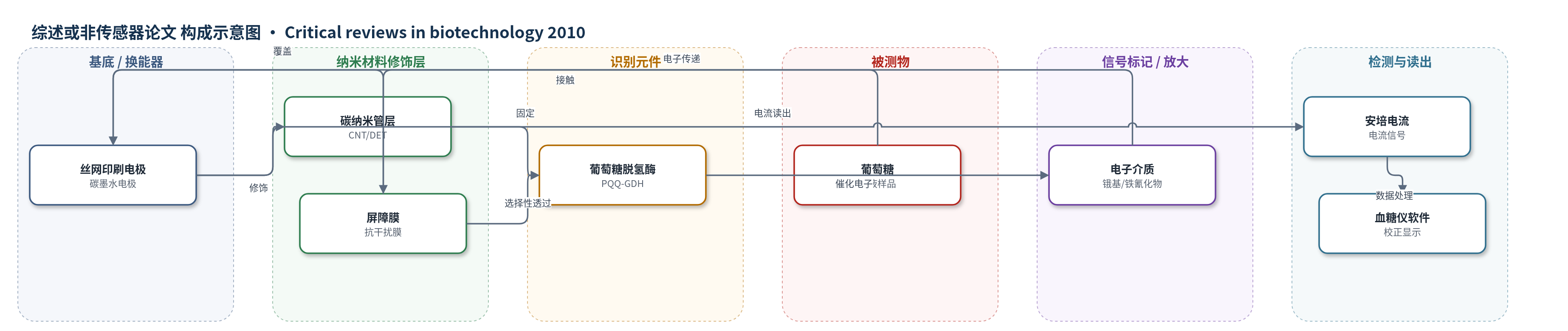
点击图片查看大图 · 依据论文自动绘制
传感器类型
综述或非传感器论文
检测对象
葡萄糖(glucose);样品基质:血液(self-monitoring blood glucose, SMBG)
检测原理
本文未提出新的传感方法,仅以血糖仪为例说明已有生物传感器原理。葡萄糖进入电极反应区后,被葡萄糖氧化酶或葡萄糖脱氢酶特异性催化;若采用介质体系,酶反应产生的电子经锇基或铁氰化物等电子介质传递到丝网印刷电极,形成与葡萄糖浓度相关的安培电流;若采用碳纳米管支撑的 PQQ 依赖葡萄糖脱氢酶,则可通过直接电子传递(DET)降低介质依赖并改善信号。屏障膜或酶复合体系用于阻挡可氧化干扰物,软件可对红细胞压积等基质因素进行校正。总体上,识别事件引发催化/电子传递变化,换能器将界面电子流转换为电流,电流随葡萄糖浓度升高而增大。
检测灵敏度
原文未报告具体 LOD、线性范围、灵敏度斜率或相关系数。
效应效果
本文是综述/管理方法论文,未报道新传感器的选择性、抗干扰、稳定性、重现性或实际样品加标回收率实验数据。案例围绕血糖仪(SMBG)指出待解决问题:可氧化物质干扰、红细胞压积低于35%或高于55%时的准确性、高压氧条件、低样品量、替代部位检测及用户友好性。文中引用精度要求:葡萄糖30–400 mg/dL时系统加用户变异不超过5%;内精度不超过5%、外精度不超过10%;基础层CV<6%(90%置信区间)。多准则排序为A3>A1>A2>A4,±50%权重敏感性分析保持稳健。作者主张用CBR/模糊MCA选择最优设计初始化深度,加速学术成果产业化。
传感器的构成
- 换能器/电极:丝网印刷安培电极(screen printed amperometric biosensor),作为案例中血糖仪的电流换能器。
- 纳米材料修饰层:碳纳米管(carbon nanotubes, CNTs),用于承载 PQQ 依赖葡萄糖脱氢酶并促进直接电子传递(DET)。
- 识别元件:葡萄糖脱氢酶(glucose dehydrogenase, GDH)或葡萄糖氧化酶(glucose oxidase, GOx),用于特异性识别葡萄糖。
- 电子介质/信号放大:锇基介质(osmium-based mediators)或铁氰化物基介质(ferricyanide/ferricinum-based mediator),用于提高信噪比。
- 抗干扰层:屏障膜(barrier membranes)或酶复合体系,用于降低样品基质中可氧化物质的干扰。
中文摘要
生物技术行业技术更新快、市场需求高,需要持续创新;由于该行业以科学为基础,创新通常来自学术研究,并通过转化过程把面向科学的知识变为可市场化的产品。然而,将学术研究成果直接转化为工业应用存在固有困难。本文以生物传感器为案例,考察从单学科、好奇心驱动的学术孤立研究,到跨组织、多学科、市场驱动的大学—产业联盟的过渡机制。与多数文献关注知识转移渠道不同,本文聚焦可转移的技术基础,并讨论产业如何对其战略建模与管理以促进创新。作者基于生物传感器范式指出,产业战略选择的关键在于在最佳阶段/节点介入并获取大学成果,植入市场性要素,从而把想法转化为可行应用。最后,作者提出一种通过商业模式重构加速大学到产业知识转移、实现科学向产品有效转化的方法论框架。
英文摘要
The fast pace of technological change in the biotechnology industry and the market demands require continuous innovation, which, owing to the science base of the sector, derives from academic research through a transformation process that converts science-oriented knowledge to marketable products. There appear to be some inherent difficulties in transforming directly the knowledge output of academic research to industrial use. The purpose of this article is to examine certain transition mechanisms from monodisciplinary academic isolation (curiosity-driven and internal-worth innovation) to university-industry alliances (market-driven and public-worth innovation) through inter-organizational multidisciplinary collaboration and contextualize the analysis with the case of biosensors. While the majority of literature on the subject studies the channels of knowledge transfer as determinants of alliance success (transferor/transferee interactions), either from the university side (science base) or the industry side (market base), this article focuses on the transferable (technology base) and how it can be strategically modeled and managed by the industry to promote innovation. Based on the valuable lessons learnt from the biosensor paradigm, the authors argue that strategic industry choices deal primarily with the best stage/point to intersect and seize the university output, implanting the required element of marketability that will transform an idea to a viable application. The authors present a methodological approach for accelerating the knowledge transfer from the university to industry aiming at the effective transition of science to products through a business model reconfiguration.